The Next Web
DeepSeek’s Liang Wenfeng overtakes Amodei and Brockman as AI’s richest founder
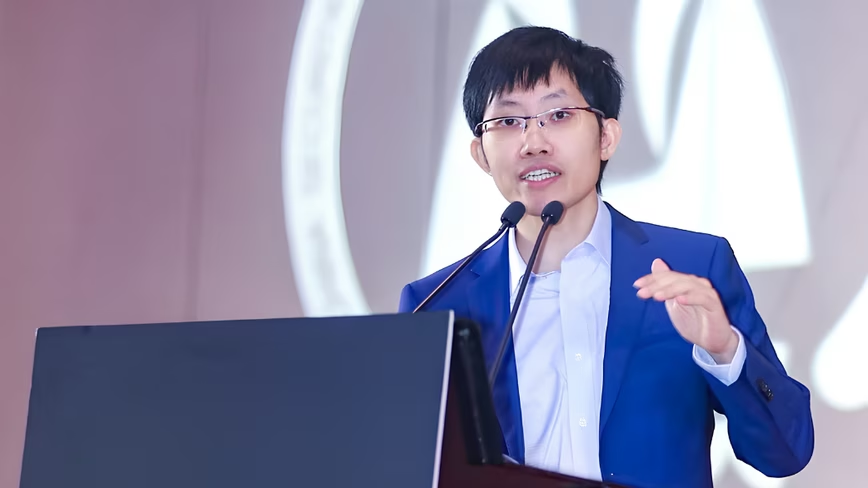
Liang Wenfeng is now the wealthiest founder in artificial intelligence, according to the Bloomberg Billionaires Index, which revalued his stake in DeepSeek on 13 July and added roughly $19bn to his fortune overnight.
His net worth is put at about $36bn, up from around $16.7bn, placing him above Anthropic co-founder Dario Amodei and OpenAI president Greg Brockman.
The revaluation follows DeepSeek’s $7.4bn funding round in June, the Hangzhou lab’s first-ever outside raise, which lifted its valuation from about $10bn in April to roughly $50bn. Liang’s stake was diluted in the process, to somewhere around 78%. Dilution, at these numbers, is a pleasant sort of problem.
The ranking comes with a boundary drawn tightly around it. It counts only companies whose primary business and revenue come from AI models themselves, which excludes conglomerates and the AI supply chain, and therefore excludes the two men who would otherwise sit at the top of any such list by an embarrassing margin. Within those walls, Liang is first.
What makes the round worth a second look is not the size but the terms. Liang put in approximately $3bn of his own money, roughly 40% of the total, drawn from profits at High-Flyer, the quantitative hedge fund he co-founded in 2016 and out of which DeepSeek was spun in July 2023.
The 💜 of EU tech
The latest rumblings from the EU tech scene, a story from our wise ol' founder Boris, and some questionable AI art. It's free, every week, in your inbox. Sign up now!
It is the kind of term sheet that would ordinarily clear a room. Instead the round was reportedly oversubscribed, which tells you something about what capital is prepared to tolerate when the alternative is not being in the deal at all. The unusual structure was apparent when the raise closed, and it has not become less unusual since.
Reported valuations for the round have varied. Figures between $45bn and $59bn have circulated, depending on whether the number quoted is pre-money, post-money, or a target floated to prospective backers; Bloomberg’s index calculation uses $50bn. Beijing’s state-backed funds were among the participants, which made the valuation itself a strategic statement as much as a financial one.
Liang has said what the money is for. He told prospective investors the lab is pursuing artificial general intelligence as its primary goal and will keep releasing open-source models rather than chase near-term commercialisation, a strategy that is easier to sustain when the people funding it cannot outvote you.
Comparisons with his American counterparts are instructive mainly for how badly they map. Amodei and Brockman hold minority equity in companies with vast external investors, complex governance, and, in OpenAI’s case, a legal history that has been aired at length in a federal courtroom, including Brockman’s own journals.
Liang owns most of a company that took no outside money at all until this year, and still answers to nobody who wrote a cheque.
He has been on this trajectory since January 2025, when DeepSeek’s R1 model landed with enough force to knock a trillion dollars off American tech stocks in a day and turn a little-known Hangzhou quant into a national figure. At the time, Forbes put his fortune at a fraction of the current estimate.
The estimates still vary enormously, and not only because of DeepSeek. High-Flyer, the source of Liang’s capital, holds around $8bn in assets according to the data provider Preqin, and Forbes has valued his stake in the fund at a small fraction of what the Bloomberg index now attributes to him.
One Hong Kong paper summarised the state of the art with the headline that DeepSeek’s founders are worth $1bn or $150bn, depending who you ask.
Numbers like these are inference, not fact. Nobody has sold a share in DeepSeek at $50bn on a public market, and the index figure rests on a private round priced by investors who accepted no governance rights in exchange for entry.
View original source — The Next Web ↗
Related stories

Engadget
TechnologyJul 14, 2026 · 1 min
X's algorithm will finally prioritize replies from people you already follow
Engadget

TechPana
TechnologyJul 14, 2026 · 1 min
Rs 50,000 Overspeeding Fine Will Apply Only to Habitual Speeding Violators, Minister Clarifies
TechPana

South China Morning Post
TechnologyJul 14, 2026 · 1 min
Alibaba to team up with Honor in race to build AI agentic devices
South China Morning Post

Wired
TechnologyJul 14, 2026 · 1 min
This Luddite Puppet Hopes You’re Not Reading This on Your Smartphone
Wired