Times of Israel
Katz seeks pardon for soldier who killed subdued Palestinian stabber; IDF opposed
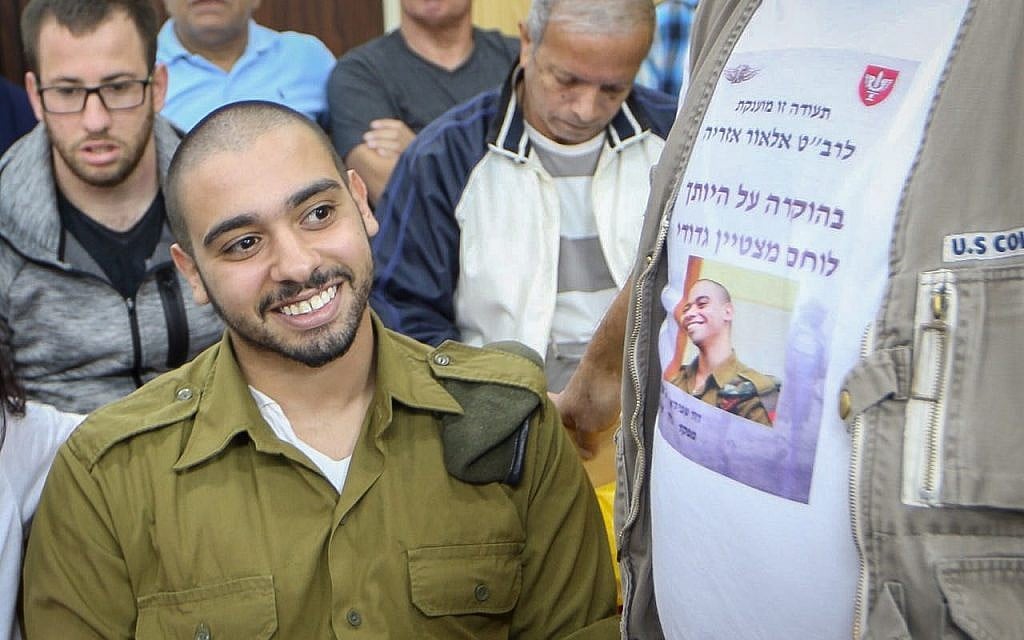
Defense Minister Israel Katz said on Tuesday that he had submitted a request to the president to grant a pardon to Elor Azaria, a former soldier convicted of killing an incapacitated Palestinian attacker in the West Bank city of Hebron in 2016.
The Israeli military said it did not support the request, noting that Azaria has never expressed remorse for his actions, though it has not yet issued a formal letter to the president.
The incident exposed deep rifts in Israeli society over the army’s activities in the West Bank, with some — mostly on the right — arguing that Azaria behaved heroically in killing the Palestinian assailant, while others said he had broken the law and deserved a harsher sentence than he received.
“It is unreasonable that after a decade, an outstanding soldier who was convicted of an offense committed during his operational service should continue to pay such a heavy price,” Katz said in a statement.
He said Azaria’s conviction “sends a negative message to our sons and daughters who are sent to face danger and serve in combat units and dangerous places.”
Get The Times of Israel's Daily Edition
by email and never miss our top stories
By signing up, you agree to the terms
“There is room to allow Elor to rehabilitate himself and begin a new life,” Katz added.
Azaria served nine months of an 18-month prison term for killing Abdel-Fattah al-Sharif, a Palestinian who had stabbed an Israeli soldier. Azaria killed al-Sharif some 11 minutes after he had been shot and subdued. Still, Azaria has always insisted he behaved correctly in the shooting, and he has gone on to protest in support of soldiers accused of beating Palestinian suspects.
The pardon request seeks to shorten the time before Azaria’s criminal record is automatically cleared, which, according to the law, should take place in 2032 if it is not expedited.
The office of President Isaac Herzog confirmed that it had received the request, along with an opinion submitted by Katz.
“Elor Azaria has submitted a request to shorten the duration of his criminal record. In accordance with standard procedure, the request was forwarded to the defense establishment in order to obtain the opinions of the relevant officials, including the defense minister and the IDF,” Herzog’s office said.
The president’s office said that, so far, it has only received Katz’s opinion.
To proceed with handling the request, the president’s office requires opinions from IDF Chief of Staff Lt. Gen. Eyal Zamir, Military Advocate General Maj. Gen. Itai Ofir, and Personnel Directorate chief Maj. Gen. Dado Bar Kalifa.
“The Office of the President is awaiting the remaining opinions required to proceed with handling the request. After receiving all opinions, the president will weigh the request responsibly and with due seriousness,” it added.
Zamir and Kalifa said that “the request should not be granted,” in a letter sent to the defense minister’s office, signed by Zamir’s assistant, Col. Alon Laniado.
“By law, the general rule is that a criminal record shall accompany the convicted individual in accordance with the prescribed timeframes, whereas granting a pardon is the exception, to be applied only under exceptional and weighty circumstances,” the letter read.
The letter stated that Zamir and Bar Kalifa’s position on the matter is based on the opinion of the deputy military advocate general, “who is in charge of applications of this type, and which relies on several considerations, including the fact that the applicant has refrained from expressing remorse and taking responsibility for his actions, even nearly a decade after his conviction in a military court; the absence of new circumstances justifying a change from previous decisions of the president; as well as the absence of concrete personal circumstances of significant weight.”
The move by Katz came ahead of the Likud party’s primaries and the upcoming national election. Yashar party chair Gadi Eisenkot, who is leading Prime Minister Benjamin Netanyahu as preferred premier according to polling, was IDF chief of staff at the time of the incident.
Eisenkot was attacked at the time by some on the far right for not intervening to stop the prosecution of Azaria. But he stood by his decision upon retiring and denounced Azaria’s actions as violating the law and “against the spirit of the IDF.”
Political scientist Gayil Talshir told The Times of Israel earlier this month that the Azaria case may resurface in Netanyahu’s campaign, calling it a “card he holds up his sleeve” to sway voters who oppose prosecuting soldiers for abusing terrorists.
Recently, the pro-Netanyahu pundit Shimon Riklin contrasted Eisenkot’s determination to prosecute Azaria with his alleged diffidence in the face of Israel’s foes.
In 2024, the Biden administration placed a visa ban on Azaria, as part of a broader effort to promote accountability for acts of violence against Palestinians in the West Bank by Israeli extremists who enjoy overwhelming impunity, despite that incident occurring eight years previously.
Ben Sales and Times of Israel staff contributed to this report.
View original source — Times of Israel ↗
Related stories

The Punch
PoliticsJul 14, 2026 · 1 min
Buhari’s integrity, compassion defined his leadership — Lai Mohammed
The Punch

Rio Times
PoliticsJul 14, 2026 · 1 min
Peru Court Ruling Hands Fujimori a Tool to Undo Costly Laws
Rio Times

The Guardian
PoliticsJul 14, 2026 · 1 min
David Lammy’s proposed cohabitation law would be bad for couples – and worse for some women | Ruth Deech
The Guardian

OnlineKhabar
PoliticsJul 14, 2026 · 1 min
73 incidences of natural disasters in a day: 2 dead, 1 missing
OnlineKhabar