Indian Express
Global oil prices jump to four-week high amid renewed hostilities in Gulf
4 min readUpdated: Jul 14, 2026 03:28 PM IST
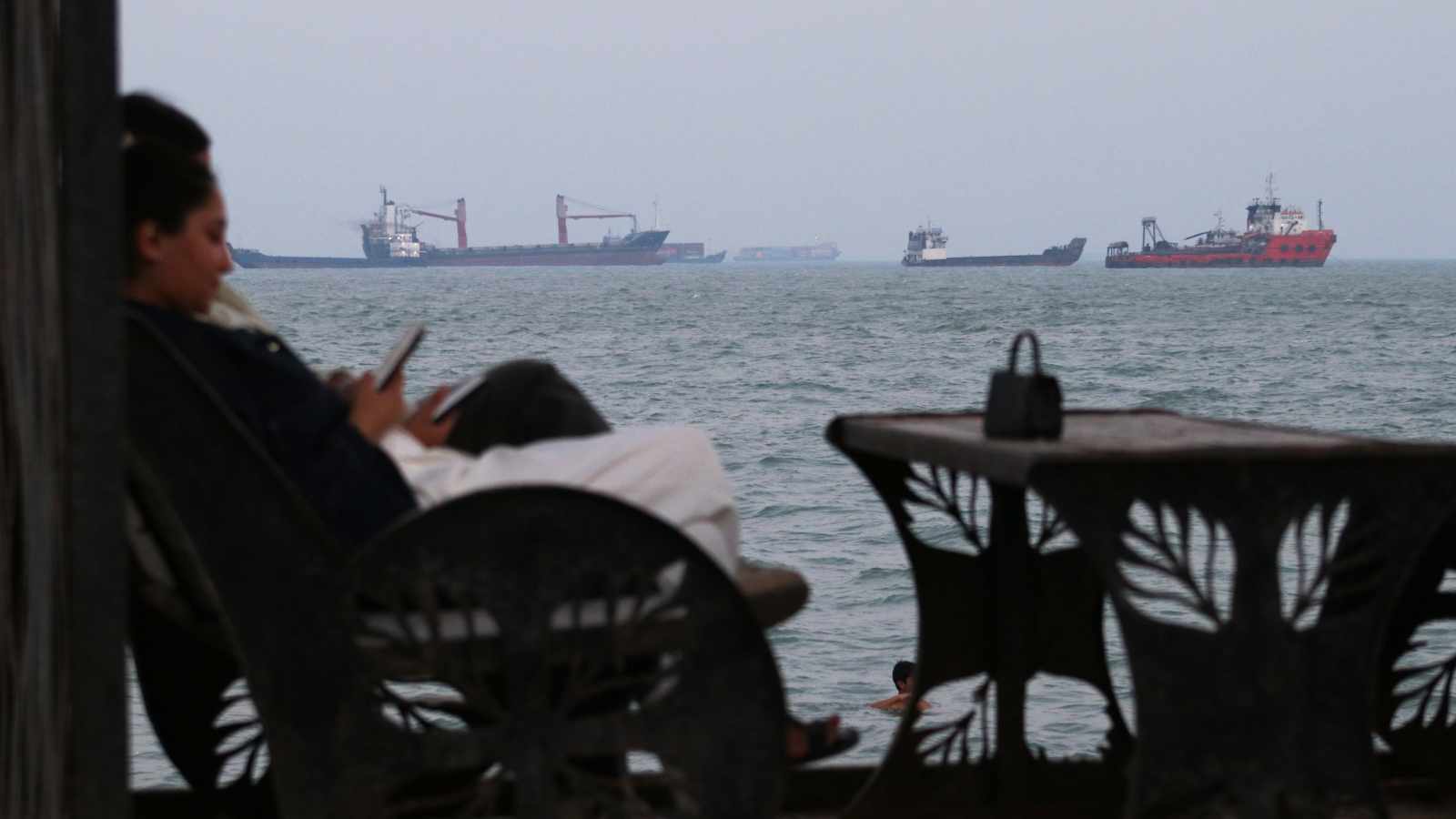
Residents check their cellphones as they sit at a cafe overlooking commercial vessels anchored in the Strait of Hormuz, off Bandar Abbas, Iran, Sunday, July 12, 2026. (Photo: Razieh Poudat/ISNA via AP)
Global oil prices jumped to their four-week high, as the US reinstated a naval blockade of Iranian ports and renewed hostilities between Washington and Tehran spiked concerns over energy supplies through the Strait of Hormuz.
Brent crude futures soared $2.74, or 3.29%, to $86.04 per barrel at 0751 GMT, while US West Texas Intermediate crude rose $2.21, or 2.83%, to $80.35 a barrel.
This was Brent crude’s highest since June 12 and WTI’s since June 16.
The United States and Iran signed a memorandum of understanding to mark an end to the conflict on June 17 — a ceasefire deal that fell apart after Iran attacked three ships in the Hormuz on July 6.
The attacks escalated this week, as US President Donald Trump reimposed a blockade of Iranian shipping and proposed charging a 20% fee as compensation for ensuring the Strait of Hormuz.
However, Iran Sunday said it has shut the waterway until “further notice”, warning that no vessels would be allowed to pass until what it called “American interventions” in the region ended.
On Monday, shipping data showed the number of tankers crossing the Strait of Hormuz fell to the lowest level in two months.
Story continues below this ad
Iran says oil exports continue despite US revoking waivers
Meanwhile, Iran’s oil minister Mohsen Paknejad said the country’s oil exports continued as usual despite the cancellation of a 60-day waiver of US oil sanctions last week, Al Jazeera reported.
Taking to his Telegram channel, Paknejad said for years the oil ministry had maintained mechanisms to neutralise the impact of US sanctions, and Iran’s oil exports would not face any hurdle despite the removal of the waivers. “The Americans, as usual, broke their promise and violated Article 10 of the memorandum of understanding related to the 60-day waivers,” he said.
Iran shipped 80 million barrels of oil in past 26 days
A maritime traffic monitor, TankerTrackers, showed that Iran has shipped out over 80 million barrels of crude oil and refined products, currently worth $6bn, in the past 26 days.
But millions more barrels are queued up for departure, it said.
It has only been twenty-six days since the United States and Iran electronically signed the sixty-day Islamabad Memorandum.
During that time (and even in the days leading up to it), more than 80 million barrels of Iranian crude oil and refined products (currently worth >$6… pic.twitter.com/xh4WRkbszp
— TankerTrackers.com, Inc. (@TankerTrackers) July 13, 2026
“Now that the US Navy blockade is being reinstated more than a month ahead of schedule, it appears that around 30 million barrels of Iranian crude oil have yet to depart,” it stated.
Story continues below this ad
“However, there are also more than 60 million barrels of floating storage capacity available within the blockade perimeter should Iran be forced to scale back its oil production.
What lies ahead?
In a note, Citi said that the possibility of the Iranian regime breaking away from the truce until after the mid-term elections in the US has also risen, and this could keep the crude prices higher for a longer period.
The crude flows from the Gulf could face further uncertainties if the Houthis extend their attacks in Saudi Arabia;s crude products, Reuters reported, citing a portfolio manager Simon Wong, as saying.
© IE Online Media Services Pvt Ltd
The Express Global Desk at indianexpress.com which delivers authoritative, verified, and context-driven coverage of key international developments shaping global politics, policy, and migration trends. The desk focuses on stories with direct relevance for Indian and global audiences, combining breaking news with in-depth explainers and analysis.
A major focus area of the desk is US immigration and visa policy, including developments related to student visas, work permits, permanent residency pathways, executive actions, and court rulings. The Global Desk also closely tracks Canada’s immigration, visa, and study policies, covering changes to study permits, post-study work options, permanent residence programmes, and regulatory updates affecting migrants and international students.
All reporting from the Global Desk adheres to The Indian Express’ editorial standards, relying on official data, government notifications, court documents, and on-record sources. The desk prioritises clarity, accuracy, and accountability, ensuring readers can navigate complex global systems with confidence.
Core Team
The Express Global Desk is led by a team of experienced journalists and editors with deep expertise in international affairs and migration policy:
Aniruddha Dhar – Senior Assistant Editor with extensive experience in global affairs, international politics, and editorial leadership.
Nischai Vats – Deputy Copy Editor specialising in US politics, US visa and immigration policy, and policy-driven international coverage.
Mashkoora Khan – Sub-editor focusing on global developments, with a strong emphasis on Canada visa, immigration, and study-related policy coverage. ... Read More
Stay updated with the latest - Click here to follow us on Instagram
Tags:
crude oil price
donald trump
Iran
Iran War
Strait of Hormuz
View original source — Indian Express ↗
Related stories

Bloomberg
BusinessJul 14, 2026 · 1 min
Fed’s Three Picks for Task Force Show AI Bullishness
Bloomberg

Philippine Daily Inquirer
BusinessJul 14, 2026 · 1 min
Lower oil prices, Fed policy to drive PH markets–Manulife
Philippine Daily Inquirer

TASS
BusinessJul 14, 2026 · 1 min
Russia to fulfill grain supply commitments to foreign partners
TASS

MarketWatch
BusinessJul 14, 2026 · 1 min
Ericsson ends up on the wrong side of memory-chip price spike. The stock slumps.
MarketWatch