Indian Express
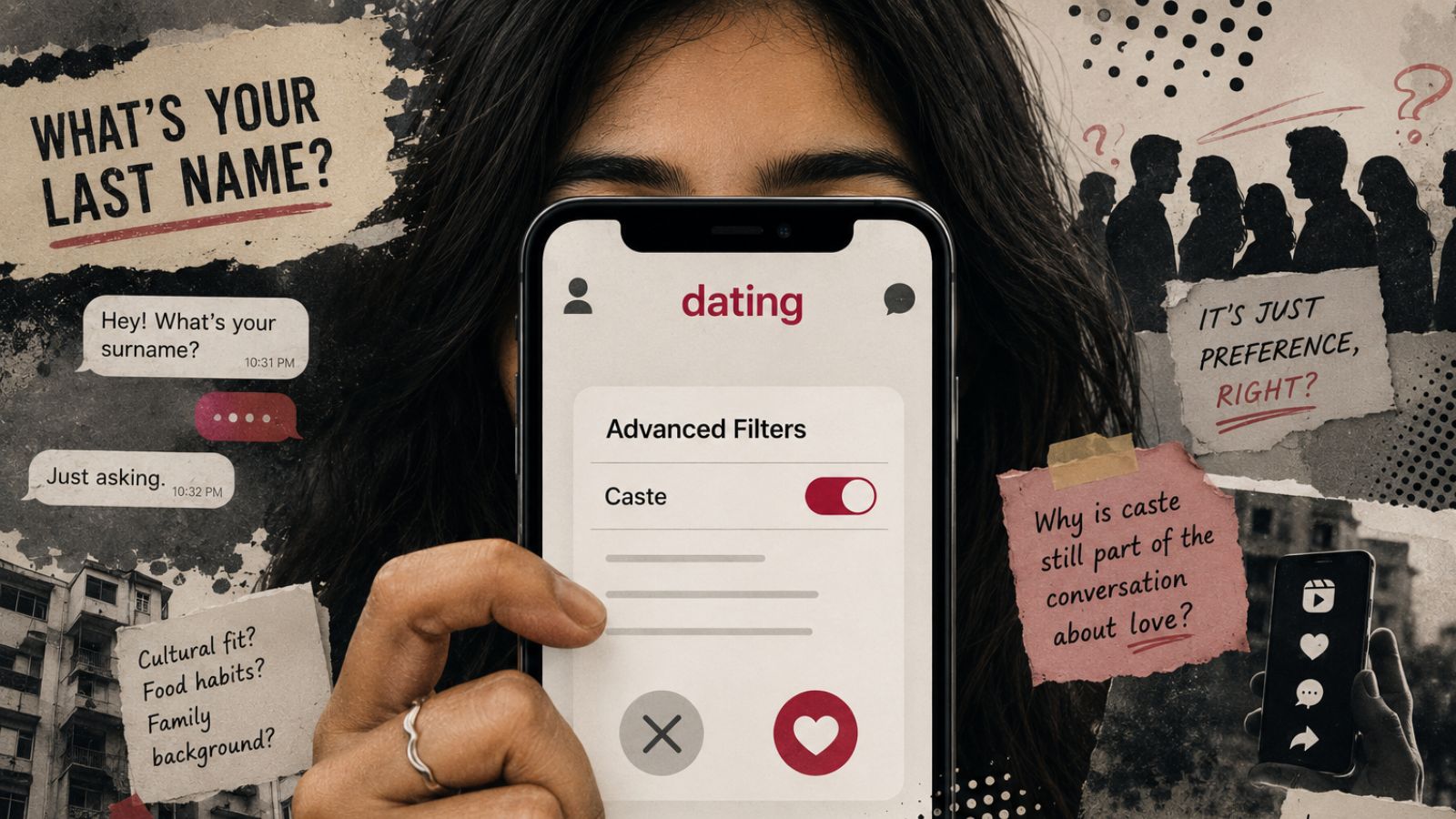
Love, with a caste filter: When dating apps turn arranged marriage-coded
As a 27-year-old single woman in the era of online dating, and, according to every aunty within a five-kilometre radius, at the perfect age to get married, I have found an unlikely cheerleader for dating apps: my mother.
This is the same woman who grew up believing marriage was a family affair, one where stability, a decent family, and yes, caste, quietly sat on the checklist. Today, much to my surprise, she has evolved faster than I have. She wants me to have the freedom to choose my own partner.
She couldn’t care less if I meet him through mutual friends, at work or on a dating app. Every now and then, she’ll casually suggest, “Just download one. At least you’ll meet people.” More than finding me a husband, she seems invested in finding herself a damaad or a son-in-law before she runs out of patience watching me hilariously fumble my way through modern romance.
Caste filter
Naturally, after enough mother-daughter conversations about marriage, my Instagram algorithm decided to join the discussion. Between memes and recipes, it served as an advertisement for a singles meet-and-greet organised by Brahman Connect.
I begrudgingly clicked. What I found was, to put it mildly, bizarre.
The page wasn’t some relic from the matrimonial era my parents grew up in. It looked unmistakably Gen Z with slick graphics, Instagram-friendly branding, young professionals smiling into the camera, networking events, mixers, and dating opportunities. The catch? Everyone belonged to the same caste.
For a fleeting second, the journalist in me wanted to sign up purely to see what happened inside. Thankfully, common sense (and professional ethics) intervened.
Story continues below this ad
But I couldn’t shake the question the page left me with. Dating apps were supposed to give my generation the freedom to choose. So why does it suddenly feel like we’ve carried one of arranged marriage’s oldest filters into the swipe-right era?
Some popular dating and matchmaking platforms for younger Indians have introduced features that allow users to disclose or filter by caste.
Bumble, but make it casteist
The more I scrolled through Brahman Connect, the more it felt like I had stumbled upon an alternate universe of online dating. It wasn’t just a page organising singles meet-and-greets for young Brahmins.
There were networking events, friendship circles, professional connections, and even a matrimonial section. It was, in many ways, a one-stop social network for people who happened to belong to the same caste. Imagine Bumble, but your surname got to swipe before you did.
Just when I thought I’d reached the end of this rather peculiar rabbit hole, I realised it wasn’t an isolated phenomenon. Some popular dating and matchmaking platforms for younger Indians have introduced features that allow users to disclose or filter by caste.
Story continues below this ad
These aren’t the matrimonial websites our parents signed us up for while we protested from across the room. These are platforms marketed to young adults who are supposedly choosing partners on their own terms.
And that’s where my confusion begins.
If the whole point of dating apps was to expand the pool of people we meet — to move beyond the social circles, neighbourhoods and family networks we inherited — why are we recreating one of arranged marriage’s oldest filters on our phones? If finding someone from your own caste is non-negotiable, what exactly are we disrupting? Why not simply let your parents create a profile on a caste-specific matrimonial website and call it a day?
Perhaps these platforms are merely responding to user demand rather than creating it. But they also do something else: they package caste as just another compatibility preference, sitting comfortably alongside age, profession and hobbies. For a generation that prides itself on questioning inherited hierarchies, that feels less like progress and more like giving an old prejudice a shiny new interface.
When did caste become a dating preference?
Once the algorithm realises you’ve clicked on one caste-related page, there’s no going back. Before long, my feed was flooded with reels of young men and women jokingly manifesting partners from their own community.
Story continues below this ad
“Bas ek Brahmin ladka mil jaaye.” “Looking for a Jaat girl.” “Need myself a Rajput husband.” Thousands of likes. Thousands of comments. Thousands of people who seemed to find nothing unusual about turning caste into dating criteria.
The comment sections, of course, had already picked their sides. Some called the reels outright casteist. Others defended them as harmless expressions of identity or personal preference. That debate is far bigger than this article, and frankly, not the one I’m trying to answer.
The question that stayed with me was much simpler.
Caste seems to have regained its place
In what I could only describe as a dystopian reality, we seem to have started treating caste as just another compatibility metric. Age, location, profession, hobbies… and now caste. It slips into bios, hashtags, reels and meet-ups so casually that it almost escapes scrutiny. It’s no longer framed as an old social hierarchy but as a lifestyle preference, a cultural match, another box to tick while looking for “the one”.
Maybe these posts are ironic. Maybe they’re genuine. Maybe they’re simply riding the algorithm. But together, they point to something bigger than a passing trend. They suggest that one of India’s oldest social divisions has found a remarkably comfortable place in one of its newest social rituals.
Story continues below this ad
Dating apps were supposed to widen our worlds. Social media was supposed to connect us with people we’d never otherwise meet. Yet somewhere between the swipe and the scroll, caste seems to have quietly reclaimed a seat at the table. And that, more than the reels themselves, is what I find impossible to ignore.
When did caste become part of the dating conversation again?
The surname test is prejudice repackaged
I grew up in a Bihari family where caste wasn’t an abstract idea from a sociology textbook. It was real. It shaped villages, politics, friendships, and marriages. During visits to my hometown, I saw how deeply it could divide people and the quiet violence it could inflict, not always through headlines, but through everyday life. The young me convinced myself that cities like Delhi had moved beyond that reality.
I was wrong.
Caste didn’t disappear as I grew up in a metro city. It simply learnt to speak a different language.
Today, I know what it means when someone I’ve just met asks for my surname before they’ve asked me anything meaningful about myself. I know why landlords and brokers sometimes seem oddly interested in their future tenants’ “background” or “culture” before handing over the keys to a flat. And now, as marriage becomes an increasingly frequent topic of conversation, I know exactly what people mean when they casually suggest, “Find a nice Mishra or Pandey boy.”
Story continues below this ad
None of these moments, in isolation, seems extraordinary. That’s precisely what makes them dangerous. Caste doesn’t survive only through spectacular acts of discrimination. Sometimes, it survives because we quietly accept it as common sense. Because we laugh along. Because we call it compatibility. Because we renamed it preference.
Perhaps that’s why seeing caste reappear on dating apps and Instagram unsettled me so deeply. Not because technology invented something new, but because it made something very old feel modern again.
My generation often likes to believe we’re too educated, too urban and too progressive to carry forward the prejudices of those before us. But if our search for love still begins by asking, “What’s your caste?”, then maybe we’ve mistaken newer platforms for newer values.
You can call it compatibility. You can call it culture. You can call it a preference. Caste doesn’t become less casteist because we’ve found softer words for it.
View original source — Indian Express ↗
Related stories

The Punch
WorldJul 14, 2026 · 1 min
How to apply for free CAC registration under FG’s 250,000 MSME programme
The Punch
The Punch
WorldJul 14, 2026 · 1 min
Missing Kwara farmer found dead in bush, family demands justice
The Punch
The Punch
WorldJul 14, 2026 · 1 min
Bayelsa approves new welfare packages for workers
The Punch
The Punch
WorldJul 14, 2026 · 1 min
FG to provide land for 10,000-home housing project
The Punch