Dawn
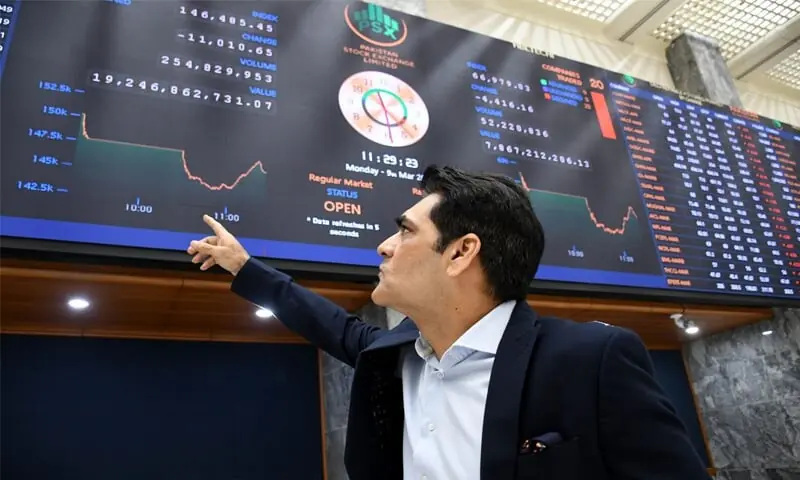
Meltdown at PSX as KSE-100 loses 6,000 points over renewed US-Iran fighting
The Pakistan Stock Exchange’s (PSX) benchmark index lost more than 6,000 points during intraday trade on Tuesday as equities experienced a massive meltdown amid renewed fighting between the United States and Iran.
The KSE-100 index opened in the red and had lost 3,464.89 points at 10am, dropping to 176,462.15 points from the previous close of 179,927.04.
After minor fluctuations, the index had lost 6,088.03 points (3.38 per cent) by 3pm, dropping to 173,839.01 points.
The decline came as global oil prices rose to their highest in four weeks on Tuesday, as the US reimposed its naval blockade of Iran while the two countries stepped up attacks in the Strait of Hormuz, heightening uncertainty about energy flows.
Brent crude futures were up $2.74, or 3.29pc, at $86.04 per barrel at 12:51pm PKT, while US West Texas Intermediate crude rose $2.21, or 2.83pc, to $80.35 a barrel. Oil prices are now at their highest since the two countries signed a memorandum of understanding to end the war on June 18.
Awais Ashraf, director of research at AKD Securities, said the market declined after the US reinstated its naval blockade of Iran.
“The decline is broad-based, with cyclical sectors witnessing the sharpest percentage losses amid heightened uncertainty over the medium-term outlook due to the emerging geopolitical situation,” he said.
The PSX had come under pressure on Monday as equity investors grew nervous over developments in the Strait of Hormuz, dragging the benchmark KSE-100 index below the psychological barrier of 180,000 points.
The benchmark KSE-100 index remained under pressure throughout the session, touching an intraday low of 2,793 points before closing at 179,927, down 2,314 points or 1.27pc.
The decline was further exacerbated by broad-based profit-taking after the market’s recent rally, as investors chose to lock in gains despite an otherwise supportive macroeconomic backdrop.
World stocks dip
Global stocks also moved back into negative territory.
European shares opened lower as escalating US-Iran tensions spooked investors, scrutinising quarterly earnings from companies such as oil major BP and telecom equipment maker Ericsson to gauge the conflict’s impact on corporate health.
The pan-European STOXX 600 index slipped 0.7pc, dragged down by travel and leisure which was last down 2.4pc.
Following a volatile trading session in Asia, MSCI’s broadest index of world shares edged into the negative as Europe opened lower.
Chinese shares surged in earlier trading after export and import data for June released on Tuesday surpassed economists’ expectations. They closed 2.15pc higher.
South Korean shares rose 0.7pc. Stocks in Taiwan fell 1.42pc on the day.
“China’s exports and imports surged to the highest levels since the pandemic-skewed 2021, as the tech boom supports growth on both fronts,” ING analysts wrote in a research note.
Overnight, stocks on Wall Street sold off. The S&P 500 closed 0.8pc lower and the Nasdaq Composite fell 1.6pc. S&P 500 futures ticked 0.1pc lower in early European trading while Nasdaq futures remained a resilient 0.3pc higher.
The US dollar index, which measures the greenback’s strength against a basket of six currencies, nudged 0.1pc lower to 101.16, trading around its highest levels of the month.
Gold was up 0.5pc at $4,020.34.
In Tokyo, the Nikkei 225 closed around 0.7pc higher after Finance Minister Satsuki Katayama said Japan may consider adjusting the strategy of the giant Government Pension Investment Fund if the investment environment changed sharply, without giving further detail.
Follow Dawn Business on X, LinkedIn, Instagram and Facebook for insights on business, finance and tech from Pakistan and across the world.
Related stories

The Punch
BusinessJul 14, 2026 · 1 min
ITF screens 225,000 artisans nationwide for skills acquisition
The Punch
MarketWatch
BusinessJul 14, 2026 · 1 min
Bank of America stock falls despite earnings beat
MarketWatch

Dawn
BusinessJul 14, 2026 · 1 min
PM Shehbaz directs remittances from abroad be fully digitised
Dawn
MarketWatch
BusinessJul 14, 2026 · 1 min
Why SpaceX and Tesla are ‘value’ stocks, according to this fund manager
MarketWatch