The Next Web
OpenAI wants its legal fees from xAI, while Apple comes for OpenAI
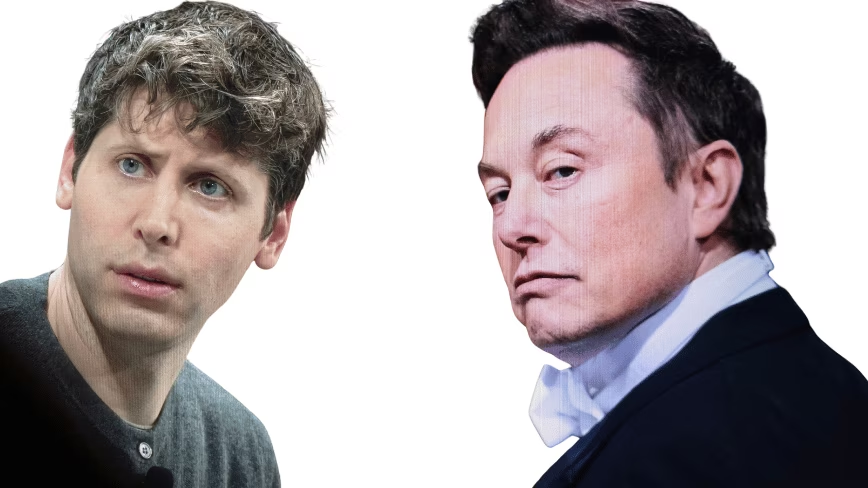
On Monday, OpenAI asked a federal judge in California to rule that xAI’s trade secrets lawsuit against it “should never have been filed,” and to make Elon Musk’s company cover more than $1m in legal expenses.
The filing landed hours after xAI gave notice that it intends to appeal. The case has been dismissed twice; It is now being appealed once and billed for.
xAI sued OpenAI in the Northern District of California in 2025, alleging that its rival had poached engineers and encouraged them to bring confidential information with them, with the complaint centring on Xuechen Li, a former xAI engineer.
In February, Judge Rita Lin granted OpenAI’s motion to dismiss the amended complaint, but gave xAI until mid-March to try again.
xAI tried again, adding allegations that OpenAI had encouraged a newly hired employee to discuss work done at his previous employer.
On 15 June, Lin dismissed the claims a second time, this time without leave to amend, finding that the complaint rested on speculation and at most described the passive receipt of information, which is not misappropriation under the Defend Trade Secrets Act.
Her characterisation, per the courthouse record, was that xAI had tried to recast ordinary Silicon Valley hiring as a conspiracy. That reading is now the basis of OpenAI’s fee motion.
Which brings us to last Friday, and the reason all of this is suddenly funny.
On 10 July, Apple sued OpenAI in the same federal district, accusing it of stealing hardware trade secrets to build consumer devices.
The complaint alleges theft “at every level, from members of its Technical Staff to its Chief Hardware Officer, and in coordination with business partners.”
That chief hardware officer is Tang Tan, who spent 24 years at Apple, latterly as vice-president of product design for the iPhone and Apple Watch.
Apple claims he directed Apple staff interviewing at OpenAI to bring digital designs and prototypes to what the filing calls “show and tell” sessions.
The suit also names Chang Liu, an eight-year Apple senior systems electrical engineer, who is alleged to have kept his Apple laptop after leaving for OpenAI and used it to download confidential technical documents.
More than 400 former Apple employees now work at OpenAI, according to the filing, which describes the evidence so far as “the tip of the iceberg.”
Apple is seeking an injunction against evidence destruction, the return of its trade secrets, and damages. OpenAI has said it has “no interest in other companies’ trade secrets” and is “focused on building innovative technology.”
Fee awards of this kind are not handed out for losing. The Defend Trade Secrets Act allows a court to make the losing side pay where a misappropriation claim was brought in bad faith, which is a considerably higher bar than being wrong twice in front of the same judge.
OpenAI is asking Judge Lin to make that finding against a company whose founder has spent the past year calling it, in various registers, a fraud.
The two cases turn on almost identical questions. Whether a company that hires aggressively from a rival is thereby acquiring that rival’s secrets, and what a court needs to see before it calls recruitment misappropriation.
OpenAI has spent a year arguing the narrow answer, and won. It will now argue the other side of the same line.
The relationship with Apple has been unravelling for a while. The two announced a headline Siri partnership in 2024, then drifted apart as OpenAI moved into hardware, buying Jony Ive’s io Products for $6.4bn. The lawsuit is already complicating OpenAI’s hardware plans well before any ruling.
Musk, meanwhile, has had a poor run in these courtrooms. A jury in Oakland rejected his separate suit against Sam Altman over OpenAI’s conversion to a for-profit structure, finding it had been filed too late.
xAI’s appeal now goes to the Ninth Circuit. OpenAI’s fee motion is before Judge Lin. Apple’s case has not yet been scheduled.
View original source — The Next Web ↗
Related stories

The Verge
TechnologyJul 14, 2026 · 1 min
Google’s Demis Hassabis says it’s time for a global AI watchdog — led by the US
The Verge
TechRadar
TechnologyJul 14, 2026 · 1 min
Is this the ultimate 'back to school' laptop? Students can get a brand new 2026 Dell XPS 13 for just $599
TechRadar
TechRadar
TechnologyJul 14, 2026 · 1 min
I've been hunting for the best travel charging gadgets to avoid low-battery stress on vacation
TechRadar
Indian Express
TechnologyJul 14, 2026 · 1 min
Ethanol row escalates: BJP seeks police action over Gadkari-related social media posts
Indian Express