Indian Express
What a mango can teach us about escaping the hustle culture
Mango season is in full swing. And so am I, swinging with this wonderful season of gorgeous mangoes that sit on carts like ornaments, waiting to be picked up. Of late, I have started having different experiences with mangoes. Don’t worry, it is a good kind of different.
I have been a foodie for as long as I can remember, and after working for long hours and living away from my family, getting back to my place feels weird. There is no one to look forward to or to tell the most mundane things that happened in your day. However, ever since the mango season kicked off, I have been feeling less wistful. This has been the case because I have a mango to look forward to eating, and just the thought of it fills me with utter delight.
As soon as I bite into a mango, the feeling it brings is comforting and makes me feel safe. I instantly time-travel to my childhood, to a time when it felt like the only (good) problem I had was finishing a mango in a day so that my dad could bring more the next day. It felt like eating the happiest fruit to ever exist. It was yellow, soft on the inside, and full of sweetness.
While I was rejoicing in the fruit during the extremely hot days that passed us by this June, I came across a poster about a mango get-together/party being hosted in Lodhi Garden by a man who seemed more in love with this fruit than I ever was. So, I decided to go nonetheless because it felt like it would strike a chord with my childhood and reel me back to the past, and that is exactly what happened.
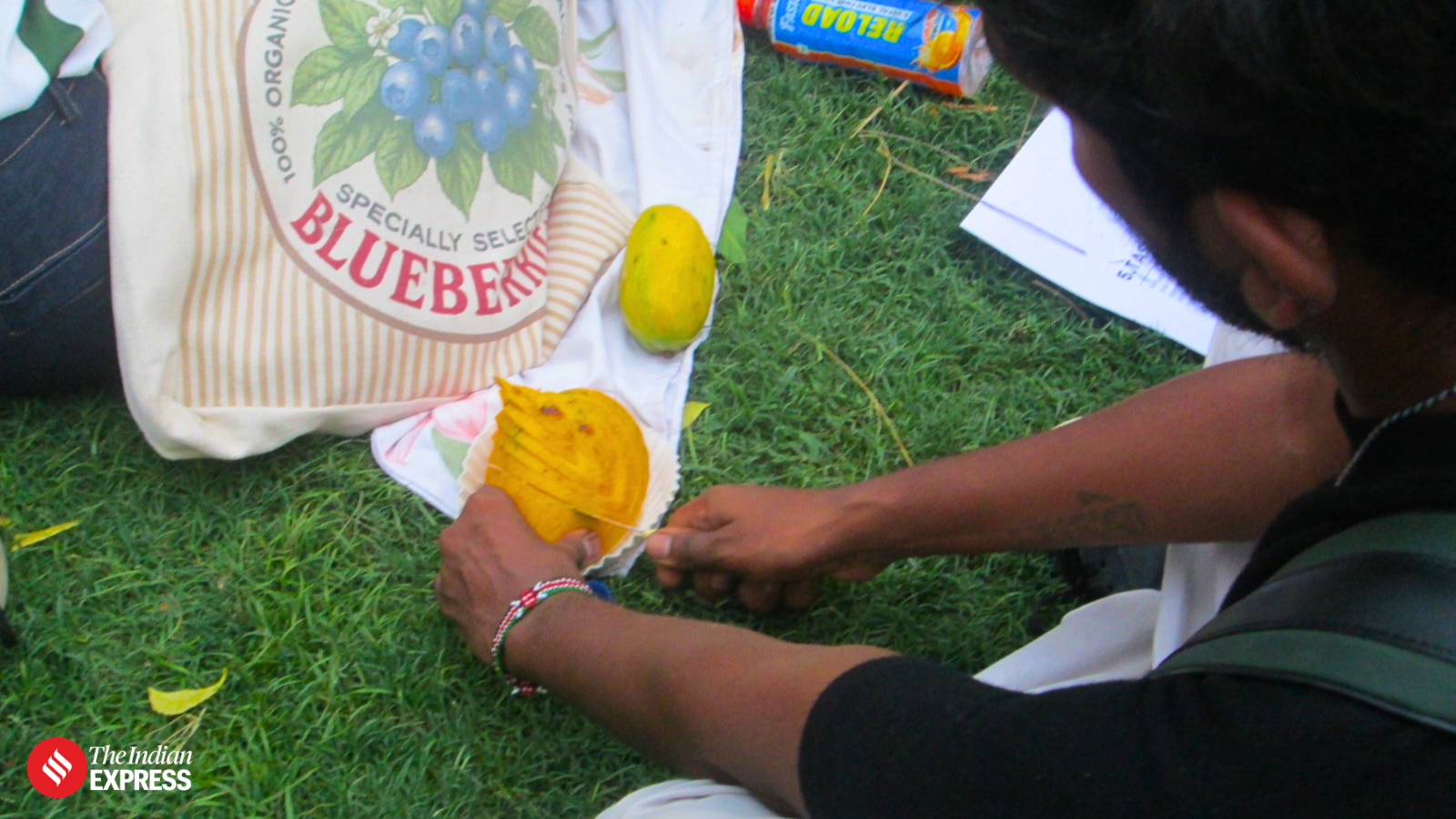
As soon as I got near the Sheesh Gumbad, there were flashes of yellow everywhere around me. People adorned in beautiful, bright yellow, and buckets full of mango varieties made me giggle a bit. People gathered in a circle, and we were asked to do fun activities that involved our sensory-motor skills, including listening to a musical performance. That was the first time I felt like I had found my own creed. I may not have gotten to know everyone, but it felt like something as simple as a mango had the power to make worked-up young professionals come into a space full of whimsy, sharing happiness and mangoes.
Ravinder Singh, a Delhi resident who grew up in Multani Mohalla, hosted the mango party in Delhi on June 28 this year. But this is not his first time hosting it. He has been doing this for over five years, since 2022, solely to bring people together over one common fruit: the mango.
When asked about how he started this initiative, he says, “I used to walk across the country without money. I gained 10 kg during the 17,000+ km journey I walked in four years. People had been super kind to me. So, I wanted to create a non-transactional space. That is when the idea of hosting a mango party came up. No RSVP, no fees, nothing at all, people could just come and eat mangoes. Sort of like a third space, free of judgment.”
But it wasn’t easy for Ravinder in the beginning. During his abusive childhood, he, along with his mother, shifted back in with his grandparents. He mentions, “My grandmother taught me how to eat a mango. In Punjabi, she used to say, ‘enu pola kar (soften this out).’ So, I tried to soften the mango with my dainty hands, after which she asked me to cut the upper nib of the mango, indulge in the juices, take the gutli (seed) out, and then ring in the festivities of it all. That is how my first memory of eating a mango started.”
Story continues below this ad
And this is where it all hit me: maybe eating mangoes and reeling back into our childhood was not a unique experience after all! When asked about what biting into a mango does, Ria Chopra, author of Never Logged Out, who attended the mango party at Lodhi Garden, mentions, “A mango always takes me back to the summer vacations of my childhood. I think there is a specific moment when you grow into adulthood, and you graduate from college, and you realise you will never have a summer vacation in your life again. But the association of mangoes with summer is just something so many of us have.”
Eating Mangoes together. (Credits: Aanya Mehta)
Bittersweet memories
Another attendee, Jagsifat, known by his artist name ConVIth, who was invited for a music performance at the party, performed his original song “Aam-Bagh”. He has some bittersweet memories to share about the fruit: “There was a time when I had almost stopped eating mangoes, it was probably after I got into college. But after I got back to eating them, it took me right back to a warm and nostalgic core memory of eating mangoes at my nani-nanu’s (maternal grandparents) old home in Patiala.”
Dr Rimpa Sarkar, Director, Sentier Wellness, Mumbai, says, “Food is one of the strongest triggers of autobiographical memory because our sense of taste and smell is closely connected to the brain’s emotional and memory centres, particularly the amygdala and hippocampus. This is why a familiar flavour or aroma can instantly transport us back to a specific moment, person, or phase of life.”
But this got me thinking: how was a fruit like the mango able to get us together and bring a feeling of community, since the act of eating mangoes can be done at home too? What is this magical power this fruit holds that comes around and makes us feel part of a larger society that brings joy? It is something worth pondering about.
Story continues below this ad
Vaishnavi Nair, an artist based in Goa, has her artwork Hand-Me-Down/Mango Curry currently on display at the Museum of Goa in the exhibition “Mangoes and Meanings”. She has a lot to say about mangoes and the idea of communal spacing. She says, “To experience eating mangoes is a vulnerable human experience that has its roots in the intimacy of our homes because of how messy it can be.”
She further explains, “Gen Z and young millennials now know that there is more to life than work; all delusions of affording homes, starting families, and climbing the ladder at their existing companies have been shattered by the economy, AI, or the impending doom of another war. The world might end tomorrow, so we cling to a memory that is safe and comforting, one that reminds us of our childhoods. Mangoes not only represent our resemblances; they mirror our differences in their vast varieties.”
Artist Vaishnavi Nair’s artwork currently on display in Museum of Goa. (Credits: Instagram/vaishoo.nair)
‘Mango isn’t just a fruit’
Gaurav, a central government officer who attended the mango party in Bhopal, has something similar to say about the fruit. When asked about the experience of the party, he says, “It sounds entirely unhinged to an outsider until you realise that in India, a mango isn’t just a fruit; it’s a shared emotional dialect. We are a country deeply divided by geography, languages, and politics, yet fiercely unified by our obsessive loyalty to our regional varieties.”
He adds, “When someone like Ravinder dedicates their entire stride to a 17,000 km journey, they aren’t just doing a walking mango promotion; they are a moving archive of Indian summers. He is actively reclaiming our traditional community spaces, carving out the slow time we need to freely talk with family, friends, and even total strangers.”
Story continues below this ad
Dr Sarkar further spoke about the collective harmony between mangoes, nostalgia, and community. She says, “From a psychological perspective, foods like mangoes evoke powerful emotions. They remind us not only of what we ate but also of who we were with, how we felt, and the relationships that gave those moments meaning. In many ways, food becomes a bridge between memory, identity, and human connection.”
So, now when I come back to eating that mango that is waiting for me, I realise that mangoes come during the summer to remind us that no matter how old we eventually get, no matter how technical and performative we become, it is okay to spill over like its juice on the table and let the ants relish it. It is okay to lick your arms while the juice falls off your hands because you don’t want to lose even a bit of its sweetness. And it is totally okay to let yourself be free from a world that keeps telling us to perform and keep it all together. That mango was harvested for you to remember that even if you cut it into pieces, its juice will still linger in the box you carry it in.
View original source — Indian Express ↗
Related stories

TASS
EntertainmentJul 14, 2026 · 1 min
Russian ombudswoman lauds Melania Trump for helping reunite children with families
TASS

TASS
EntertainmentJul 14, 2026 · 1 min
Two-fifths of Russians not driven by becoming rich — poll
TASS

Deadline
EntertainmentJul 14, 2026 · 1 min
BBC Director General Supports Streamer License Fee Plan But Says Enforcement Will Be “Difficult”
Deadline

Variety
EntertainmentJul 14, 2026 · 1 min
Isaac Ezban Sets Next Movie ‘Delivery,’ His ‘Most Personal Project Yet,’ Partnering With Sin Sentido Films (EXCLUSIVE)
Variety