Indian Express
England vs Argentina, London vs Buenos Aires: Football’s greatest cultural duel
Jorge Luis Borges, the Argentine writer, once dismissed football with disdain, saying it was popular because ‘stupidity is popular.’
It was perhaps the most futile act of resistance in Argentine cultural history.
Buenos Aires simply carried on loving football. It argued over it in cafes, lived through it on Sundays and organised entire neighbourhoods around it. As football writer Jonathan Wilson notes in Angels with Dirty Faces, football became the city’s common language, discussing the seriousness of politics and the intimacy of family.
London’s relationship with the game is no less profound, only expressed differently. If Buenos Aires made football the subject of endless conversation, London made it part of the city’s fabric. Every weekend, the Underground is taken over by the supporters, each line heading towards a different corner of the English capital, where clubs have come to embody neighbourhoods and traditions.
ALSO READ | The cheeky Argentina anthem that gets Messi to dance on the field
One city debates football as an idea; the other lives it through institutions that have shaped the modern game.
Which is why England against Argentina has always been about more than history. Behind the familiar prism of war, politics and Diego Maradona lies another, richer contest – between two great football cultures, represented by their capitals.
Story continues below this ad
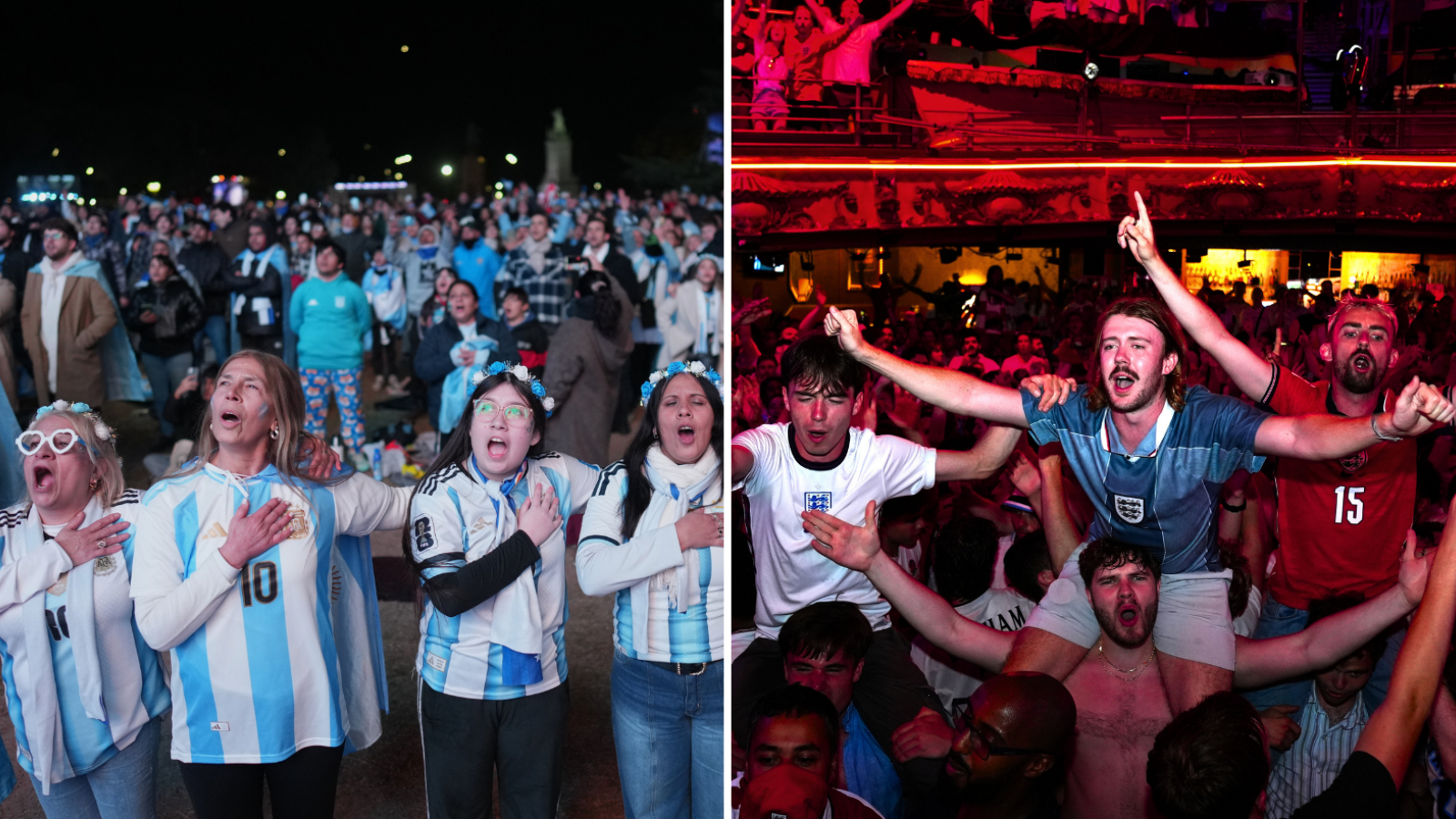
Fans celebrate England’s win following a screening of the World Cup 2026 quarterfinal match vs Norway at The Clapham Grand in London. (AP)
London and Buenos Aires have each shaped football in their own image. One built the structures of the modern game. The other gave it a language of imagination, identity and romance.
London likes to think it is where modern football grew up. It is difficult to argue otherwise. The Football Association codified the game’s laws in England. Professional leagues flourished there. Clubs became neighbourhood institutions.
Depending on promotion and relegation, London routinely has around a dozen professional clubs across England’s top divisions, more than any other city in the country. Football here became part of civic life. Boroughs found identities in clubs. Saturdays were organised around fixtures. The game acquired structure, rituals and institutions that would eventually be exported around the world.
Humanising football
If London institutionalised football, Buenos Aires humanised it. The Argentine capital is home to more than 35 professional clubs, an astonishing concentration that has made the city arguably the world’s greatest football metropolis. Around a third of Argentina’s professional clubs are based there.
Story continues below this ad
ALSO READ | England chase redemption: not just a trophy, but a release from tragic fates
The city’s football map is almost indistinguishable from its street map. La Boca belongs to Boca Juniors. Nunez belongs to River Plate. Almagro has San Lorenzo. La Paternal has Argentinos Juniors. And so on. Almost every barrio has a club to call its own, and with it a fiercely guarded identity handed down through generations.
As Wilson writes, football in Buenos Aires extends well beyond the ninety minutes. It spills into cafés, barber shops, buses and family lunches. Tactical debates are a daily ritual. Conversations about formations, centre-forwards and referees can stretch for hours.
The irony, too, is hard to miss.
Argentina learnt football from Britain.
Railway engineers, dock workers, merchants and teachers carried the game across the Atlantic in the late 19th century. Many of the earliest clubs bore unmistakably British names, and for a while football remained largely an expatriate pastime.
Then Buenos Aires made it its own.
Story continues below this ad
Wilson argues that somewhere between the railways and the potreros – the vacant neighbourhood lots where children played without coaches or perfectly manicured pitches – the game stopped being English and became unmistakably Argentine.
Argentina capital Buenos Aires humanised football. (AP)
The potrero occupies an almost mythical place in Argentina’s football imagination. Uneven surfaces, broken fences and makeshift goals rewarded ingenuity over instruction. Children learnt balance because the ground demanded it, close control because the ball rarely bounced true, and deception because the quickest way past bigger opponents was with a feint rather than force.
From those dusty neighbourhood pitches emerged la nuestra – “our way” – a football philosophy that prized imagination, improvisation and technique over rigid systems. As Eduardo Galeano notes in Football in Sun and Shadow, “On the playing fields of Buenos Aires, a style came into being… players created their own language in tiny space where they chose to retain and possess the ball rather than kick it, as if their feet were hands braiding leather together.”
ALSO READ | England vs Argentina: A rivalry forged by war, on-field spats and history of cons
Story continues below this ad
Of course, neither country neatly fits its old caricature anymore.
Thomas Tuchel’s England are blessed with technicians such as Jude Bellingham and Bukayo Saka. Lionel Scaloni’s Argentina, meanwhile, have become one of international football’s most tactically disciplined sides.
That is what makes Wednesday’s semifinal so compelling. Beyond merely the weight of old scores or famous goals, it is the meeting of two capitals that have spent more than a century shaping football in different ways.
One is home to pubs where every borough has its club. The other is home to cafés where every conversation eventually returns to football. One exported the game. The other exported its romance.
Story continues below this ad
For 90, or 120, minutes, history and politics will inevitably linger in the background. But they need not define the occasion. For England against Argentina is also a meeting of London and Buenos Aires – two cities that have spent generations teaching the world different, but equally beautiful ways to love football.
And perhaps that is the rivalry’s richest story of all.
View original source — Indian Express ↗
Related stories

ESPN
SportsJul 14, 2026 · 1 min
The MLB All-Stars we stop everything to watch -- a...
ESPN

ESPN
SportsJul 14, 2026 · 1 min
MLB All-Star Game: Predictions, live updates and t...
ESPN

ESPN
SportsJul 14, 2026 · 1 min
Eight new NFL coach-player pairings Solak can't wa...
ESPN
ESPN
SportsJul 14, 2026 · 1 min
Top 10 NFL linebackers: How execs, coaches and sco...
ESPN