The Guardian
‘Misuse’ of crowd control weapons on ICE protesters led to blindings and traumatic brain injuries, report finds
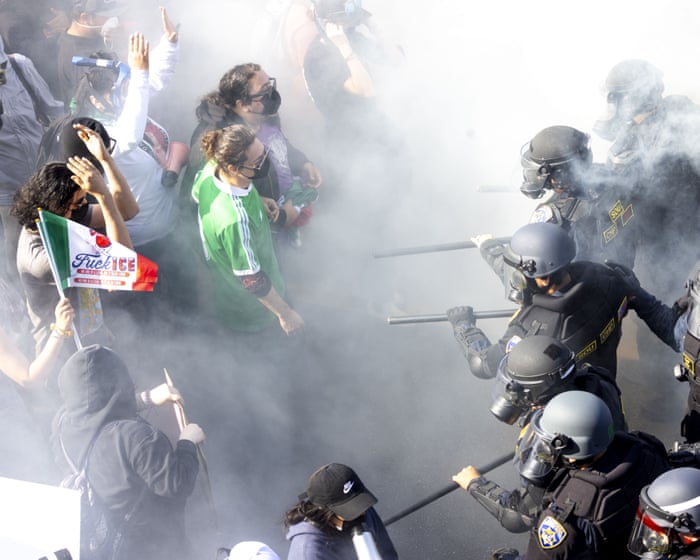
It’s been a brutal tactic deployed by local and federal law enforcement officials time and again over the past year: using teargas, rubber bullets and pepper spray to control protests outside ICE detention centers or during enforcement operations.
Now, a new report lays bare the scale of the use of these crowd control weapons during anti-immigration demonstrations across the US, including hundreds of incidents that resulted in lasting and traumatic injuries.
The report and an interactive map was created by Physicians for Human Rights (PHR) and the Human Rights Center at the University of California, Berkeley (HRC) and released this week. Doctors and human rights experts with PHR and HRC documented 412 verified incidents of the “misuse” of these crowd control weapons, also known as “less-lethal weapons”, from June 2025 through May 2026.
“This is a concerning story,” said Dr Rohini Haar, the lead author of the report and a PHR medical expert, in an interview with the Guardian.
The report documented 203 injuries stemming from the alleged misuse of the crowd control weapons. Some of the injuries included blindings, traumatic brain injuries, lacerations, fractures and contusions.
The researchers struggled to confirm the full scale of the injuries, because “visual investigative techniques cannot adequately assess invisible injuries, such as chemical injury or chronic pain or hearing loss”.
“The true number of injuries is likely far greater,” the report adds.
Such tactics were on display earlier this summer, when dozens of protesters gathered outside the Delaney Hall immigration detention center in Newark, New Jersey, in solidarity with detained immigrants on hunger strike. As protests became more and more heated, a line of masked Immigration and Customs Enforcement (ICE) officials stood outside to guard the detention center.
During a scuffle, ICE officials pepper sprayed Andy Kim, a New Jersey senator, making national news and helping set off one of the country’s flashpoints in demonstrations against the Trump administration’s immigration enforcement operations.
In the days and weeks that followed, local and state officials also moved in on protesters, using batons and shields, deploying teargas canisters and arresting dozens. Many were injured during the demonstrations outside Delaney Hall by the crowd control weapons that the local, state and federal officials used.
The use of crowd control weapons in New Jersey was not new – local, state and federal law enforcement officials have used them on protesters nationwide opposing the aggressive anti-immigrant arrests, detentions and deportations.
But their use has become widespread as the backlash to Trump’s immigration crackdown has grown – prompting researchers to track down incidents and the types of weapons used nationwide, and to establish a map where readers can see how those weapons have been used in their communities.
Haar began working on the report after she saw news of a pastor being blasted in the face with a chemical weapon by a federal official in Oakland. Haar and PHR have been researching the impacts of crowd control weapons for years.
“Those weapons can cause harm,” Haar added. “It’s just when they’re used, how they’re used and if they’re used.”
DHS did not respond to Guardian inquiries about the report’s findings before publication.
The crowd control weapons include chemical irritants, including teargas, pepper spray and Mace, along with “kinetic impact projectiles”, which include rubber bullets and bean bag rounds. Researchers with PHR and HRC also documented the use of stun grenades, water cannon and other “improvised” weapons, like horses and riot police shields.
Haar explained to the Guardian that they qualified “misuse” by a number of methods. First, they tracked whether people in “protected categories”, including journalists and health workers, were targeted by officials. Next, they documented if vulnerable populations, including elderly people and children, were affected. And lastly, they tracked whether the weapons were used improperly, like using the weapons in close range, targeting people’s heads or going against the weapons’ manufacturing guidelines.
A report from earlier this year by ProPublica identified 70 children across the US who had been harmed by teargas or pepper spray – not just at protests, but during immigration enforcement operations as well.
On a national level, officials with the Department of Homeland Security (DHS), like ICE or Customs and Border Protection (CBP) officials, were responsible for over half of all misuse incidents – 64%. But local law enforcement officers also played a role in many incidents.
“The involvement of state and local [authorities] is also concerning,” Haar added. “Because in many places, they’re coming on top of what is already happening with DHS. But in places like Los Angeles, there is a lot more involvement [of local law enforcement officials].”
The researchers found that there was an increase in the use of these weapons during immigration enforcement surge operations under the command of former Border Patrol commander-at-large Gregory Bovino, who took a hardline approach to his enforcement tactics. After the shooting deaths of two US citizens in Minneapolis by federal immigration officials, Bovino was pulled from his position. He became critical of the Trump administration, accusing them of not taking a tough-enough approach, and retired in March of this year.
“In each city where there were federal directions to escalate enforcement, incident counts rose sharply within days,” PHR said in a statement announcing the report and the map. “Much of this was coincident with the arrival of Greg Bovino.”
“Many of the enforcement operations that coincided with spikes in documented misuse were also promoted through public social media accounts, including Bovino’s,” PHR continued.
For researchers, the scale of the use of the crowd control weapons harkened back to law enforcement’s response to the 2020 racial justice protests. That year, protesters throughout the country took to the streets to protest police killings of people of color throughout the US. And in some cities, the Border Patrol’s elite unit participated in arrests and crowd control operations.
Since June 2025, mass protests have erupted in Los Angeles, Chicago, Minneapolis, Newark and Portland. The report documented that over 90% of the documented “misuse” incidents happened in those regions.
DHS and local law enforcement officials have fallen under repeated criticism for their response to their protests and their aggressive use of force. Since January of 2025, federal immigration officials with DHS have been responsible for at least 11 shooting deaths. The two most recent fatal shootings by immigration authorities took place this month, less than one week apart, in Texas and in Maine.
On 7 July, ICE agents shot and killed Lorenzo Salgado Araujo, a 52-year-old construction worker, during an arrest operation in Houston as he drove his work van. And just this Monday morning, a 26-year-old Colombian man was shot and killed by a federal official in Biddeford, Maine, DHS confirmed.
View original source — The Guardian ↗
Related stories
South China Morning Post
PoliticsJul 14, 2026 · 1 min
Why is a Trump commission attacking Nietzsche, Foucault and Sartre?
South China Morning Post

The Hill
PoliticsJul 14, 2026 · 1 min
How to hold Trump accountable: Sue, baby, sue
The Hill
The Guardian
PoliticsJul 14, 2026 · 1 min
New US Ebola patient arrives in Germany for treatment
The Guardian

TASS
PoliticsJul 14, 2026 · 1 min
Vucic says doesn’t want to drag Serbia into any conflicts, not seeking NATO membership
TASS