Indian Express
Who is Thomas Tuchel, the England coach who keeps fighting his own players?
Jude Bellingham had just scored both of England’s goals in a bad-tempered 2-1 extra-time win over Norway. It sent the team into the World Cup semi-final, the first goal standing despite Norwegian protests it struck an overhead camera cable in the build-up. Thomas Tuchel (pronounce: Toe-mazs Too-kh-uhl) in the post-match interview, called the win “lucky” and the performance “sloppy.” Told what his manager had said, Bellingham didn’t dress it up. “Maybe he doesn’t know what it’s like to play in those kind of conditions against Erling Haaland, Ødegaard, Nusa, Sørloth,” he said.
It wasn’t the first time. Tuchel had already apologised once for describing Bellingham’s on-field behaviour as “repulsive.” “If he smiles, he wins everyone,” he’d said. “But sometimes you see the rage, the hunger and the fire and it comes out in a way that can be a bit repulsive, for example, for my mother when she sits in front of the TV,” calling him, in the same breath, “a special boy.”
The German coach later said he’d used the word “unintentionally,” in his second language. Months on, substituted while visibly furious, Bellingham got the answer he’s had before: “That’s the decision, and he has to accept the decision,” Tuchel said. “We will not change our decision just because someone waves their arms.”
ALSO READ | England chase redemption: not just a trophy, but a release from tragic fates
Borussia Dortmund’s chief executive, Hans-Joachim Watzke, who worked with Tuchel for two years, summarised him in eight words: “A fantastic coach but a difficult person.”
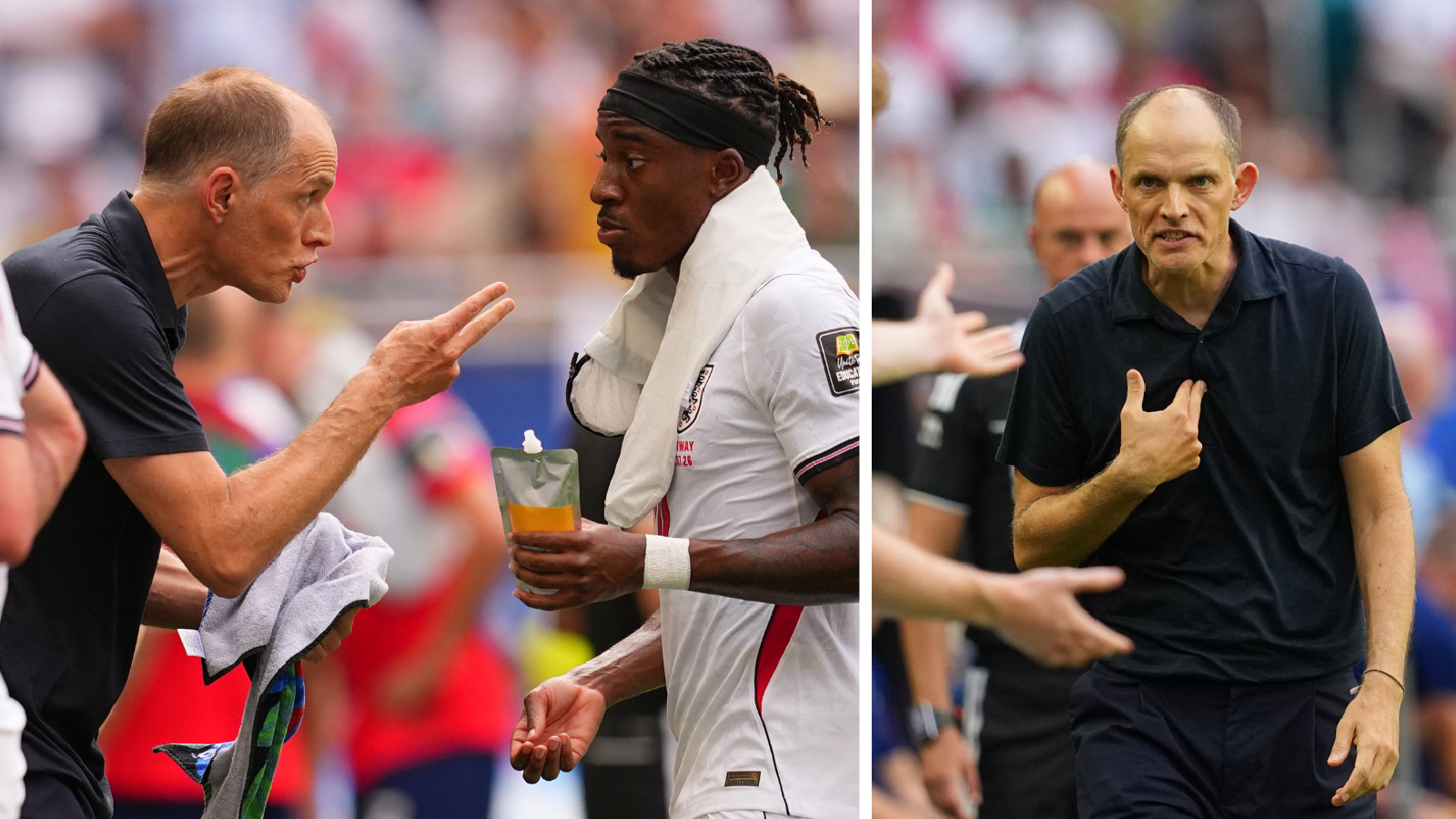
England head coach Thomas Tuchel speaks with Jude Bellingham during the World Cup round of 16 soccer match between Mexico and England in Mexico City, Sunday, July 5, 2026. (AP Photo)
At Dortmund, winger Emre Mor protested during a punishment run; Tuchel told him to shut his mouth, three times, then had him crawl across the pitch on his hands and knees. Mor was sold within months.
Story continues below this ad
Dortmund sacked Tuchel in 2017, days after he won the German Cup, once captain Marcel Schmelzer and Marco Reus publicly distanced themselves from his decision to leave veteran Nuri Sahin out of the squad. The trophy didn’t save him. Neither, later, did a Champions League title at Chelsea, where, per journalist Simon Phillips, around 70 per cent of the squad wanted out by the time he was sacked fifteen months later.
Both halves of Watzke’s sentence are true, and England hired him for exactly the first one.
Tuchel was in his mid-twenties when a knee injury ended his playing career at SSV Ulm in 1998, having already been cut loose by Stuttgarter Kickers and, before that, Augsburg’s academy. Out of football and needing money, he pursued an MBA and took a job at a Stuttgart bar, collecting glasses, then mixing cocktails. He might have stayed there, if his old Ulm coach, Ralf Rangnick, by then at Stuttgart, hadn’t tracked down where he’d ended up and offered him a youth-coaching job instead. Tuchel was reluctant, until, mid-shift at the bar, he heard Ulm had just been promoted to the Bundesliga without him. “I always wanted to get to the Bundesliga, and now they are living my dream,” he told Die Zeit. He left work shortly afterward.
ALSO READ | Tuchel-ball: Special ops substitutions, internal competition for spots
Story continues below this ad
By 2000 he coached Stuttgart’s youth teams. In 2004, his under-19 side beat VfL Bochum to the German championship. It changed nothing. Stuttgart still didn’t renew Tuchel’s contract afterward, the academy’s youth chief having already decided against him, reportedly telling a colleague, “I’ve always known that he’s a flop.”
He moved to Augsburg’s under-19s, and by 2009, Mainz 05 hired him as head coach, let go once as a player and once as a title-winning coach before it stuck.
England head coach Thomas Tuchel in action. (FILE photo)
Dortmund, PSG, Chelsea, Bayern Munich followed; in his first season at Chelsea he won the Champions League, beating Manchester City.
England hired him in October 2024 on an 18-month contract that ran only to this World Cup, since extended through Euro 2028. Philipp Lahm, who captained Bayern Munich under him, wrote in The Athletic that wherever Tuchel has worked, “at some point there always seems to be tension. It’s never down to tactics, but rather to interpersonal relationships.”
Story continues below this ad
Tuchel has said England suits him better than home ever did. “I feel that we are very critical of each other in Germany,” he said, “especially with players and coaches.”
At this World Cup, he left out Cole Palmer, Phil Foden, Harry Maguire and, again, Trent Alexander-Arnold, prioritising tactical shape over reputation. Maguire called himself “shocked and gutted” on social media. Tuchel’s explanation was unsentimental: “We are trying to select and build the best possible team, which is not necessarily selecting and collecting the 26 most talented players. Teams win championships.”
There is a gentler account too. Late at PSG, Tuchel learned his cleaner had been working extra hours to pay for her son’s heart surgery, and paid for it himself. Marcus Bettinelli, who played under him at Chelsea, says that whether you’re “the chef, the bin man or the gardener,” Tuchel asks how your family is doing, small things that sit oddly beside Watzke’s “difficult person,” until you accept both were watching the same man.
Bellingham has moved past Saturday’s exchange, saying simply that “all of the players have put in a very tough shift.” England are in the semi-final regardless. Whether the tension between the two men resolves, or repeats, as Lahm suggested it always does, is the question this tournament will actually answer.
View original source — Indian Express ↗
Related stories

The Punch
SportsJul 14, 2026 · 1 min
Four possible 2026 World Cup finals as last-four battle begins
The Punch
The Punch
SportsJul 14, 2026 · 1 min
World Cup final ball, halftime show outfits to be auctioned
The Punch

ESPN
SportsJul 14, 2026 · 1 min
Confusion, dysfunction and ESPN alerts: Inside the hopeful resurrection of the Chicago Bulls
ESPN
Sky Sports
SportsJul 14, 2026 · 1 min
Englannd World Cup Semi-Final and Final? A reminder of where and when!
Sky Sports