Indian Express
UPSC Mains Answer Practice — GS 3: Hydrogen fuel-cell technology and Project 17A frigates (Week 163)
UPSC Essentials brings to you its initiative for the practice of Mains answer writing. It covers essential topics of static and dynamic parts of the UPSC Civil Services syllabus covered under various GS papers. This answer-writing practice is designed to help you as a value addition to your UPSC CSE Mains. Attempt today’s answer writing on questions related to topics of GS-3 to check your progress.
🚨 Click Here to read the UPSC Essentials magazine for June 2026. Share your views and suggestions in the comment box or at [email protected]🚨
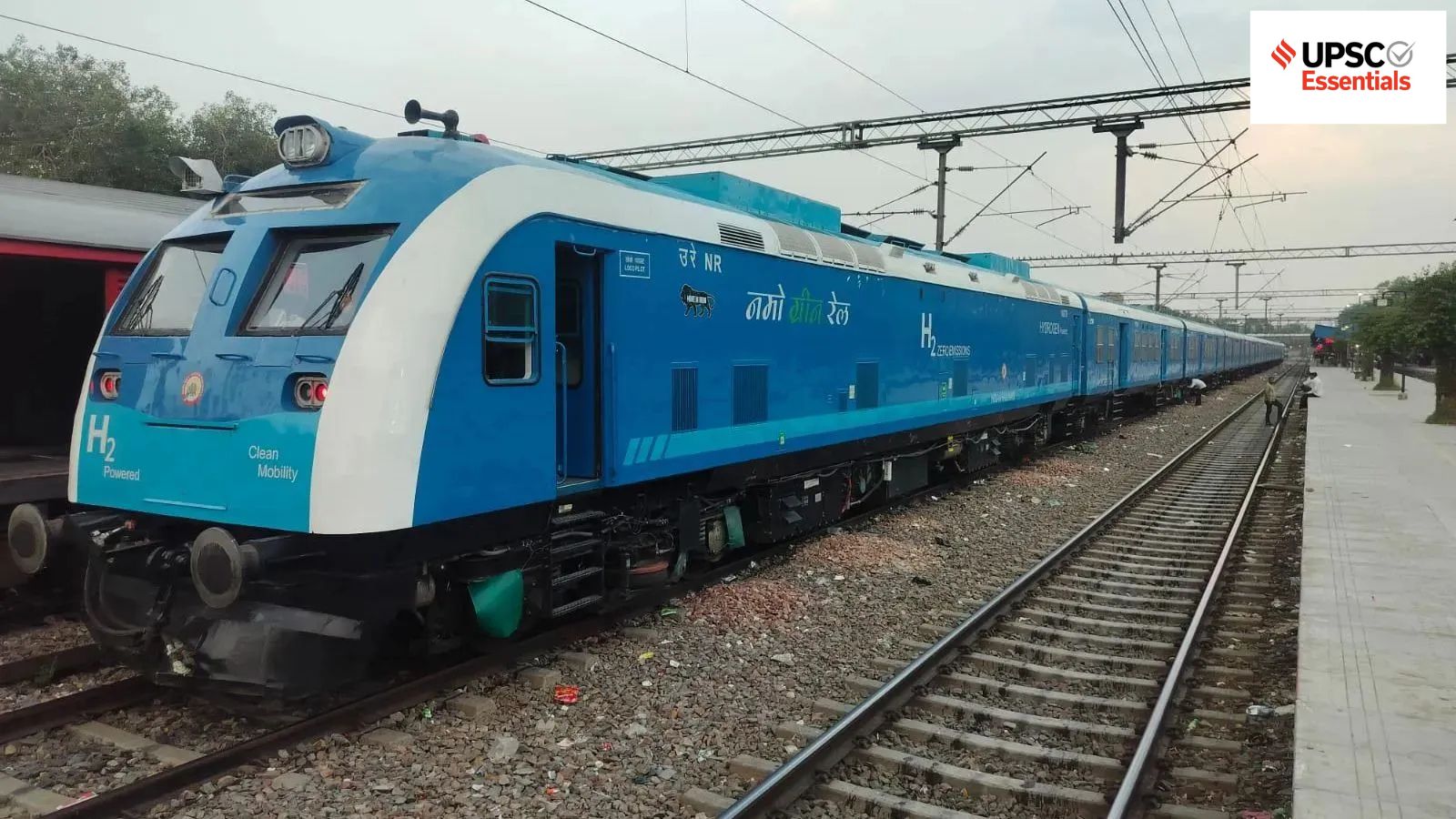
Hydrogen fuel-cell technology is emerging as a promising alternative for decarbonising the transport sector. Explain the working principle of hydrogen fuel-cell trains and discuss their potential advantages and limitations in the Indian context.
QUESTION 2
Modern warship construction involves the integration of advanced technologies such as stealth design, automation, and network-centric warfare. Discuss the technological innovations incorporated in India’s Project 17A frigates and assess their implications for future naval warfare.
QUESTION 1: Hydrogen fuel-cell technology is emerging as a promising alternative for decarbonising the transport sector. Explain the working principle of hydrogen fuel-cell trains and discuss their potential advantages and limitations in the Indian context.
Relevance: This topic is highly relevant for GS Paper 3 as it integrates green hydrogen, clean energy, railway modernisation, sustainable infrastructure, climate commitments, and emerging technologies. It can also be linked with the National Green Hydrogen Mission, India’s Net Zero target (2070), energy security, and decarbonisation of the transport sector.
Note: This is not a model UPSC answer. It only provides you with a thought process which you may incorporate into the answers.
Introduction:
Story continues below this ad
— India plans to launch its first hydrogen fuel-cell train as part of its efforts to promote renewable transportation and decarbonise the railway sector.
— Hydrogen fuel-cell technology provides a zero-emission alternative to diesel propulsion, particularly on non-electrified railway tracks, while also contributing to India’s overall shift to green energy.
Body:
You may incorporate some of the following points in your answer:
Potential advantages
Story continues below this ad
— It provides a clean alternative to diesel locomotives, which reduces greenhouse gas emissions.
— It can replace diesel trains in areas where railway electrification is not economically or technically possible, decreasing reliance on imported fossil fuels and promoting India’s sustainable energy transition.
— It enhances environmental quality, especially in ecologically fragile and urban settings.
— It promotes investments in hydrogen production, storage, and refuelling infrastructure.
Limitations
Story continues below this ad
— High capital expenses for fuel cells, hydrogen storage systems, and specialised rolling stock. Green hydrogen availability is limited and expensive when compared to traditional fuels. Storage and transportation are difficult due to hydrogen’s low volumetric energy density and safety constraints.
Conclusion:
— Hydrogen fuel-cell trains can help India shift to low-carbon transportation, especially on routes where electrification is problematic. However, widespread implementation will require affordable green hydrogen, strong infrastructure, technological innovation, and ongoing regulatory backing.
(Source: PM to flag off India’s first hydrogen train: How they work, and why they haven’t picked pace globally, Knowledge Nugget | India’s first hydrogen train: How does hydrogen fuel cell technology work?, Union Cabinet approves Green Hydrogen Mission: A look at India’s push for the fuel)
Points to Ponder
How can the National Green Hydrogen Mission facilitate the deployment of hydrogen-powered railways?
Related Previous Year Question
Story continues below this ad
The adoption of electric vehicles is rapidly growing worldwide. How do electric vehicles contribute to reducing carbon emissions and what are the key benefits they offer compared to traditional combustion engine vehicles? (2023)
QUESTION 2: Modern warship construction involves the integration of advanced technologies such as stealth design, automation, and network-centric warfare. Discuss the technological innovations incorporated in India’s Project 17A frigates and assess their implications for future naval warfare.
Relevance: The commissioning of INS Mahendragiri, a Project 17A indigenous stealth frigate, is highly relevant for GS Paper 3 as it covers defence indigenisation, Aatmanirbhar Bharat, maritime security, indigenous technology, shipbuilding, blue-water naval capability, Indo-Pacific strategy, and defence manufacturing.
Note: This is not a model UPSC answer. It only provides you with a thought process which you may incorporate into the answers.
Introduction:
Story continues below this ad
— The commissioning of INS Mahendragiri, the sixth stealth frigate under Project 17A, is a key milestone in India’s indigenous naval shipbuilding plan.
— The Project 17A frigates, which boast innovative design characteristics and cutting-edge combat technologies, represent the Indian Navy’s move to technology-intensive and network-enabled maritime operations.
Body:
You may incorporate some of the following points in your answer:
Technological innovations in Project 17A frigates
Story continues below this ad
— Advanced contouring of the hull and superstructure, combined with reduced radar, infrared, acoustic, and magnetic signals, improves survivability by making the ships harder to detect.
— Integrated Platform Management System (IPMS): Automation allows for centralised monitoring and management of propulsion, machinery, and auxiliary systems, reducing crew workload and increasing operational efficiency.
— The frigates are intended to function as part of a larger naval battle network, allowing for real-time information exchange and coordinated actions with ships, submarines, and aircraft.
— The ships are outfitted with advanced sensors, surveillance systems, electronic warfare suites, and precision-guided weaponry, allowing them to conduct multidimensional missions against aerial, surface, and subsurface threats.
— Project 17A has a substantially higher level of indigenous equipment and systems, which strengthens India’s defence industrial ecosystem.
Implications for future naval warfare
— It would improve India’s ability to conduct multi-domain and network-enabled operations while also boosting marine situational awareness via integrated sensor networks.
— It will increase deterrence and operational preparedness in the Indian Ocean Region (IOR).
— It encourages Aatmanirbhar Bharat by minimising reliance on imported defensive platforms.
Conclusion:
— Project 17A illustrates India’s increased technological maturity in naval shipbuilding. These frigates improve the Indian Navy’s combat effectiveness by combining stealth, automation, and network-centric capabilities with indigenous innovation, while also strengthening India’s long-term maritime security and strategic autonomy.
(Source: What INS Mahendragiri’s commissioning shows about India’s naval shipbuilding prowess, INS Mahendragiri joins Indian Navy: Rajnath commissions indigenous stealth frigate, Two warships from 2 shipbuilders: Features and legacy of INS Udaygiri and INS Himgiri, now commissioned into the Indian Navy, http://www.pib.gov.in)
Points to Ponder
How do stealth features enhance the survivability of modern warships?
How will these technological advancements influence the future nature of naval warfare in the Indo-Pacific?
Related Previous Year Question
“Investment in infrastructure is essential for more rapid and inclusive economic growth.” Discuss in the light of India’s experience. (2021)
Previous Mains Answer Practice
UPSC Essentials: Mains answer practice — GS 3 (Week 162)
UPSC Essentials: Mains answer practice — GS 3 (Week 161)
UPSC Essentials: Mains answer practice — GS 2 (Week 162)
UPSC Essentials: Mains answer practice — GS 2 (Week 161)
UPSC Essentials: Mains answer practice — GS 1 (Week 161)
UPSC Essentials: Mains answer practice — GS 1 (Week 162)
Subscribe to our UPSC newsletter and stay updated with the news cues from the past week.
Stay updated with the latest UPSC articles by joining our Telegram channel – IndianExpress UPSC Hub, and follow us on Instagram and X.
View original source — Indian Express ↗
Related stories

TechRadar
TechnologyJul 14, 2026 · 1 min
AI does not solve poor finance infrastructure: it weakens it
TechRadar

TechRadar
TechnologyJul 14, 2026 · 1 min
Autonomous AI worms mark a new era of adaptive cyberattacks
TechRadar

TechRadar
TechnologyJul 14, 2026 · 1 min
Real Housewives of London season 2 release date confirmed as Hayu promises 'most personal season yet'
TechRadar

TechCrunch
TechnologyJul 14, 2026 · 1 min
The real AI race may no longer be at the frontier
TechCrunch