Indian Express
World Cup: Why creaking Argentina and squeaking England can still scrap out wins
5 min readUpdated: Jul 14, 2026 07:34 PM IST
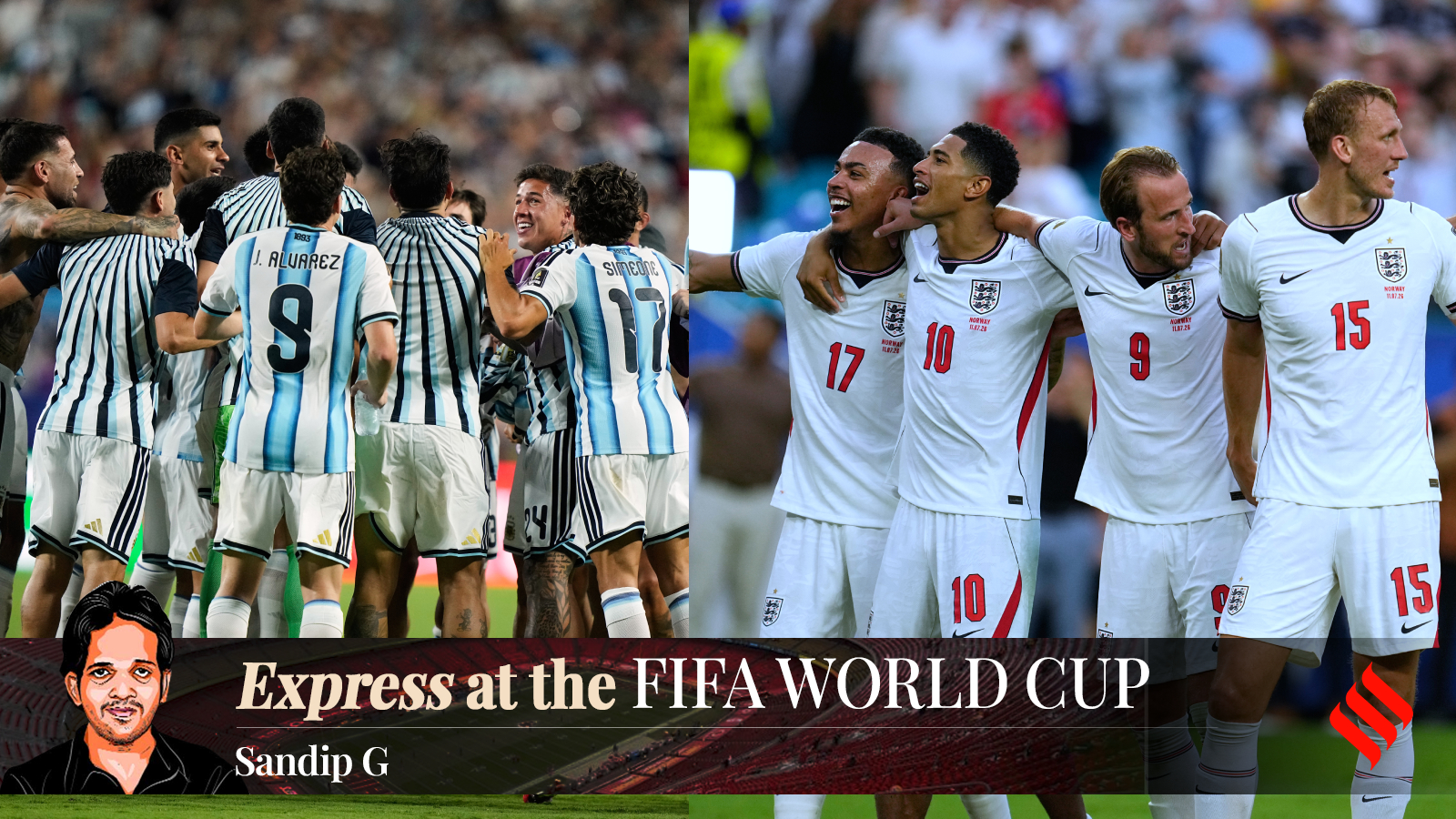
Unlike France and Spain, smooth-sailing vessels, Argentina and England have creaked and squeaked their way to the last four. (AP)
The managers, as managers are, were not happy with their troops in the quarterfinals.
“I am not happy with the performance in every sense,” England boss Thomas Tuchel bemoaned. “The commitment is there, but we made life very difficult for us in how we played, in the way we played. Sloppy, not fast enough. Not repetitive enough. We were lucky today,” he added, much to the bemusement of Jude Bellingham, the afternoon’s hero.
Hours later, in a milder tone, Argentina’s supremo admitted his team’s struggle to douse Switzerland, even when they were down to 10 men. “It was very difficult for us to win the duels, to put more than five or six passes together,” he confided. He didn’t say his team was lucky, but “ultimately we found the solutions.” The team’s entry to the semifinal, he emphasised, was historic, “but we should have played better.”
Unlike France and Spain, smooth-sailing vessels, Argentina and England have creaked and squeaked their way to the last four, weathering literal and metaphorical storms, surviving scares, crossing the line through force of personalities and moments of individual wizardry and defiance, bound by a thread of positive volatility.
England outlasted Mexico with ten men for the 30 minutes; they overturned a 0-1 deficit against Congo DR in the last 15 minutes; the Norway game looked a lost cause until Jude Bellingham intervened. Argentina waddled through two extra-time scares and a last-gasp comeback against Egypt. Individuals have seized the moments. Harry Kane against Congo, Bellingham versus Norway; Lionel Messi in almost every game, Julian Alvarez with a pearler against Switzerland.
Imbalances reek in midfield and flanks. Argentina’s midfield has looked weary. Fatigue has crippled Leandro Paredes and Rodrigo de Paul, both in their early 30s. Running the runs for Messi in two games decided by extra time. has eventually caught up with them. Paredes did not last the game against Switzerland, and when he was substituted, Argentina lost their control in the midfield, and were fortunate that they enjoyed numerical superiority. Head-to-head, England midfield is a superlative product, younger, quicker, stronger and technically sturdier. But the talisman Declan Rice is fighting his fitness; Eberechi Eze, reduced to cameos, has not recreated the same flourish as he had in his Arsenal days; Elliot Anderson, for all his diligence, lacks the all-action-hero verve of Rice.
A peak Rice and Bukayo Saka would have been a different story and could have run Argentina’s weary midfield ragged. Alexis Mac Allister and Enzo Fernandez are not exactly fierce ball shielders and prone to being dispossessed under pressure and in swift transitions, which Bellingham and Co could orchestrate. Out of possession, Mac Allister and Fernandez can sometimes be a burden. But both have a knack of scoring goals from improbable situations. If the game boils down to durability and physicality, England would lick their lips in excitement. The caution: Argentina with their doggedness have worn down far superior physical teams.
Story continues below this ad
The right wing bothers both sides. England have a right-side concern. Winger Noni Madueke has pace, but lacks incisiveness, and has a tendency to lose the ball under pressure. His link-up between the right-back is dodgy, compounded by England’s injury concerns. If Reece James, reduced to substitute shifts, starts and could sustain his intensity, England could be quicker and stronger on that side. But Ezri Konsa, while aerially superior, can be ponderous at times.
Argentina’s counterparts, Nahuel Molina and Gonzalo Montiel tend to run out of steam in less than an hour. Both Egypt and Switzerland exploited their susceptibility. They can’t be blamed either, because they have to perform the heavy-lifting of a largely immobile midfield, creating depth in the absence of natural wingers. England could ratchet up the pace on the side. Nico O’Reilly and Anthony Gordon could put them to the sword with their blinding speed and trickery. England, arguably have a sturdier centre-back pairing and depth in quality too. If the match loiters into extra time, England have better reinforcements to rely on.
But for all of England’s marginal superiority in midfield, defence, physicality and height (Argentina’s is 179.7cm and England’s 184.2cm), Argentina have a shorthand solution for all their woes: Lionel Messi. Teams can tie him in knots for 90 minutes and in two seconds he could change the game. He wouldn’t be a relentless threat as he was at his peak, but beware when he drops into the pockets of space outside the area.
Limiting his influence needs a mixture of fortune and unflinching focus. The practical way, perhaps, is to not fixate over Messi and miss the rest of the plot. And minimise dead-ball situations, from where Messi’s deliveries could be devilish. Set-pieces have contributed to six of Argentina’s 17 goals (one third). Though shorter than England’s, their aerial prowess is staggering.
Story continues below this ad
Hence, the Argentina-England skirmish couldn’t be a delight for purists as the Spain-France encounter would be. But there is a beauty about flawed grounds, in their unpredictability and imperfections, in the moments of madness and magic, in the victory of personalities over structures and systems, in its wild swings of fortunes. It could be cagey and chaotic, but thrilling too. And leave something for the manager to gripe.
© The Indian Express Pvt Ltd
View original source — Indian Express ↗
Related stories

ESPN
SportsJul 14, 2026 · 1 min
Faldo blasts Bryson: 'Zero strategy' for links gol...
ESPN
ESPNcricinfo
SportsJul 14, 2026 · 1 min
India's quicks and Axar restrict England to 258
ESPNcricinfo

CNA
SportsJul 14, 2026 · 1 min
EU blasts threats against ICC as US targets court
CNA

ESPN
SportsJul 14, 2026 · 1 min
Sources: MLB in LA28 facing hurdles with MLBPA
ESPN