Times of Israel
Knesset passes law banning arrests of Haredi draft dodgers, legitimizing ongoing non-enlistment
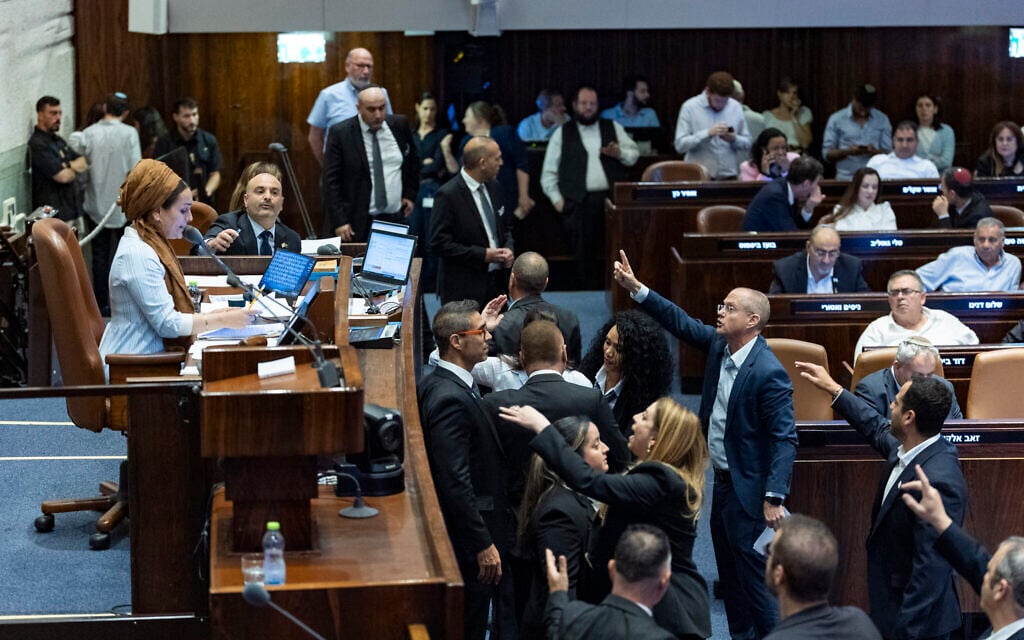
The Knesset voted 58-54 on Tuesday to pass a coalition-backed law temporarily banning the arrest and prosecution of ultra-Orthodox men evading military service, and thereby legitimizing continued mass Haredi non-enlistment. In practice, the measure will halt most Haredi enlistment to the IDF for at least the next few months.
The law — part of a last-minute legislative blitz by the government that is centered around Haredi demands to ensure blanket draft exemptions for yeshiva students — grants tens of thousands of Haredi draft evaders immunity from arrest until late January 2027, and extends that protection to those who become eligible for military service after it takes effect, effectively eliminating the threat of arrest and making it easier to refuse to enlist during that period. It also suspends ongoing criminal proceedings against those already facing enforcement measures.
On Monday, IDF Chief of Staff Lt. Gen. Eyal Zamir called the proposal “inconceivable,” saying it was “clearly and unequivocally inconsistent with the IDF’s needs” and amounted to “providing mass exemptions from prosecution.” Some 72,000 ultra-Orthodox men aged 18 to 24 are currently believed to be eligible for military service, but have not enlisted. The IDF has said repeatedly in recent months that it urgently needs 12,000 new recruits amid the ongoing multifront conflict. The law has drawn fierce opposition from reservists, Knesset legal advisers and much of the public.
New Hope MK and Deputy Foreign Minister Sharren Haskel resigned in protest after the vote, and opposition parties and NGOs immediately petitioned the High Court of Justice to overturn the law, accusing the government of advancing “mass Haredi draft evasion” while “trampling the principle of equality in bearing the burden.” Haredi MKs, meanwhile, warned that any attempt by the courts to intervene would spark mass civil unrest.
The vote came after a brief coalition standoff over the bill’s place on the agenda, as well as overnight and day-long speeches and opposition filibustering, including 1,748 reservations, and amid a flurry of legislation that must be completed before the Knesset dissolves on Friday ahead of the October 27 election.
Get The Times of Israel's Daily Edition
by email and never miss our top stories
By signing up, you agree to the terms
Amid the legislative rush and the jockeying among coalition partners to get their favored bills on the agenda, Knesset legal advisers warned that there were several instances of improper Finance Committee votes overnight and said those decisions would be considered invalid. Also, a major public transportation reform was reportedly dropped amid ultra-Orthodox opposition and horse-trading between the parties.
Several coalition lawmakers broke ranks to oppose the contentious law, including Religious Zionism MK Moshe Solomon, Haskel, and Likud MKs Yuli Edelstein and Dan Illouz, both of whom recently announced they were leaving the party over the issue.
Harrel denounced the legislation as “a law that harms those who serve and the security of the state. It harms those who have served the state for three years and paid a heavy price.” Hence, she said, “I have decided to resign from my position in the government.”
Prime Minister Benjamin Netanyahu attended part of the debate, drawing cries of “Shame!” and “Leave!” from opposition lawmakers. He left before the vote and did not participate. Defense Minister Israel Katz’s vote in favor likewise prompted chants of “Shame!” from the opposition.
Netanyahu was branded a “traitor” by an opposition MK when his name was called in his absence.
Opposition leaders continued lobbying coalition lawmakers until the final moments before the vote. According to Channel 12, Yisrael Beytenu party chairman Avigdor Liberman texted several Likud MKs: “You have nothing to lose. For four years, you helped Netanyahu survive. Now help the IDF.”
“Who would have believed that it is easier to recruit fucking [Mahmoud] Ahmadinejad than the Haredim,” Liberman said in a bitter address, referencing reports of the former Iranian president’s interactions with Mossad. “But that’s the reality.”
High Court challenge
Minutes after the law passed, both the Movement for Quality Government in Israel and the opposition Yesh Atid and Yisrael Beytenu parties filed petitions to the High Court of Justice against the law.
“A law that grants draft dodgers immunity from arrest is not the modest, temporary emergency measure it is being portrayed as,” the movement said, announcing the submission of its petition. “Rather, it is an attempt to enshrine in legislation a reality in which the obligation to serve applies only to part of the public—while combat soldiers and reservists continue to shoulder the burden for a third consecutive year.”
Yair Lapid’s Yesh Atid argued that “at a time when IDF soldiers and those who serve are carrying the burden, the government is once again spitting in their faces and prioritizing narrow political considerations over the good of the country.”
It further charged that the legislation “deepens the discrimination between one person’s blood and another’s,” creating one legal standard for secular, traditional and religious Jews subject to military service, and another for members of the ultra-Orthodox community.
United Torah Judaism MK Meir Porush, meanwhile, warned the court against trying to strike down the law, claiming it “will have no legal validity” and calling on the army to immediately release detained yeshiva students and on police not to cooperate in arresting them or comply with High Court rulings.
He warned that “any other course of action will lead to civil rebellion on a scale never before seen” among Israel’s approximately 1.5 million ultra-Orthodox Jews.
Ultra-Orthodox celebrate
The passage of the law sparked celebrations by Haredi lawmakers.
Shas party chairman Aryeh Deri hailed the legislation as the end of the “persecution” of yeshiva students, declaring that “today the Knesset is telling the ousted attorney general in a clear voice: Enough with the persecution. Enough with the hatred toward Torah students.”
United Torah Judaism MK Moshe Gafni declared: “We promised, and we delivered. After a prolonged struggle, the Knesset today approved the law ending the persecution of Torah students and preventing their arrest.”
Their characterizations of the law stood in stark contrast to those of coalition lawmakers who have insisted that the measure is merely a temporary freeze on arrests rather than blanket military exemptions for ultra-Orthodox men.
Opposition leaders, meanwhile, excoriated the coalition for abandoning the IDF in the midst of a multifront war despite repeated military warnings of a severe manpower shortage.
Yashar party chairman Gadi Eisenkot accused the government and Netanyahu directly of “choosing to weaken the IDF in the midst of a difficult war” by granting “sweeping approval and encouragement to draft evasion.”
Left-wing Democrats party chairman Yair Golan called the vote “one of the greatest moments of disgrace in the Knesset since the founding of the State of Israel,” accusing the coalition of extending protection to draft dodgers while soldiers and bereaved families bear the cost of the war.
Former prime minister and Together party leader Naftali Bennett likewise branded the legislation “a shameful and anti-Zionist moment,” saying the outgoing government was showing “utter contempt for the soldiers, their families and everyone who serves,” while Reservists party chairman Yoaz Hendel said Religious Zionism and Likud voters were “sold out” by Netanyahu and Finance Minister Bezalel Smotrich, who he said “surrendered to political extortion” to preserve their alliance with the ultra-Orthodox parties.
Coalition battles
The debate and vote followed a crisis that erupted shortly after the Knesset approved the controversial Basic Law for Torah Study late Monday night, when Gafni demanded lawmakers immediately advance the arrest-freeze bill and threatened to boycott all other coalition legislation until it was brought to a vote.
Smotrich’s Religious Zionism insisted that legislation backed by its lawmakers, including bills that would gut the powers of the attorney general and expand gender-segregation in academia, take priority on the agenda.
Plenum proceedings were suspended until a compromise was reached, even as Knesset committees advanced other legislation overnight, including Communications Minister Shlomo Karhi’s media overhaul and the extension of mandatory military service to 32 months, from 30.
The arrest-freeze law is part of a broader agreement between Netanyahu and the ultra-Orthodox parties, under which the Haredi factions agreed to back a series of coalition priorities in exchange for measures aimed at protecting yeshiva students from military service.
Under that agreement, the coalition is fast-tracking legislation demanded by the Haredi parties, including a bill restoring the Chief Rabbinate’s monopoly over kosher certification.
In return, the Haredi parties are backing legislation that Netanyahu wants, including a bill that would give the government control over appointing a commission to investigate the failures surrounding the October 7, 2023, attack, as well as the legislation weakening the powers of the attorney general, one of the country’s only institutional checks on executive power.
The Haredi legislative push comes after the High Court ruled unanimously in 2024 that the government must draft ultra-Orthodox yeshiva students into the military since there was no legal framework to continue the decades-long practice of granting them blanket exemptions from army service.
A proud conflict of interest
During the debate, Knesset Legal Adviser Sagit Afik said that lawmakers with close relatives who stand to directly benefit from legislation freezing the arrest of ultra-Orthodox draft evaders must disclose a potential conflict of interest before participating in the debate or vote.
In a letter to MKs ahead of the vote, Afik wrote that the bill “raises concern over a conflict of interest, or at the very least the appearance of a conflict of interest” because it would freeze arrests, halt prosecutions and suspend ongoing legal proceedings against draft evaders.
She said any lawmaker with a child or grandchild who has already been issued an arrest warrant for draft evasion or desertion, has been arrested, or is already subject to enforcement or legal proceedings, and “intends to participate in the debate or vote on the bill must make a proper disclosure before the vote,” while stressing they may still vote afterward.
She added that no disclosure was required for MKs whose relatives are draft evaders, but have not yet been issued arrest warrants or become subject to legal proceedings.
The ultra-Orthodox United Torah Judaism and Shas parties then issued a pair of provocative statements proudly announcing their MKs’ conflicts of interest.
The wording of the twin statements, signed by all 18 lawmakers from both parties, sparked vocal protest from the law’s opponents when Knesset Speaker Limor Son Har-Melech (Otzma Yehudit) read them aloud.
In the name of the lawmakers, the letter discloses that “among tens of thousands of Torah scholars, we too, by the grace of God, have children and grandchildren over the age of 18 who serve as the Tribe of Levi, and we are proud of them.”
“As such, it is possible that the provisions of the present bill could have an impact on them,” the letter continued.
The lawmakers’ reference to the biblical Tribe of Levi was an analogy often used by supporters of Haredi non-enlistment, likening yeshiva students who avoid army conscription to the Levites, who in Jewish tradition dedicated their time to religious rather than material matters.
Transportation reforms dropped
Amid the jockeying for legislation to be added to the day’s agenda, a massive transportation reform was dropped amid protest from ultra-Orthodox parties, Hebrew media reported.
According to the Ynet news site, the proposal would have decentralized powers away from the Transportation Ministry and assigned them to local authorities in the central Dan region — the Tel Aviv metropolis — and the Jerusalem and Haifa areas.
The move would allow public transportation to be adapted to the local population, the Ynet news site reported.
The reports said that Haredi lawmakers blocked the law amid concerns that secular localities could use the reform to promote public transportation on Shabbat.
The long-awaited legislation had been expected to bring improvements to public transportation, coordinate times between different modes of transportation, increase cycle paths, and make intercity movement easier by public transportation — all with the aim of reducing traffic jams.
Channel 12 reported that Knesset House Committee chairman Likud MK Ofir Katz removed the legislation from the agenda after Haredi parties demanded that legislation to freeze the arrest of ultra-Orthodox men evading military service be passed before any other bills.
Invalid votes
Amid the frenzy to push laws through, Knesset legal advisers warned that some procedures were not being followed properly and were invalidating the moves.
The Knesset Finance Committee’s legal adviser Shlomit Erlich warned that the committee’s votes on Monday night to approve three budget requests were held in violation of procedure and therefore invalid, Haaretz reported.
In a biting letter to Finance Committee chairman Likud MK Hanoch Milwidsky, Erlich detailed the three budget requests from the Finance Ministry that were approved, claiming each is marred by legal deficiencies and therefore must be voted on a second time.
She noted that Milwidsky himself told committee members last night that votes would not be held on the requests, but went forth with them regardless. The about-face angered opposition lawmakers, who left the meeting room in protest.
“Your intentional violation of the committee’s procedure, harming the committee members’ ability to participate time and time again over the past week, their ability to study and delve into the budget transfers, as well as the legal counsel’s ability to address them, is causing significant harm to the committee’s work,” Erlich told Milwidsky.
“If you wish to bring the request to a vote, it is necessary to correct the defects that arose as mentioned, and to hold the discussion again,” she wrote.
Per the letter, published by Haaretz, the Finance Ministry sent one of the requests, concerning coalition funds, close to 11 p.m. on Monday. It was voted on and passed, despite a provision requiring all requests to be sent a minimum of two days before a vote is held.
The request moreover lacked essential information, including a legal opinion, the relevant government decision and details, she claimed, concluding that the vote was an “unprecedented departure from the committee procedure.”
She noted that another request to allocate some NIS 970.9 million ($321 million) to the government’s regional grants program, meant to boost cities and localities marked for investment, went above and beyond the NIS 67.6 million ($22 million) provided for in the budget, and had not been subject to a legal review.
The third request, concerning budget allocations to two separate programs totaling NIS 1 million ($300,000) and NIS 400,000 ($133,000) respectively, was approved without her legal review and lacked necessary details, she said.
View original source — Times of Israel ↗
Related stories

The Punch
PoliticsJul 14, 2026 · 1 min
SGF slams Makinde for politicising Oyo pupils’ abduction
The Punch
The Punch
PoliticsJul 14, 2026 · 1 min
Yoruba group hails rescue of Oyo pupils, teachers
The Punch

Rio Times
PoliticsJul 14, 2026 · 1 min
Ending Brazil’s 6×1 Work Week Could Push Bus Fares Up 8%
Rio Times
The Punch
PoliticsJul 14, 2026 · 1 min
Read our laws before criticising us, Akpabio urges Nigerians
The Punch