Times of Israel
Netanyahu warns of ‘far more powerful’ response than before if Iran attacks
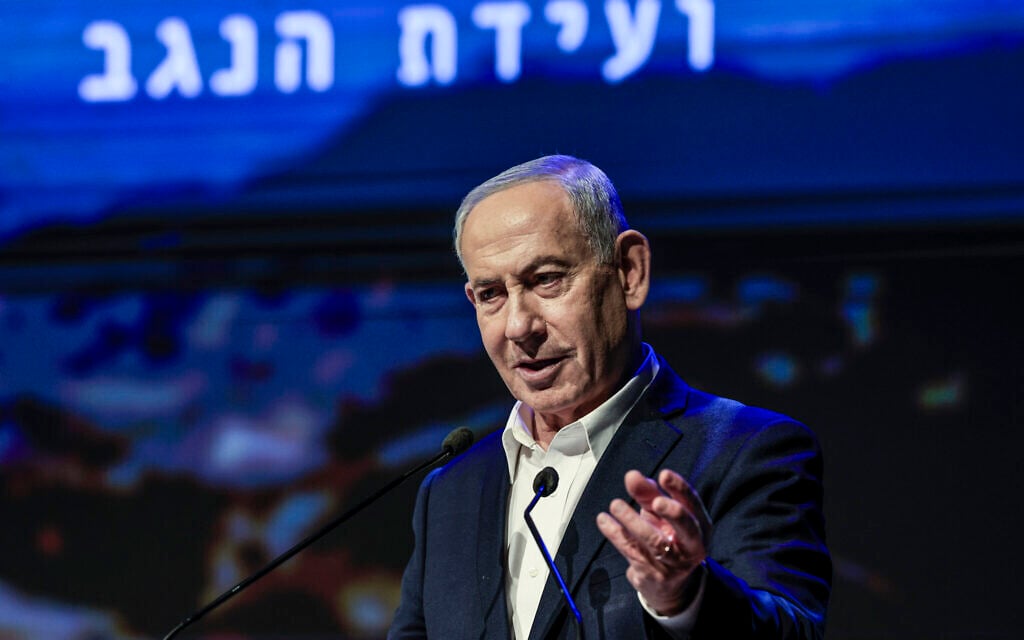
As Iran again targeted US allies across the Middle East, including Israel’s neighbor Jordan, Prime Minister Benjamin Netanyahu warned Tehran on Tuesday that Jerusalem would respond overwhelmingly to a strike on its territory.
“We are prepared for every scenario,” he said at a conference in the Negev city of Dimona.
“I have one message for Iran’s leaders: Do not count on there being calm if you attack us,” he continued. “Do not expect a repeat of what happened before, because there will be no repeat. The previous response was powerful enough, but any further attempt to harm us will be met with a different response — far more powerful.”
Israel struck Iranian petrochemical facilities in southwest Iran on June 8 in response to Iranian missile attacks on Israel, after which a ceasefire was quickly reinstated under US pressure.
“The days when someone can attack us without paying a heavy price are over,” said Netanyahu. “We proved that in confronting Iran’s axis of evil, and we will continue to act decisively against anyone who harms us. That is how we have acted, and that is how we will continue to act.”
Get The Times of Israel's Daily Edition
by email and never miss our top stories
By signing up, you agree to the terms
Iran has so far not made good on its threat last week to target Israel as well if American strikes persist.
The US launched strikes on Iran early in the morning, hours after US President Donald Trump said Washington was “reinstating” a blockade on Iran in the Strait of Hormuz, as the two countries have repeatedly skirmished over the past few days.
Iran responded with attacks targeting Bahrain, Jordan and three ships traveling through the strait, killing one mariner and wounding eight. Two of the vessels were tankers associated with the United Arab Emirates, which threatened to retaliate against Iran, potentially drawing the Gulf nation back into fighting with Tehran.
Hours after the US said it ended its campaign of strikes, the Iranian city of Bushehr on the Persian Gulf was hit in at least four locations, the state-run IRNA news agency reported. It again raised the possibility that Gulf Arab states were attacking Iran in retaliation.
“Four points in the city of Bushehr were hit by enemy projectiles at noon (0830 GMT),” deputy provincial governor Ehsan Jahanian was quoted by official news agency IRNA as saying, blaming the attacks on the United States.
Also, Iranian state television reported that five explosions were heard around the port city of Bandar Abbas, near the Strait of Hormuz.
Explosions were also heard on Iran’s Gulf island of Qeshm, in the strait, the Fars news agency reported.
“In recent days, the Masan area of Qeshm has been attacked several times by the American enemy,” Fars said.
The Qeshm governor’s office said the island was hit by a US projectile, state media reported.
During the evening, Kuwait said it was intercepting projectiles over its airspace.
“The General Staff of the Kuwait Armed Forces announces that any explosions are the result of the Air Defense systems intercepting hostile attacks,” the army said in a statement, also referring to “hostile aerial targets” without further details.
Trump backtracks on Hormuz passage fees
Meanwhile, Trump announced a reversal of plans to charge a 20 percent fee on cargo going through the Strait, saying that Middle Eastern countries will instead make investment and trade deals with the US.
“Based on highly productive conversations with Middle East leadership, I have decided to replace the 20% United States Reimbursement Fee with Trade and Investment Deals that the various Gulf States will be making into the United States,” Trump said on social media.
The president said the investments “will be MASSIVE,” though it was unclear if these would be new commitments relative to what Trump announced after a visit last year to the Middle East.
Trump also claimed oil is “flowing like never before” out of the Strait of Hormuz, thanks to the US military efforts in the region, adding that a blockade of Iranian ports was now in place.
Before Trump announced his reversal on fees, Iranian Foreign Minister Abbas Araghchi wrote on X that Tehran was the guardian of the strait and would remain so “forever,” adding in response to Trump: “20% is of course too much. We will be fair.”
Trump met with Iraq’s new Prime Minister Ali al-Zaidi at the White House. US Secretary of State Marco Rubio was to meet Jordan’s Foreign Minister Ayman Safadi at the State Department. Jordan has come under repeated missile attack by Iran over the past week.
The focus of the conflict now is the strait, through which a fifth of all traded crude oil and natural gas passed in peacetime. Iran effectively shut the passage during the war by attacking and threatening ships — a tactic that proved its greatest strategic advantage. It sent the price of oil, fertilizer and other goods soaring at a time when world leaders were already struggling to address rising costs.
An interim deal signed last month was supposed to reopen the waterway, but Iran has attacked ships moving through the strait on a route overseen by the US military that is outside Tehran’s control.
The two targeted ships, both associated with the UAE, were set ablaze for a time. The Emirati Defense Ministry said the attack on the tankers Mombasa and Al Bahiyah killed one mariner and wounded eight others.
Dutch shipping firm Stolt Tankers said that one of its ships came under attack. The attack on the Stolt Magnesium off Oman sparked a fire in the engine room, but the company said all the mariners were safe.
As the flare-up showed no signs of petering out, the European Union Aviation Safety Agency (EASA) reinstated and toughened its warning to airlines operating in the Middle East, telling them to avoid the airspace of Bahrain, Kuwait, Qatar, the United Arab Emirates and the Gulf of Oman.
Just a week ago, EASA withdrew its previous advisory following a brief easing of regional tensions as a result of last month’s interim ceasefire between Tehran and Washington. That warning had asked airlines to exercise caution when operating within the airspace of these countries, as well as Israel, Jordan, Oman and Saudi Arabia.
The new, more restrictive advisory is valid until July 29.
“The presence of major US military facilities in the region increases the likelihood that the states covered by this Conflict Zone Information Bulletin may be directly exposed to Iranian missile and drone attacks,” EASA said, citing also the risk of misidentification of civil aircraft by US and other air defence systems.
Separately, EASA’s advisory asking airlines not to operate within the airspace of Iran, Iraq and Lebanon was extended last week until the end of August.
Mediation efforts still underway
Regional mediators are still trying to get the United States and Iran back to the negotiating table, according to two regional officials.
The officials, speaking on condition of anonymity to discuss the delicate diplomatic process, said Pakistan-led mediation was working around the clock to reactivate the ceasefire.
Meanwhile, Lebanese and Israeli delegations met in Rome to continue US-mediated negotiations. Shortly after the US and Israel launched the war on February 28, the Lebanese terror group Hezbollah joined the conflict in support of its ally, Iran, and began attacking Israel. Israel responded with a ground invasion of Lebanon.
Last month, Lebanon and Israel announced a “framework agreement” outlining the withdrawal of Israeli forces from southern Lebanon in exchange for the disarmament of Hezbollah. Implementation has stalled.
View original source — Times of Israel ↗
Related stories

BBC
PoliticsJul 14, 2026 · 1 min
Starmer becomes first UK PM to receive top French honour
BBC

The Hill
PoliticsJul 14, 2026 · 1 min
House Democrat shouts at Mullin over shootings: ‘You’re back on the godd— front page now’
The Hill
Indian Express
PoliticsJul 14, 2026 · 1 min
Mere participation in violent protest, sloganeering against Government does not mean sedition: HC
Indian Express

The Hill
PoliticsJul 14, 2026 · 1 min
Green groups sue over Trump rollback of habitat protections for endangered species
The Hill