CNA
IN FOCUS: Have drones become the 'silver bullet' in wars?
SINGAPORE: The controller fits snugly in the palm of a hand. A quick swirl of the joystick and a small drone lifts quietly into the sky.
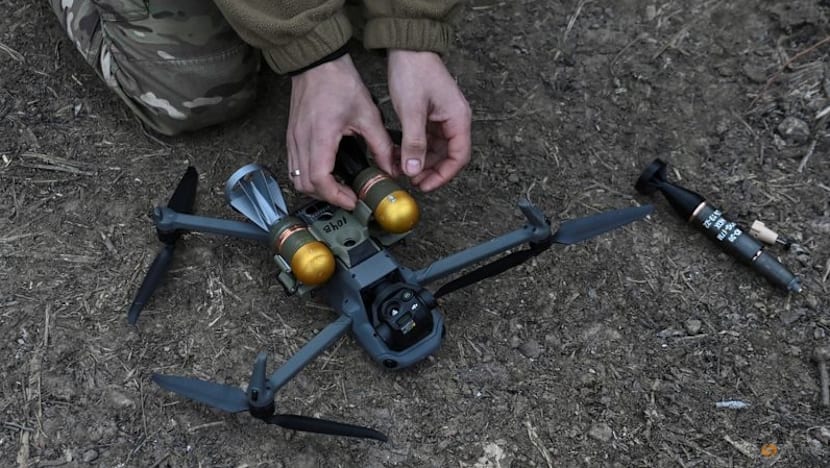
For a hobbyist, it is another afternoon of chasing the perfect aerial shot. But in the hands of a soldier, a drone can become a weapon.
With an explosive strapped to it, a drone costing a fraction of a tank's price can destroy it in moments.
These aircraft, referred to officially as unmanned aerial vehicles (UAVs), have increasingly become the frontline of modern battlefields.
"Militaries are looking for the silver bullet," said associate research fellow at the S Rajaratnam School of International Studies (RSIS) Thomas Lim.
"Every time a new form of technology comes forward, you want to think about how we can resolve the threat. If it's a potential threat to me, I need to make sure I have the solution to it when the time comes.
"In that larger picture, militaries are already clear on how they can keep up – speeding up your acquisition processes, trying to stay with the curve … or find the solution that allows you to stay constantly ahead of the curve.”
From the battlefields of Ukraine to the Middle East, recent conflicts have shown that drones are a core component in the military toolbox.
For starters, militaries should invest in drones, defence experts said. Whether they risk falling behind by not doing so, however, depends on what the respective states are trying to achieve.
"In terms of strike capabilities, for example, if a state wants to acquire those capabilities, but perhaps lacks the budget or the resources to invest in high-end fixed-wing aircraft or missile platforms, then drones might actually provide a viable alternative," said Dr Ian Li Huiyuan, a research fellow at RSIS.
"Of course, the state will need to be cognisant of the limitations in its capabilities, but at least you will have something, as opposed to not having something."
The adversaries also matter.
"Why does Iran, for example, focus on cheap drones? I think the main reason is that its adversaries or its main competitors, like the US and Israel, have access to very high-end technological capabilities, which they will not be able to match if they were to go like-for-like," Dr Li added.
"So they need to find some way to kind of close the gap between them, and I think drones provide the option for them to do so."
Drones have proven that they can deliver tactical results. But can these unmanned aircraft single-handedly determine the outcome of wars?
RECENT WARS
As drones transform battlefields, militaries around the world are readjusting their priorities.
The United Kingdom unveiled its Defence Investment Plan in late June, announcing its "largest ever drone investment".
More than £5 billion (US$6.7 billion) will be set aside over the next four years to build drone capabilities across Britain's armed forces.
“As the conflicts in Iran and Ukraine show, drones are rapidly reshaping warfare, with cheap systems destroying high-value targets and innovation cycles measured in weeks, not years,” said the UK’s defence ministry.
The British navy’s ageing warships will not be replaced, while new “hybrid” vessels equipped to deploy drones will be built.
South Korea plans to acquire 20,000 military drones to fend off North Korean threats, similarly citing lessons learnt from wars in Ukraine and the Middle East.
Calling drones "game changers on the battlefield", South Korean Defence Minister Ahn Gyu-back said the drones would include short-range reconnaissance drones and small attack drones, known as loitering munitions.
The Russia-Ukraine war has spurred a new era for drones, showcasing their battlefield advantages.
In recent weeks, Ukraine has launched drone strikes on Russian oil refineries and tankers. An attack on Jun 18 evaded Russian air defences and struck deep inside enemy territory.
Ukraine has also used advanced quadcopter drones to drop grenades into Russian tank hatches, as well as "dragon drones" to spew thermite over forested areas, presumably concealing Russian units.
Thermite is a mixture made from powdered metal, most often aluminium, and iron oxide or rust, and generates heat at extreme temperatures, reportedly more than 2,200 degrees Celsius.
The drone war has also reportedly hit the seas, with Ukraine claiming its seaborne drone shot down a Russian fighter jet.
Russia responded by expanding its own domestic drone manufacturing base, Ukrainian-American freelance journalist David Kirichenko wrote in a piece for American think-tank the Atlantic Council.
It deployed fibre-optic drones, which are controlled by a wire connected directly to the operator, making them immune to jamming technologies.
Russian commanders started using these drones in large quantities in late 2024, and they have been used to disrupt Ukrainian supply lines, wrote Mr Kirichenko.
It was also widely reported that Hamas adapted drone tactics from the Russia-Ukraine war in its own war with Israel.
The Palestinian militant group used small drones equipped with improvised explosive devices on communications towers close to the Gaza border and on Israel's observation posts in its Oct 7, 2023 attack that killed hundreds.
It also managed to damage advanced systems, some costing millions, and paralyse infrastructure that prevented communication between troops.
Some videos showed Hamas using commercial drones that had been modified to transport weapons to hit Israel’s Merkava 4 tank.
Global news organisation Al Jazeera's Sanad verification agency found that the Israeli military had similarly retrofitted commercial drones to bomb hospitals and shelters.
Drones were also prevalent in the Cambodia-Thailand clash; Cambodia reportedly used fibre-optic drones against Thailand while the latter set up an unmanned aerial system centre and battalion to control and integrate the army's drone operations.
In the ongoing Middle East war, Iran unleashed hundreds of Shahed drones – low-cost, one-way attack drones – to overwhelm air defence systems.
The US also used drones – modelled after Iranian designs – in its attacks.
THE DEAL WITH DRONES
The advantages of drones are hard to ignore - they are cheaper than conventional weapons and can be more precise.
Low-cost first-person view (FPV) and commercial drones can be deployed en masse for frontline and strike operations.
With cameras and munitions, FPV drones can guide operators to remote areas, identify targets and drop the payloads directly while providing real-time video feeds.
Some drones can loiter over an area for hours, gathering intelligence. Their expendable nature also allows militaries to undertake dangerous missions without putting their soldiers at risk.
For countries like Ukraine, cheap and potentially plentiful drones are an attractive option to compensate for their adversaries' greater resources, manpower, firepower and funding, Mr Kirichenko noted in his analysis.
However, drones cannot replace missiles entirely and there are constraints on what they can do, RSIS' Dr Li said.
They are typically smaller, which means their payloads and the amount of fuel they can carry are limited.
"Of course, you can say we buy more drones, but it's still quite a different proposition. So, it's not really about replacing apples with a new kind of apple; it's really about apples and oranges, and what suits your palate at that point in time," he said.
SINGAPORE'S DRONE STRATEGY
Military drones are not new to the Singapore Armed Forces (SAF). The SAF first employed UAVs in their nascent form as early as 1979 and has vastly expanded its capabilities since.
The landscape has evolved with the rise of cheap-asymmetric drones and the use of drone swarms for intelligence, surveillance, and reconnaissance (ISR) missions that allow a single operator to control many of these assets.
Defence Minister Chan Chun Sing said during his ministry's budget speech this year that the SAF will develop a "high-low" mix of capabilities to complement high-end conventional systems with cheap, dual-use systems available in the commercial market, especially in the drone and digital areas.
"We will also be focusing our efforts to integrate both manned and unmanned operations as a system. As to the mix between manned and unmanned, that will be a dynamic equilibrium determined by the rate of technology progress," he said.
During a biennial exercise in the US last year, the SAF had trialled three types of commercially available drones, namely the Skydio X10, the Ascent Spirit and the Neros Archer.
In addition, the Republic of Singapore Air Force (RSAF) has acquired the Hermes 900, which is equipped to conduct persistent operations. These are continuous, long-duration missions without returning to base.
It also has the Hermes 450, which has a communication system that can transfer imagery in real time.
The Heron 1 UAV helps to improve awareness and mission effectiveness, while the Orbiter 4 Close-Range UAV can operate within a wide range of environments, including urbanised and confined areas, to support counter-terrorism and peacetime operations.
The Republic of Singapore Navy (RSN) has equipped its Littoral Mission Vessels with the locally designed Veloce 60 UAV, built for long-range maritime and land-based ISR missions.
This is in addition to the ScanEagle UAV installed on the Navy's Victory-class missile corvettes, which acts as a fast-moving lookout for threat situations.
The Singapore Army uses the Veloce 15 for close-range urban operations and reconnaissance.
Recruits in Basic Military Training are learning how to fly and counter drones, Mr Chan announced last year.
The first cohort to receive drone training, comprising more than 3,000 servicemen, enlisted in July last year and passed out in September.
Various army units in last year's Exercise Wallaby – the SAF’s largest overseas unilateral exercise – had the opportunity to conduct missions and air-land integrated live firing supported by UAVs.
Defence experts noted the SAF's efforts to incorporate drones holistically throughout the entire force rather than limiting the technology to a specific service.
While this shows that the SAF recognises what drones can deliver on the battlefield, this needs to transition to reliably deploying the devices to achieve results through training and military exercises, both local and overseas, said RSIS’ Mr Lim.
The Singapore military is also faced with different vulnerabilities, including a projected one-third reduction in manpower by 2030 due to declining birth rates.
"The SAF always talks about, for instance, technology as a force multiplier. But that idea of technology as a force multiplier …. at this point in time, with the limits in the technology, you can only go that far. You're still going to need human operators at least at this point," added Mr Lim.
"So the SAF is forced to confront this new reality, alongside the kind of limitations that we've had in the past, to rethink our force structures, our warfighting doctrines, and the way we approach newer technological developments like these."
DRONES VERSUS TRADITIONAL WEAPONS
With drones taking centre stage in recent conflicts, it is natural to wonder if countries should buy drones and only drones. But defence experts cautioned against doing so.
Some militaries are developing larger UAVs that can fly far and carry payloads, in a similar class to strike assets.
"But we are not at a point where we can say that drones can replace everything that a manned force can currently do," said RSIS' Mr Lim.
"By doing that, you are also somewhat removing the human directly from – not really out of the loop – but from the frontline of that loop of decision-making, which could complicate procedures when it comes to who takes responsibility for those strikes."
He added: "There's always a human element to war or to battlefields … War is a clash of wills; when we talk about wills, we talk about it often in the human setting.
"It seems a bit scary to leave the personal political objectives purely in the hands of machines. I think that would be my own quiet fear of this, I don't want to say dystopian, but almost dystopian scenario."
Rather than just buying drones, what is more important is investing in innovation and development and production capacity, said Professor of International Security Stefan Wolff from the University of Birmingham.
"The innovation cycle in drones and counter-drones capabilities is very quick; so, if you buy lots of drones today, you are probably spending (wasting) a lot of money on drones that will have become obsolete by the time you need them on the battlefield," he said.
Prof Wolff is the co-founder of Navigating the Vortex, which aims to provide intelligence across topics such as geopolitics, governance and technology, among others.
Listen:
Military technologies seldom retain an uncontested edge for prolonged periods, as former Hungarian Special Forces Lieutenant Colonel Sandor Fabian puts in his analysis for the Modern War Institute at the US military academy West Point.
It is a national resource that studies recent and ongoing conflicts to prepare present and future leaders.
"Every offensive innovation soon generated defensive adaptation," said Dr Fabian. Electronic warfare has rapidly expanded to counter drones, with jamming and signal interception becoming part of military operations.
"Improvements in drone autonomy are being matched by advances in electromagnetic warfare, air defence, passive detection systems, deception, and technologies to counter unmanned aircraft.
"This dynamic should temper predictions that drones will dominate future battlefields indefinitely. Their effectiveness will not only depend on innovation in drone technology but also on the pace of defensive adaptation," he said.
Besides, traditional assets still possess strengths drones have yet to match – especially in terms of firepower.
Drones are smaller and cannot carry large warheads. Aerial drones are also not as robust or reliable compared with manned platforms, as their use depends on conditions such as weather, said Dr Li from RSIS.
"If the weather is bad, in fact, drones are not very effective at all," he said.
"If you look at the Ukraine war, currently, in terms of success rates of drones hitting the targets, I think it's about 40 per cent, so that's not actually very reliable.
“If you were to factor in drones that can't even take off because of all these kinds of (weather) conditions, some studies show it drops to about 30 per cent."
Manned platforms are tried and tested. "They are more reliable tools in most situations, in terms of at least delivering the effect," said Dr Li.
The ideal approach would be to combine traditional assets with drones, to complement each other's strengths and offset limitations.
"Drones do not seize cities. They do not secure supply routes or hold defensive lines. They do not evacuate civilians, repair infrastructure, or enforce political control," Dr Fabian said in his analysis.
"This is why the most effective militaries do not treat drones as a replacement capability; rather, they treat them as an extension of combined arms manoeuvre warfare."
Agreeing, Dr Li said manned platforms are useful when operating at higher altitudes where conditions are more restrictive.
But they are not as effective at lower altitudes where they become more susceptible to ground fire – that is where drones come in.
"There's no really one answer to everything … the way moving forward is really to have a variety of options, so to have more tools in your toolbox."
LOOMING ARMS RACE?
Reports from this year indicate that Ukraine has fielded new drones equipped with artificial intelligence, known as the Hornet, in its ongoing fight against Russia.
These drones use AI to analyse live video feeds and strike Russian targets with a built-in warhead.
Analysts likewise are predicting that future drones will be faster, smarter, more autonomous and more lethal.
The best way to keep up with the pace at which drones are evolving is to observe ongoing conflicts and consult militaries that are at the forefront of drone use, said RSIS' Dr Li.
But what also matters is whether militaries are adaptive enough to incorporate drones. "Because this requires, in some cases, fundamental transformation of how things are being done," he said.
"Sometimes, I think the limitation is not so much whether we know or we can learn fast enough about what drones can do, but it's really - unfortunately - things like red tape, the bureaucracy, fixed practices in terms of what kind of assets we purchase.
"It's one thing to learn, but I think the organisation itself must be prepared to be more adaptive to these kinds of changes, and to really be willing to incorporate these things, and that will require more than just learning about what drones can do."
Mr Lim from RSIS added that acquisition processes are changing rapidly because of how quickly drones develop.
But he does not see this leading to an arms race. Drones are not a new technology; they are just now in the spotlight because of the results they have achieved on the battlefield.
"Militaries sometimes get very enthralled with the developments of the latest trends … You try to keep up with the technology, you end up going too quickly,” said Mr Lim.
“And you look back and you realise, did I end up wasting resources on something that I could have invested elsewhere?
"How fast do I need to go to ensure that I'm not behind, but not too far ahead, right? This is very critical, especially for militaries with less room for error.
"It's just tough for militaries to position themselves to fight the battles today, while being ready for whatever comes tomorrow. Trying to identify and maintain that perfect position is something that I think … (military) planners today are continuously struggling with on a daily basis."
Source: CNA/ng(mi)
Related stories

TechRadar
TechnologyJul 14, 2026 · 1 min
This sleek Japanese power strip finally fixes your office desk's ugliest pain point
TechRadar

Times of Israel
TechnologyJul 14, 2026 · 1 min
Top Democrat in US House says he won’t support bill to cut off US aid to Israel
Times of Israel

TASS
TechnologyJul 14, 2026 · 1 min
Air defenses down 340 drones heading for Moscow Region in 24 hours — authorities
TASS

TechCrunch
TechnologyJul 14, 2026 · 1 min
Lorde says AI glasses are “not sexy”
TechCrunch