Mexico News Daily
Made in Mexico and the US: 250 years of a bilateral relationship
This year, the United States of America turned 250. This piece isn’t about the fireworks over the National Mall, the commemorative coins or the flotillas of tall ships — that’s already been covered amply elsewhere. What I want to consider is what those 250 years of American history look like from south of the border, for the simple reason that this is the anniversary of the country that has, in many ways, shaped what Mexico is.
This isn’t so different from what we do when we raise a toast at a friend’s or a loved one’s birthday: you tell their story through what you’ve lived together. Mexico and the United States are two nations bound by an extraordinarily complicated shared history — you cannot toast a neighbor’s 250th without also telling the story of the land that changed hands, and the family members who ended up on opposite sides of it without ever moving. That story is 250 years of proximity, collaboration, a shared economy, resentment at times and, more recently, an entanglement so deep that neither country can fully separate its fate from the other’s.
An asymmetry baked in from the start
The U.S. declared independence in 1776. Mexico would not exist as a sovereign nation for another 45 years. That head start — institutional, territorial and demographic — is the foundational fact of the entire relationship, and it never really went away. As historians Marcela Terrazas, Gerardo Gurza, Paolo Riguzzi and Patricia de los Ríos argue in their sweeping account of two centuries of bilateral relations, no single country has done more to shape Mexico’s face than its northern neighbor — and, they add, no single country has shaped the United States quite the way Mexico has, either. It is a two-way influence, but never a two-way power.
By the time Mexico won its independence from Spain in 1821, the U.S. was already a functioning republic with expansionist ambitions clearly in view. Mexico spent its first decades of nationhood consumed by internal conflict, foreign debt and the near-constant threat of losing more territory. The two nations were never starting from the same place, and the 19th century made sure that gap would only widen.
The founding wound: 1846-1848
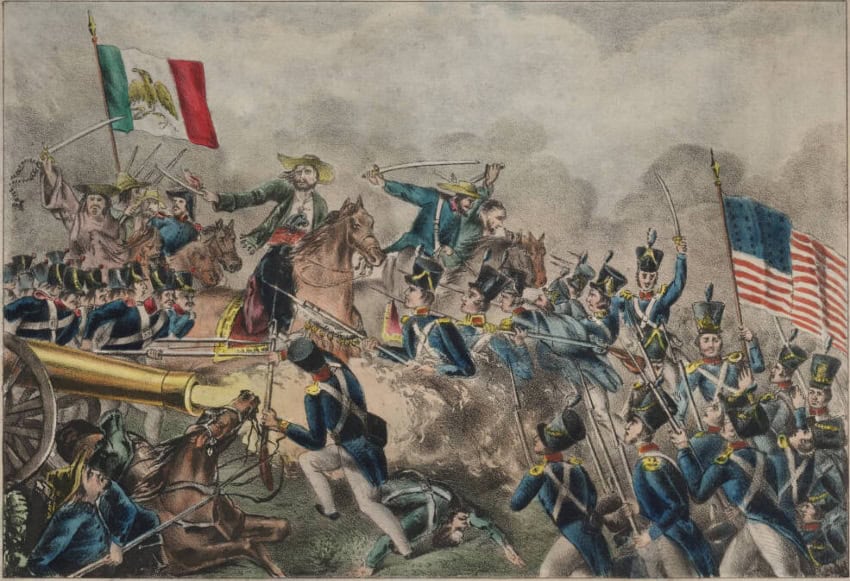
If there is one chapter of this relationship that the commemorative columns circulating this July have carefully avoided, it’s this one. The Mexican-American War ended with the Treaty of Guadalupe Hidalgo in 1848, under which Mexico ceded roughly 55% of its national territory — what is now California, Nevada, Utah, most of Arizona and New Mexico, and parts of Colorado, Wyoming and Texas.
Albert Camarillo, a Stanford historian specializing in Mexican American history, has pointed out something that rarely makes it into Fourth of July retrospectives: tens of thousands of Mexicans became part of the United States without ever crossing a border. The border crossed them. Overnight, longtime residents of what had been northern Mexico were told they had a year to decide whether to leave or accept citizenship under a new set of laws — laws that, in practice, did little to stop Anglo settlers from seizing land from Mexican families still nursing the wounds of a war they’d just lost.
Camarillo’s broader point, made in recent interviews tied to the anniversary, is that this omission isn’t necessarily deliberate malice — it’s the residue of Manifest Destiny, the doctrine popularized by John L. O’Sullivan holding that U.S. expansion across the continent was divinely ordained. Under that framing, what existed on the other side of an advancing frontier simply didn’t matter. That framing, Camarillo argues, still shapes how the country tells its own origin story today. It’s hard to disagree when you notice how rarely this war appears in the flood of 250th-anniversary retrospectives — American or Mexican.
Investment, intervention and distrust: From the Porfiriato to the Mexican Revolution
The late 19th century brought a different kind of asymmetry: economic rather than territorial. Under Porfirio Díaz, American capital poured into Mexican railroads, mining and oil, embedding a dependency that would outlast the dictatorship itself. When revolution broke out in 1910, Washington did not stay neutral for long. In 1914, U.S. Marines occupied the port of Veracruz, ostensibly over an arms-delivery dispute, in reality asserting the kind of leverage a much larger power reserves for a much smaller one. The pattern that would define the next century was already visible: economic dependency, punctuated by direct intervention whenever Washington judged its interests were at stake.
When the relationship became human: 1942-1986
If the 19th century was about land, the mid-20th century was about labor — and it’s here that the story stops being about loss. In 1942, Franklin D. Roosevelt launched the Bracero Program, formalizing decades of informal labor migration and bringing millions of Mexican workers into American fields and railroads during wartime labor shortages. In 1986, Ronald Reagan signed an amnesty that regularized the status of roughly 3 million people, the vast majority of Mexican origin — a single stroke of policy that reshaped the lives of entire extended families on both sides of the border.
These decades produced the counterweight to everything the 19th century took away: a human relationship that no treaty fully anticipated. Today, roughly 26 million Mexican Americans hold dual nationality, U.S.-born but entitled to claim Mexico as their own. Add another 8 million Mexican-born residents living in the United States, and you get a demographic reality no government on either side can legislate around: millions of families who belong, fully and without contradiction, to both nations. If the war of 1848 was the wound, this is the scar tissue — not painless, but binding.
Economic integration, formalized: From NAFTA to the USMCA
By the 1990s, the relationship’s center of gravity had shifted again, this time toward formal economic integration. NAFTA in 1994, followed by its 2020 successor, the USMCA, tied the two economies together. The numbers today tell the story better than any treaty language: Mexican exports to the United States hit a record $54.18 billion in May alone, a 17.5% year-over-year jump. That is not a trading relationship anymore. It’s a shared circulatory system — and it is precisely why any disruption to it now carries consequences neither government can afford to treat lightly.
The present: tariffs, extraditions and a treaty under review
Which brings us to the summer of this 250th anniversary, when the pattern that has defined this relationship since 1848 is once again on full display — just dressed in 21st-century language. President Claudia Sheinbaum has spent recent weeks insisting the USMCA is not at risk, confirming Mexico has already signed on to extend the treaty for another 16 years, while Washington has refused to endorse an automatic extension, forcing the region to undergo yearly reviews. Steel and aluminum tariffs sit at 50% for Mexican producers, with U.S. trade officials signaling — but not confirming — that adjustments might be coming.
Meanwhile, the security side of the relationship has moved at its own accelerated pace: Mexico has transferred 92 people wanted by U.S. authorities to American custody in under a year, a rate of extraditions with few precedents. But security, like trade, has never been a problem either country can solve unilaterally on its own side of the line. The same asymmetry that shapes tariffs and treaties shows up here too — Washington has been far quicker to demand cooperation on cartels and fentanyl than to confront the flow of American guns south or the demand that sustains the drug trade in the first place. If the last 250 years have taught both countries anything, it’s that neither the border nor what crosses it belongs to just one country.
250 years later, still not equals — but no longer separable
For 250 years, the United States and Mexico have never related to each other as equals. Not in 1846, not in 1914, not in the tariff negotiations happening in Washington conference rooms.
But somewhere between the war that took half our territory and the 26 million people who now hold both nations’ passports without contradiction, the relationship stopped being one a treaty could fully contain. We are not just neighbors who share a border. We are, whether either government finds it convenient or not, a single, unevenly stitched-together community that no longer has the option of imagining its future separately. That is the real anniversary worth marking — not because it is comfortable, but because it is true.
Maria Meléndez writes for Mexico News Daily in Mexico City.
View original source — Mexico News Daily ↗
Related stories

The Punch
PoliticsJul 15, 2026 · 1 min
2027 race: INEC recognises Atiku, 470 ADC candidates
The Punch
The Punch
PoliticsJul 15, 2026 · 1 min
Reps dump own state police bill, adopt Tinubu’s version
The Punch
The Punch
PoliticsJul 15, 2026 · 1 min
2027: APC confident of victory, opposition divided over strategy
The Punch
The Punch
PoliticsJul 15, 2026 · 1 min
Akpabio challenges critics to study N’Assembly laws
The Punch