Indian Express
‘400% land compensation or monthly rent’: Morbi farmers take out padayatra
At least 365 village panchayats opposed a July 4 notification of the state government on land compensation even as hundreds of farmers took out a ‘padayatra’ to the district collector’s office, in Morbi on Tuesday.
Their banners read in English, Hindi and Gujarati and stated that the circular ‘favoured’ a company and was not acceptable to them. They termed the Government Resolution (GR) issued on July 4 by the Energy and Petrochemicals Department on compensation to farmers for transmission towers and cables on their land as ‘invalid’ and ‘unacceptable’.
On Tuesday, a seemingly equal number of men and women from more than 300 villages of Morbi district and 50 villages in 12 other districts of Gujarat took part in the 3.5-km-long foot march, which was flagged off at Mahendranagar Chokdi and culminated at the collector’s office.
Farmers and sarpanches from 12 districts, including Ahmedabad, Gandhinagar and Vadodara, extended support to the ‘padyatra’ in a meeting on July 9, when discussions on how to conduct the agitation and suggestions received to decide the strategy forward were held.
Farmers’ committees are likely to be formed at the district, taluka and gram panchayat levels to plan out the agitation further.
The farmers in Morbi’s Jetpar are protesting the installation of a756 kV Double-circuit line by ‘Halvad Transmission Limited’ — a special purpose vehicle of Adani Energy Solutions Ltd (AESL) — on a stretch of 246 km from Khavda in Kutch to Halvad in Morbi.
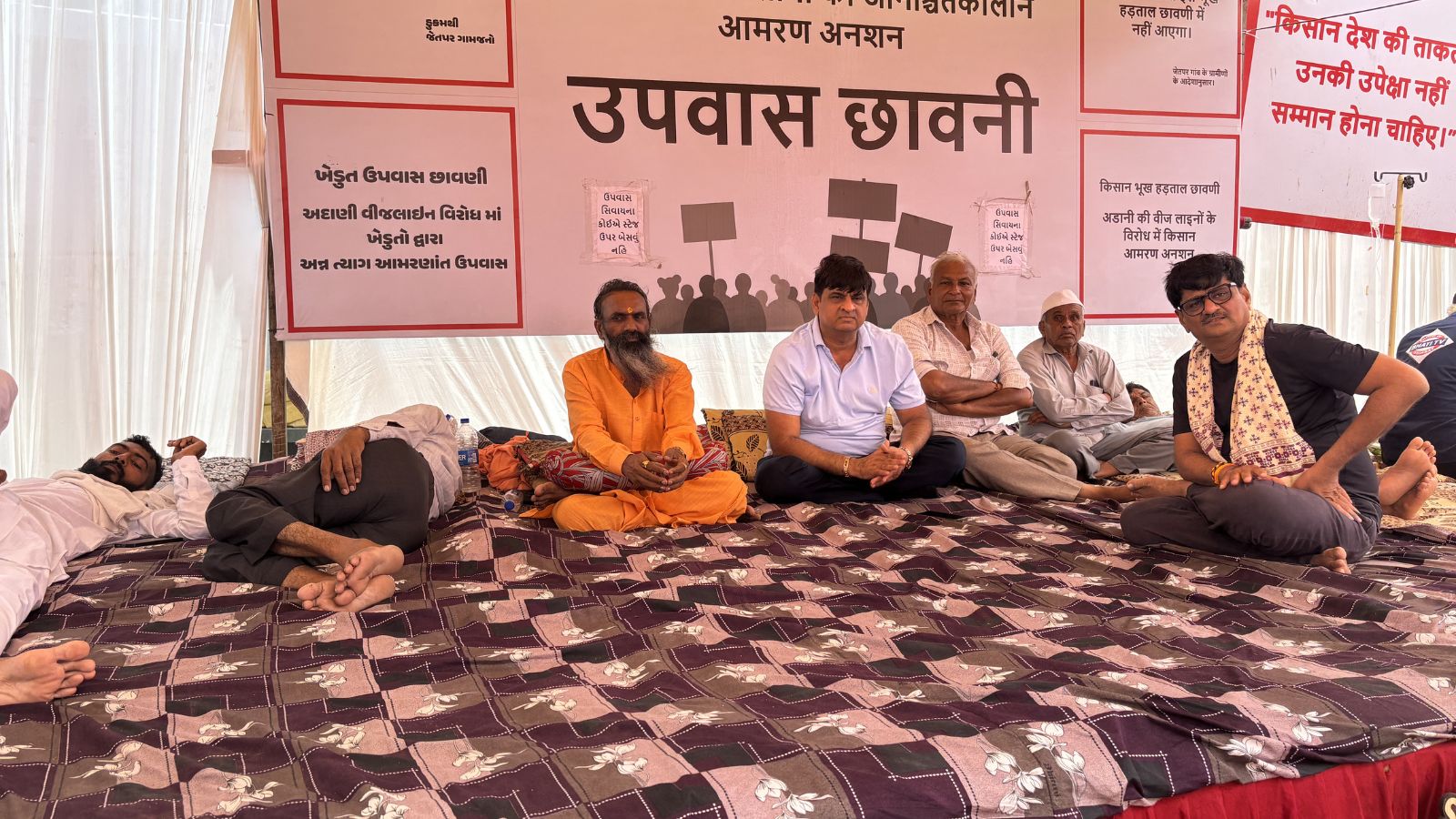
‘Unhappy’ with the state government, they had previously called off their indefinite hunger strike in Jetpar, but announced ‘satyagrah’ as ‘part-3’ of their protest.
Story continues below this ad
Demanding “minimum loss and full compensation for the loss” in accordance with the mandatory provision of Section 10(d) of the Telegraph Act, the farmers, in their representation to the district collector, stated, “We humbly request that the amendments suggested be adopted…. Until the amendments suggested by the Gujarat Khedut Chhavni are implemented…resolution will be not implemented.”
The farmers demanded 400 per cent compensation for the installation of transmission tower or structure in the tower-based area, which must be assessed at the market value as determined by the Market Rate Committee (MRC) in case of strong electromagnetic field.
Further, for the Right of Way (RoW), against the three categories for rural, semi urban and urban areas, the farmers sought 260 per cent of the market price in rural, nagarpalika and municipal corporation areas. They cited that the market price in gram panchayat, nagarpalika, and municipal corporation limits should be determined with the area in view so that the compensation cannot be fixed at a lower slab.
Alternatively, they suggested monthly rent for both the tower and the corridor, the cost of which
Story continues below this ad
would be determined by the district collector after listening to the farmers’ grievances.
“The transmission company will be liable to pay for damages to land/crops/fruit trees not once but every time the damages are caused. The transmission company shall compulsorily obtain accident insurance, medical claims for the benefit of the farmers…” the letter stated.
If the transmission company has installed the transmission line for 25 years, the line must be removed at the expense of the transmission company after the period; the transmission company will be legally responsible for any loss caused to the farmer due to the removal, it said.
The July 4 Government Resolution (GR) stated that against the previous compensation of double the ‘jantri’ or circle rate (200 per cent) for laying of transmission towers and cables in their farmland, farmers would be paid double the current market price of the land.
Story continues below this ad
The final market price will be determined by the Market Rate Committee (MRC) based on the ‘reference market rate’ as well as a ‘lottery system’, it stated.
The appointed evaluators must submit their independent evaluation reports in a sealed cover directly to the district collector within 21 days of their appointment by the Committee. After receiving all three reports, two reports will be opened by the district collector by randomly selecting them through a ‘lottery system’.
For the valuation of the land, the committee will appoint land valuers who are empanelled by the Insolvency and Bankruptcy Board of India (IBBI), ‘desirable’ that these valuers should be primarily state valuers. Three valuers (one by the landowners’ representative, one by the TSP and one by the district collector) will be appointed on the day of the committee meeting itself.
The appointed evaluators must submit their independent evaluation reports in a sealed cover directly to the collector within 21 days of their appointment. After receiving all three reports, two reports will be opened by the collector by randomly selecting them through a ‘lottery system’, the guidelines said.
Story continues below this ad
The ‘method’ laid down for determining the ‘Reference Market Rate’ (which has been incorporated for the first time since the state government has adopted formation Market Rate Committee) states that if the difference in the market rates determined by the two selected valuers is less than 20 per cent of the lower value, the average value of both the valuations will be considered as the reference market rate.
In the second case, if the difference between the two is more than 20 per cent, the reference market rate can be fixed at 10 per cent more than the lower valuation. “Only if this is not acceptable, the sealed report of the third valuer shall be opened and the reference market rate shall be finalised by taking the average of the two lowest valuations,” the guidelines states.
View original source — Indian Express ↗
Related stories

The Punch
WorldJul 15, 2026 · 1 min
NCC consults stakeholders on free educational internet access
The Punch
The Punch
WorldJul 15, 2026 · 1 min
FG inaugurates advisory committee to deepen economic reforms
The Punch
The Punch
WorldJul 15, 2026 · 1 min
Ekiti recruits teachers to fill primary school vacancies
The Punch
The Punch
WorldJul 15, 2026 · 1 min
NDDC pledges procurement compliance
The Punch