Times of Israel
Tova Saul, the cat rescuer of Jerusalem
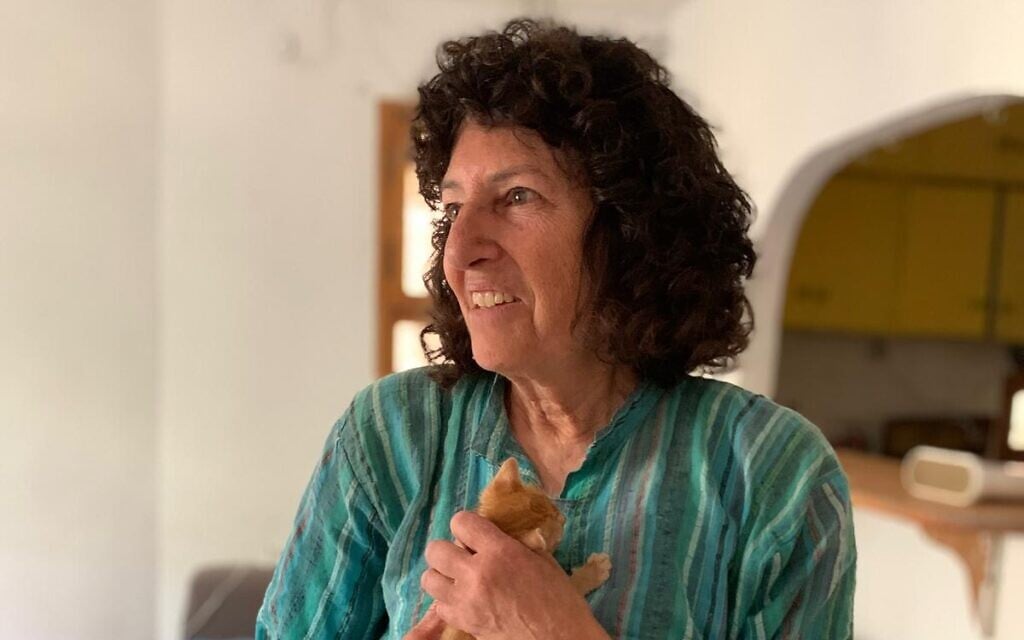
Two tiny kittens — one the color of marmalade and the other the color of soot — sprawl across Tova Saul’s lap. A black-and-white cat watches from a windowsill.
An injured feline recuperates inside a large cage near the wall. Yet another snoozes on a chair, completely unconcerned with visitors.
“I’ll tell you about the kittens,” Saul says while the little orange fellow tries to climb up her shoulder and the grey one bats at her sleeve.
From her apartment in Jerusalem’s Jewish Quarter, she fields calls about injured cats, abandoned kittens, trapped animals and wildlife in distress. Over the years, she estimates she has helped well over 1,000 orphaned kittens and injured cats.
The work continues almost daily.
A few days before we spoke in her Old City apartment, Saul was preparing for a quiet evening at home when her phone rang around 9 p.m.
The caller told her that two kittens had been found abandoned in a garbage bin in Beitar Illit, a Haredi city southwest of Jerusalem.
So Saul got in her car and drove.
“I’ve been rescuing animals for about 40 years in Israel,” Saul says. “I have never in my life heard such screaming from kittens.”
Today, those same kittens were quite content on Saul’s lap.
Originally from Philadelphia, Saul immigrated to Israel more than four decades ago. She says caring for vulnerable animals has been part of her life for as long as she can remember.
One of her earliest memories involves a kitten her mother found abandoned on the street. Someone had painted a white stripe down its back to make it resemble a skunk.
“She brought it to a veterinarian, paid the bill, brought it home, and we adopted it,” Saul says. “That became our cat, Blackie.”
WATCH this week’s Peoples of Israel here:
Saul also remembers finding a stray dog as a child and running home to ask permission to keep him. Her mother was upstairs taking a bath.
“I yelled through the screen door, ‘Mother!’” Saul recalls. “She yelled back, ‘What?’ I said, ‘Can we have a dog?’ And she said, ‘Okay!’”
Saul believes that early experience shaped her understanding of responsibility toward animals.
Sometimes, her rescue operations become a community event.
Several years ago, a kitten became trapped inside a drainage pipe running down the side of a building along the Via Dolorosa in the Muslim Quarter of Jerusalem’s Old City.
By the time Saul arrived, a crowd had gathered.
“There must have been 10 different Arabs working together trying to get that kitten out,” she recalls.
Residents, tourists and Muslim, Christian and Jewish religious leaders stopped to watch as rescuers worked to free the animal.
When the kitten finally emerged from the bottom of the pipe, the crowd applauded.
“There was a nun standing there, tourists standing there,” Saul says. “And when the kitten finally came out, everyone was clapping.”
The kitten survived and was later adopted.
Stories like that have repeated themselves throughout Saul’s decades of rescue work. Her home often serves as a temporary refuge for animals awaiting treatment, recovery, or adoption. She also works as a tour guide and runs an Airbnb in her building.
When asked what continues to inspire her, Saul pauses.
“I’ve often wondered about that,” she says.
Then she offers a comparison.
“I watch people dancing all the time,” she says. “How do they move their bodies like that? It has to be genetic.”
Perhaps, she suggests, compassion for animals works the same way.
For now, the rescued animals continue arriving.
As Saul speaks, one kitten curls up in her lap while another climbs onto her shoulder. Around them, the apartment remains busy with the quiet work of recovery.
“What I don’t understand is how people can walk past a suffering animal and do nothing,” Saul says. “How can one not help?”
View original source — Times of Israel ↗
Related stories

The Punch
WorldJul 15, 2026 · 1 min
FG offers land to investors for mass housing projects
The Punch
The Punch
WorldJul 15, 2026 · 1 min
Fulham close in on Nwaiwu
The Punch
The Punch
WorldJul 15, 2026 · 1 min
Amusan secures 2026 Diamond League final spot
The Punch
The Punch
WorldJul 15, 2026 · 1 min
Braga snaps up Inter Lagos teen
The Punch