Indian Express
FIFA World Cup 2026: Spain consign France to death by disruption
The cruellest punishment Spain imposed on France was not that they upended them and progressed to the final; or that they reduced them to futile escape artistes in an airless glass box, or that they imprisoned France’s vaunted forward-line in a grid-iron cage, but that they pushed them to utter hopelessness, that they sucked the fight out of them, that they infused an irrevocable sense of fatalism into a group smattered with high-class football artistes, a bunch that features the most expensive footballer, the Ballon D’or and Champions League winners.
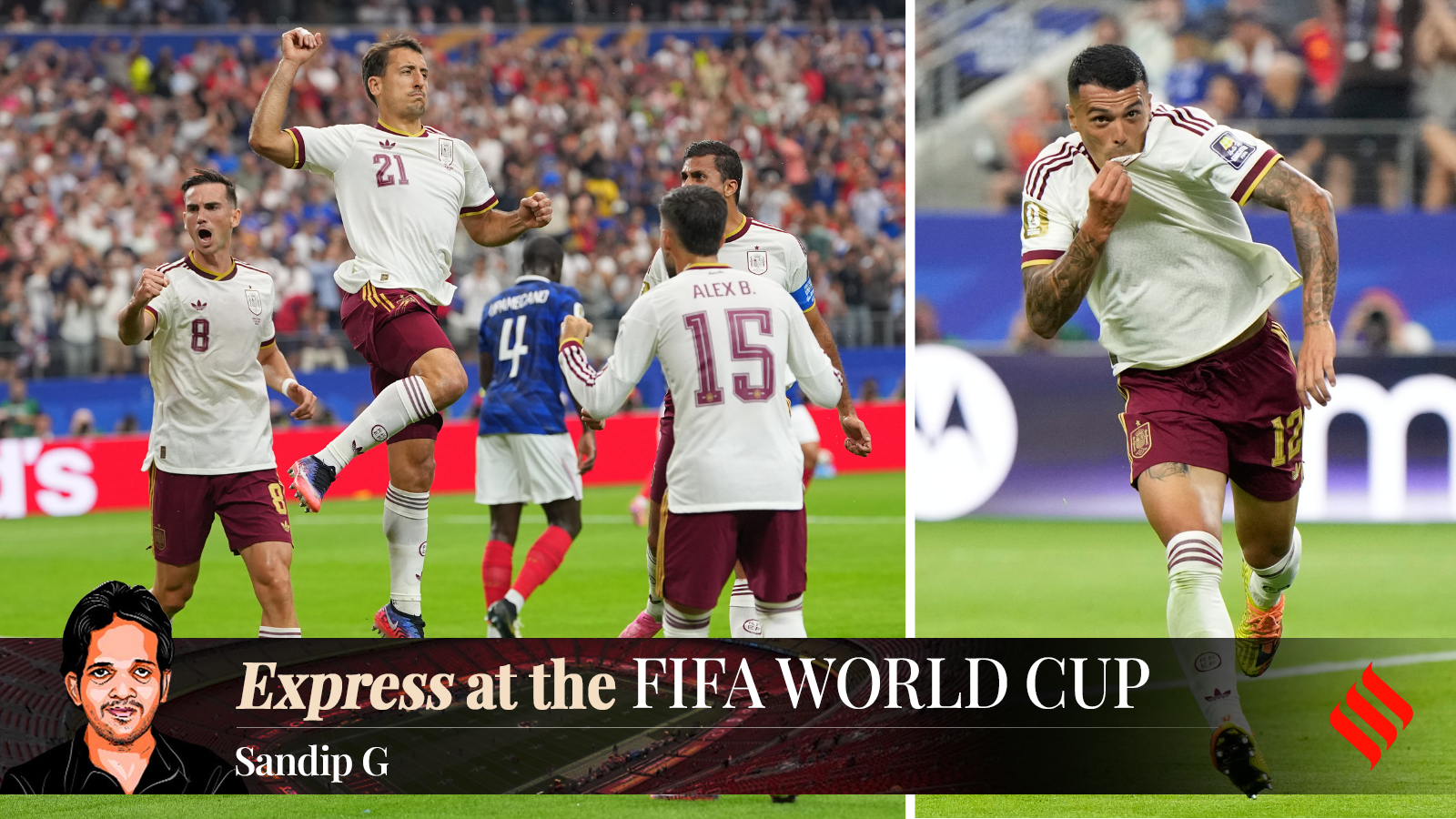
The match, a 2-0 victory achieved through the goals of Mikel Oyarzabal and Pedro Porro, wouldn’t be remembered for its electrifying thrills, not every game should be a see-sawing rope-a-dope boxing bout, or its riveting drama or suspense, but for the tactical coup, for the flawless technical showmanship. It’s place is not so much among the World Cup classics album as it would be in a football academy’s tutorial video or textbook. It was a treatise on subduing a buzzing, smolderingly offensive team without resorting to cynical defending or unholy dark arts, a demonstration on taunting authority that makes Spain an unassailable force.
AS IT HAPPENED | SPAIN VS FRANCE FIFA WORLD CUP 2026 SEMIFINAL
This was France. The critics whispered. This was an unstoppable force, the realists sighed. But this was Spain, too, shapeshifting perfectionists, who study their opponents to its minutest details, who frame their stanza in perfect rhyme scheme. It required a perfect symphony, and Spain produced one, without a rebelling note or tune. The fundamental idea was simple, as all grand thoughts are. To give France as little time on the ball as possible; or better to not give them the ball at all. Even Van Gogh needs a canvas to paint his masterpieces. And France is a team that loves as much as time on the ball as possible to transform them into cannonballs from their feet.
So France starved for the ball in their first act —death by pressing, where once it was death by passing. The more France were without the ball, the more they couldn’t enjoy quality time on the ball, they shook. The raw numbers don’t reveal much. Spain enjoyed marginally better possession that France (51-49), but sterile, passive hoarding of the ball. The press was vigorous, like a pack of angered predators unleashed, and collective, reminiscent of Jurgen Klopp’s Liverpool heyday. They lived by the Kloppian principle that “the best moment to win the ball is immediately after your team just lost it.” Pressing relentlessly is exhaustive, but Spain had the will and energy.
Most top sides press, and know how to remain press-resistant. But what emboldens Spain’s pressing is the superlative passing range of their players. Simple bur scything passes that tore the heart and belief of France.
The moment a blue shirt snatched the ball, be it in their own box, they buzzed incessantly, suffocatingly close to their body, with more than one man around them. The French sought a sideways route, or they slapped the ball back. The ball is a footballer’s oxygen. It was destruction by disruption. A worse feeling than not getting the ball is perhaps losing the ball. France’s frustration grew louder; the brains of their creative heads scrambled. Mbappe, forlorn and fumbling, mustered three wayward shots. None of them were on goal, all of them were bereft of venom. His xG was .09, and undoubtedly it was his worst World Cup night.
Story continues below this ad
Spain’s Lamine Yamal defending the ball from France’s Kylian Mbappe with all this might. (AP)
As suffered by Michael Olise (0 shots and one touch in the opposition box), France’s ingenuity plank. So ragged was he that Didier Deschamps ousted him in the 72nd minute. None of Ousmane Dembele, Desire Doue, or Bradley Barcola could script a moment of magic. Didier Deschamps, a picture of unease, rolled his carousel of gifted forwards with little consequence. For, Spain was magically methodical. It’s not a happenstance that all French lieutenants chose the worst afternoon to underperform; it was simply Spain’s effect on them that they looked horrendously out of depth.
The audience might misinterpret France’s bluntness as a lack of urgency. Even after Spain netted their second in the 58th minute, France did not exhibit the belief that they could overturn the deficit. Perhaps, all their hopes had been nipped by then. But it was how Spain made them look. The clarity and stability, the contentedness, was startling.
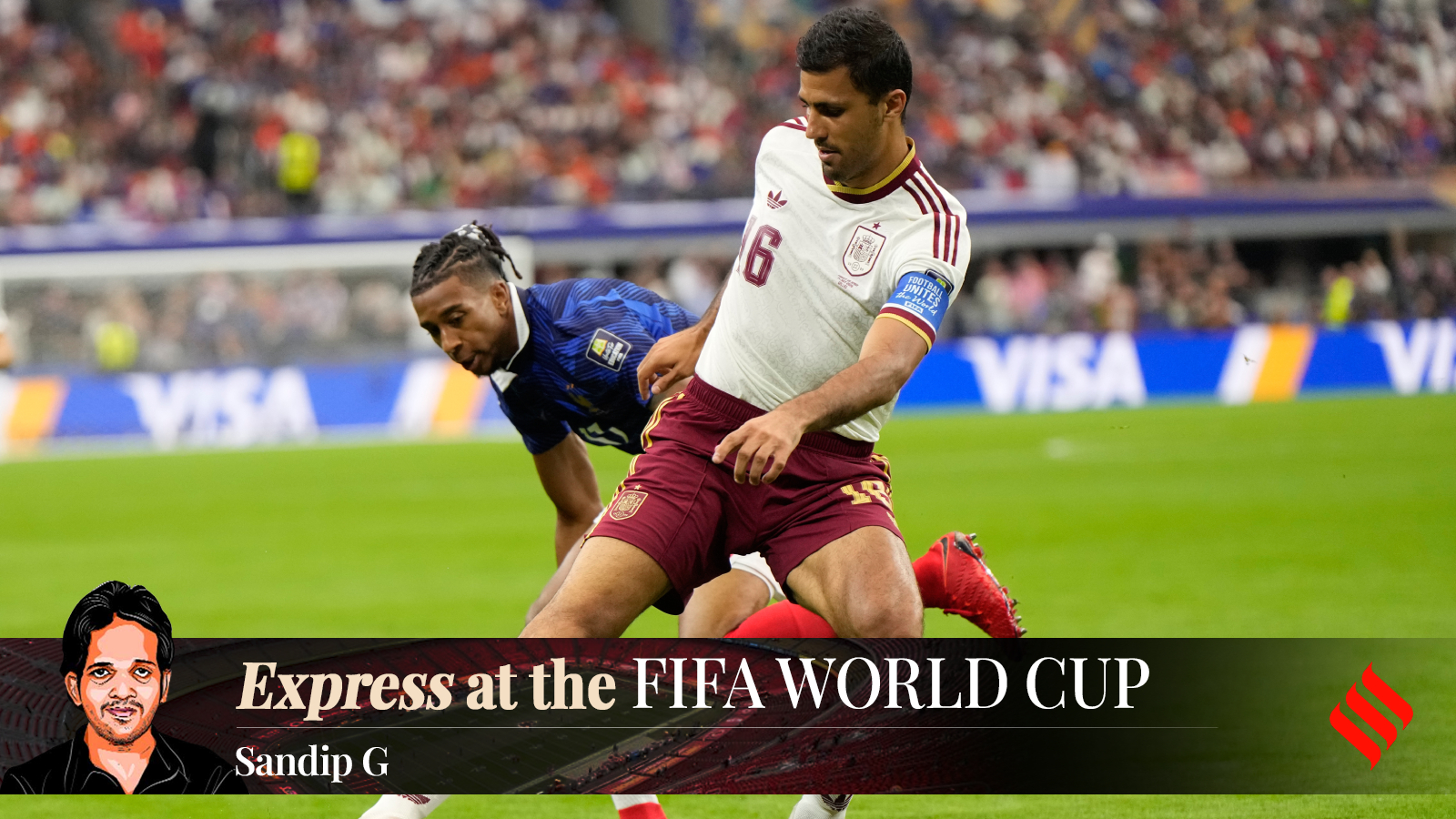
Marshalled by Rodri, putting in his most impactful shift since his Ballon D’Or year (2024), they doubled-up and often tripled-up, especially when Mbappe or Olise, had the ball. The ploy carried risk, as it created potential overload situations for France. But Spain were supremely athletic and foresightful, in covering the spaces and snuffing the potential danger. Aymeric Laporte and Pau Cubarsi dust up memories of Alessandro Nesta and Paolo Maldini in their presence and personality, in their superhuman anticipation of a potential move. Always in control, few last-ditch tackles, or seldom caught out of possession, they form an unbudging wall of defiance that takes some heavy artillery to break. Cubarsi read Mbappe’s mind like a clairvoyant.
To define Spain’s dismembering of France as a defensive masterclass is to belittle their penetrativeness upfront. The first goal stemmed from Lucas Digne’s unawareness of Lamine Yamal nudging behind him. It was a soft and clumsy penalty to concede, but there were numerous other times when Yamal and Dani Olmo stretched France’s back-line. Yamal’s pace continued to spook Digne so much so that he was tracking Yamal when Pedro Porro enjoyed a literally free run towards the box for his goal, and slashed home a delectable touch-pass from Olmo.
Story continues below this ad
France tried to regroup after the goal. Mbappe exhorted his teammates to be calm. But their faces were tired and sullen. They knew their fate. They had no hope. And that’s the worst kind of defeat. To lose without hope.
View original source — Indian Express ↗
Related stories

ESPN
SportsJul 15, 2026 · 1 min
AL 3B Caminero hit by pitch, exits in 3rd inning
ESPN

RNZ
SportsJul 15, 2026 · 1 min
Drua focus on collision and execution for Super W semifinal against Reds
RNZ

Japan Times
SportsJul 15, 2026 · 1 min
IOC asked to investigate FIFA president’s role in Balogun reversal
Japan Times
Indian Express
SportsJul 15, 2026 · 1 min
Rodri: Spain’s omnipresent all-action hero — the mastermind who dismantled France
Indian Express