Indian Express
Why Test cricket remains an uneven playing field for women
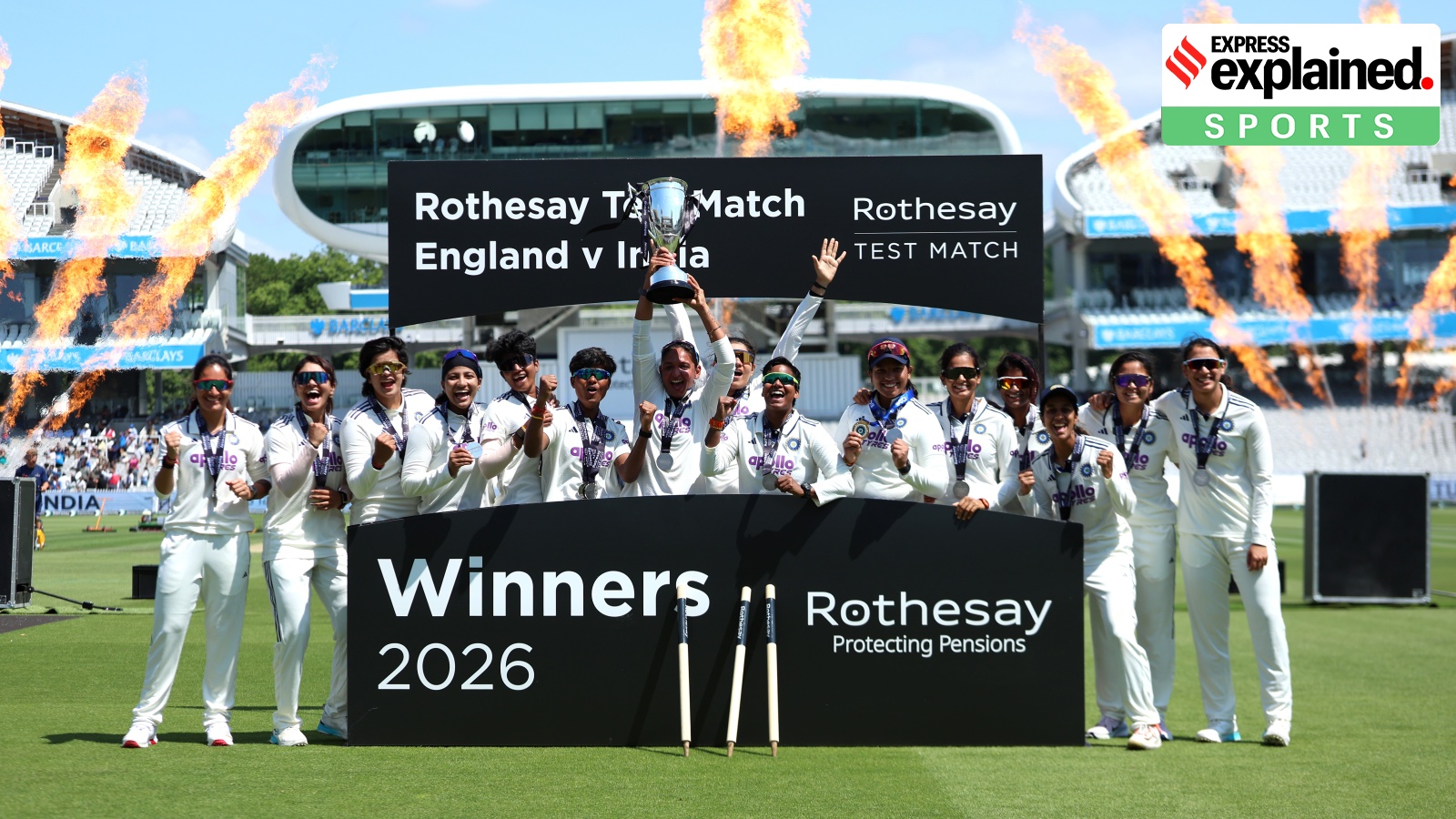
India’s historic 270-run victory over England in the first-ever women’s Test at Lord’s came as a relief after the team’s exit in the group stage of the T20 World Cup. But the win also highlighted a bigger problem. Unlike the men’s game, which has the World Test Championship, women’s Tests are still few and far between. Most are one-off matches played as part of bilateral tours. There is no regular competition, no points table and no long-term calendar to give women’s Tests context. Here are some key questions about the state of women’s Test cricket.
Exceptionally rare. Since the first women’s Test in December 1934, only 154 Tests have been played over 92 years. Men’s cricket has staged more than 2,600 Tests. The format is largely restricted to occasional one-off matches rather than multi-Test series.
The scarcity means entire generations miss out. New Zealand great Suzie Bates retired in 2026 after a 20-year international career without playing a single Test.
“A whole generation from countries like New Zealand and South Africa might go their entire careers without ever playing a Test… there’s a piece of cricket history we are completely locked out of,” Bates said.
Which countries actually play women’s Tests?
Only 10 nations have played a women’s Test. England have played 104 women’s Tests, Australia 81 and India 43. New Zealand have played 45 Tests but none since 2004. The West Indies have played 12, also without a Test since 2004. South Africa have played 16 Tests, most recently in 2024. Pakistan have played three Tests, while Sri Lanka and Ireland have played one each.
The Netherlands remain the only Associate nation to play a women’s Test, doing so in 2007. Bangladesh, Zimbabwe and Afghanistan are yet to make their Women’s Test debuts.
Was there ever a period when more women’s Tests were played?
Story continues below this ad
Yes. Between 1985 and 1999, 42 Tests were played. Teams such as New Zealand, India and the West Indies regularly contested three-match series. The number dropped sharply after 2000 as white-ball cricket became the game’s commercial focus. Only five women’s Tests were played worldwide between 2015 and 2021.
Why don’t more Tests happen?
Financial losses and scheduling dictate the calendar. Women’s cricket built its commercial footprint on white-ball formats, while boards and broadcasters have largely prioritised white-ball cricket because it is easier to schedule and generates greater commercial returns. Each match stands on its own instead of being part of a bigger story.
Former ICC chair Greg Barclay noted: “There is no doubt that white ball is the way of the future… I don’t really see women’s Test… evolving at any speed.”
New Zealand’s Sophie Devine, who retired in 2026, acknowledged the commercial reality: “As a purist, I would love to see Test cricket back… But we have to earn that right through performing in white-ball formats first to generate that revenue.”
Is there enough domestic red-ball cricket?
Story continues below this ad
Very little. India is one of the very few countries with a regular women’s multi-day domestic competition, through the Senior Women’s Multi-Day Trophy that was added to the calendar from the 2023-24 season. England has begun introducing more multi-day cricket within its domestic structure, while South Africa has staged occasional three-day provincial competitions. Australia, however, still has no regular multi-day women’s domestic competition, relying instead on the Women’s National Cricket League (50 overs) and Women’s Big Bash League (T20).
After England’s defeat at Lord’s, head coach Charlotte Edwards admitted the lack of exposure had made a difference. “This is a format I don’t think our players are exposed to… They (India) play a lot of domestic three or four-day cricket, and that absolutely has an impact.”
Is India driving the revival?
Yes. Since December 2023, India have played five Women’s Tests, winning four and losing one. They have beaten Australia by eight wickets at home, South Africa by 10 wickets and England again by 270 runs at Lord’s to maintain their unbeaten run in the longest format in the country.
Those results have coincided with the BCCI’s expansion of domestic multi-day cricket, giving Indian players far greater exposure to the red-ball game than those in most other countries.
Story continues below this ad
Before retiring after the Lord’s Test, former England captain Heather Knight stressed the need for more Tests. “I’d love to see some domestic red-ball cricket. It doesn’t necessarily have to be a full part of the calendar, but I do think it would help us develop as better white-ball cricketers as well.”
Is there actually public demand?
For the biggest occasions, yes. The Lord’s Test attracted an aggregate attendance of 37,846, the highest ever for a women’s Test. The challenge is financial rather than emotional.
Boards such as New Zealand Cricket and Cricket South Africa operate on far smaller budgets than the BCCI. Without dedicated broadcast deals or commercial partners, staging home Tests often results in financial losses, making white-ball cricket a more practical investment.
Former India batsman and coach WV Raman felt that while players deserved to be given more chances to play Tests, one also needed to consider the expenses that comes with staging the matches.
Story continues below this ad
“Yes, on the cricketing front, they need to be given opportunities by making them play a lot more Test cricket. But the big question will be whether it is commercially viable, because these days you cannot really separate the two, sport and commerce. So that being the case, you’ll have to see if it’s possibly something that all the other boards will be keen to take part in,” he told The Indian Express.
“By that I mean whether all the other boards will be keen to play Test cricket, as it does involve quite a lot of scheduling, quite a lot of logistics and also, quite obviously, all these things come at a cost. So, will all the boards be able to bear the cost is what will be the moot question. So it’s something you would want to happen, but at the same time, will it be a practical option is what everybody has to try and work out,” Raman said.
What would make women’s Tests sustainable?
Three major changes could transform the format.
First, the ICC could introduce a Women’s World Test Championship or a points-based competition for all series to provide context. Second, expanding matches from four to five days would reduce the likelihood of draws and allow contests to develop more naturally. Third, the ICC and wealthier boards could create funding pools to subsidise hosting costs, ensuring smaller nations are not discouraged from staging Tests because of financial losses.
View original source — Indian Express ↗
Related stories

CNA
TechnologyJul 15, 2026 · 1 min
Rosmah Mansor, wife of Malaysia's ex-PM Najib Razak, files lawsuit against comedian Harith Iskander over stand-up show
CNA

South China Morning Post
TechnologyJul 15, 2026 · 1 min
China memory giant CXMT valued at US$85 billion in record Shanghai IPO
South China Morning Post
The Guardian
TechnologyJul 15, 2026 · 1 min
Icac inquiry raises questions over whether taxpayer funds were used in alleged illegal political donations
The Guardian
Indian Express
TechnologyJul 15, 2026 · 1 min
Demis Hassabis says AGI could arrive within years, proposes Frontier AI Standards Body
Indian Express