Dawn
Supreme Court to decide if it can still hear NAB bails
• AGP argues both appeals and bails in pending NAB cases will now be heard by FCC
• Imran, Bushra file chamber appeals seeking SC jurisdiction in Al-Qadir case
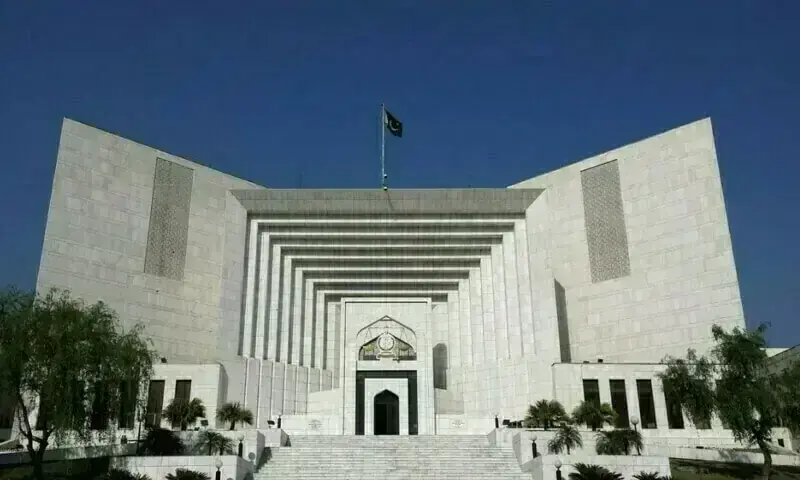
ISLAMABAD: The Supreme Court on Tuesday dropped hints that it would thrash out in detail a jurisdictional controversy over whether it retains the authority to hear bail applications in pending National Accountability Bureau (NAB) appeals, or if such pleas must be transferred to the newly established Federal Constitutional Court (FCC) under the Constitution (27th Amendment).
Headed by Justice Muhammad Ali Mazhar, a three-judge SC bench, also consisting of Justice Musarrat Hilali and Justice Shahid Bilal Hassan, is seized with the issue of whether pending appeals and bail applications in NAB cases fall within the category that must be shifted to the FCC for final determination.
On Tuesday, Attorney General for Pakistan (AGP) Mansoor Usman Awan argued that both appeals and bails in pending NAB cases will now be heard by the FCC.
It is legally inappropriate for one part of a case to be heard by the SC and the other by the FCC, the AGP contended, adding that under the NAB Amendment Act 2026, all appeals and bail applications against the decisions of the high courts in NAB cases stand transferred to the FCC.
On March 5, Section 32-A was inserted into the National Accountability (Amendment) Act, 2026, which provided for a second appeal. The amendment states that any person convicted, or the Prosecutor General Accountability (if so directed by the Chairman NAB), who is aggrieved by a decision made by the High Court under Section 32, may prefer a second appeal to the FCC within thirty days.
The AGP contended that under this amendment, the SC has no jurisdiction in NAB cases, meaning that such appeals regarding bails or sentences awarded in NAB cases will now be heard by the FCC.
Since an appeal in NAB cases is a fundamental right, this right of appeal has been routed to the FCC through the recent amendments, the AGP said, adding that the right itself has not been abolished. Under Article 175(F-2), cases pending in the SC were automatically transferred to the FCC.
During the hearing, Justice Mazhar inquired whether NAB cases had already been transferred to the FCC. In response, Nasir Mehmood Mughal, appearing on behalf of NAB, argued that the cases have not been transferred yet.
When Justice Mazhar questioned whether the SC can grant bail in NAB cases, the NAB representative replied that the right of appeal had been given to the FCC through the NAB Amendment Act 2026. He argued that because it is inappropriate for the forum for bail to be separate from the forum of appeal, the FCC remains the proper forum for both.
Senior counsel Ibadur Rehman Lodhi, appearing on behalf of under-trial prisoner Aamir Mahmood, opposed this view. He stated that the second appeal provided under Section 32-A of the NAB law only comes into play against convictions awarded by the high courts. In pending matters, he argued, the SC remains competent to hear bail applications under Section 32 of the NAB law.
He explained that no corruption reference or liability has been determined against his client, who was arrested in June 2025. Earlier, his bail plea was rejected by the Islamabad High Court in September 2025. Therefore, his client’s bail application before the SC does not fall within the category of a second appeal.
Advocate Lodhi contended that the bail application of an under-trial prisoner like his client falls within Section 497 of the Criminal Procedure Code (CrPC), which deals with the grant of bail, and not under Section 426 of the CrPC, which relates to the suspension of sentence of a convicted individual by an appellate court.
Interestingly, the same plea has been taken before the SC by the counsel representing former prime minister Imran Khan and his wife, Bushra Imran, in the high-profile £190 million Al-Qadir Trust case.
Their plea was returned by the Registrar Office, but chamber appeals have been filed against the objection. These appeals argue that Section 32-A of the National Accountability Ordinance provides that only a person convicted, or the Prosecutor General Accountability, aggrieved by a decision of the High Court under Section 32, may prefer a second appeal before the FCC. The expression “second appeal” clearly reflects the legislative intent and leaves no ambiguity that only the final judgement or order passed by the High Court in the first appeal is amenable to challenge before the FCC.
During the hearing, the NAB lawyer conceded that he had objected to the jurisdictional question when the matter was previously heard by the SC on March 18.
At this, Justice Shahid Bilal Hassan remarked that jurisdiction is always the first hurdle, which NAB itself crossed by mistake. The SC postponed further proceedings until July 16.
Published in Dawn, July 15th, 2026
Related stories

CNA
BusinessJul 15, 2026 · 1 min
Exclusive-Stripe, Advent offer to buy PayPal for more than $53 billion, sources say
CNA
Dawn
BusinessJul 15, 2026 · 1 min
WHEN Pakistan assumed the chairmanship of the OIC Ministerial Conference on Women this week, it did so while…
Dawn

Japan Times
BusinessJul 15, 2026 · 1 min
JR East announces design of new inspection shinkansen train
Japan Times

Financial Times
BusinessJul 15, 2026 · 1 min
China Evergrande liquidators warn PwC partners not to use divorce to shield assets
Financial Times