Times of Israel
Knesset passes law restoring Chief Rabbinate’s monopoly over kosher certification
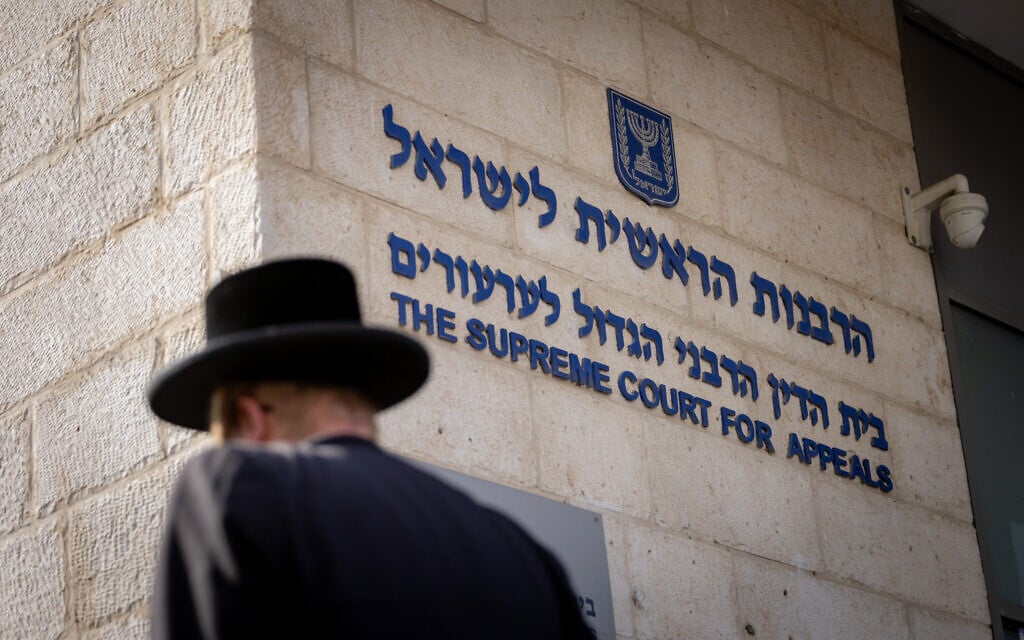
The Knesset on Tuesday night voted 46-41 to give final approval to legislation restoring the Chief Rabbinate’s exclusive control over kosher certification, one of a series of laws that the ultra-Orthodox parties demanded be passed in exchange for support for key coalition bills.
The law, which was championed by the Shas party, will reverse reforms from the previous government that allowed private Orthodox organizations to issue kosher certificates in their own name, provided they meet the state’s standards.
Opponents of the bill argue that it will eliminate competition and ultimately increase costs for and harm businesses and consumers.
The approval came just a week after the Chief Rabbinate appeared to authorize the liberal Tzohar Rabbinical Organization to issue kosher certificates under Israeli law for the first time, following a High Court ruling last month ordering it to withdraw its refusal to recognize the group — a move that prompted pushback from the current Religious Services Ministry. But within hours, the decision came under dispute, with senior officials saying the approval had not been properly authorized and therefore had no legal standing.
The new bill approved Tuesday would enshrine that only the Chief Rabbinate can issue kosher certification.
Get The Times of Israel's Daily Edition
by email and never miss our top stories
By signing up, you agree to the terms
In Israel, the right to use the word “kosher” on food labeling is highly regulated, with only certification bodies recognized by the Rabbinate allowed to recognize a product or establishment as meeting religious requirements. Unlike in other countries, where kashrut is seen as a strictly religious matter, in Israel any business claiming to be “kosher” without receiving certification from a recognized body is in violation of the law.
The bill forms part of the coalition’s agreement with the ultra-Orthodox parties to advance several Haredi priorities, including a Basic Law enshrining Torah study as a fundamental state value and a measure freezing the arrest of Haredi draft dodgers, both of which were passed into law this week.
In exchange, Haredi parties would support key coalition legislation, including bills establishing a politically appointed probe into the failures surrounding the October 7, 2023, attacks; curbing the powers of the attorney general; and overhauling the media.
Haredi parties say ‘rift’ with Netanyahu over, next government must pass permanent exemptions
Following Tuesday’s passage of the law temporarily banning the arrest and prosecution of Haredi draft dodgers, ultra-Orthodox politicians in the Knesset told reporters that their “rift” with Prime Minister Benjamin Netanyahu is over.
One senior member of a Haredi party told Channel 12, however, that, after the October 27 election, if the results go their way, the Haredi parties will demand legislation permanently exempting all ultra-Orthodox men from military service, and that they will insist this legislation be passed before formally joining another Netanyahu-led coalition. (Ultra-Orthodox young men do not do military or national service, but this is not enshrined in law.)
“Netanyahu proved today that we are a single [political] bloc, but that is not enough,” the unnamed senior Haredi politician was quoted as saying. “After the elections, we will demand an IDF draft law permanently [exempting Haredim from IDF service], before we establish a government. We’ve learned how to work with him.”
Channel 12 quoted unnamed military sources lamenting that, with today’s law, the IDF now has no leverage to get Haredim to serve, even as it urgently needs thousands more combat soldiers, and that it will now also have to free several dozen Haredi draft dodgers from military jails.
Before the law was passed, IDF Chief of Staff Lt. Gen. Eyal Zamir called the proposal “inconceivable,” saying it was “clearly and unequivocally inconsistent with the IDF’s needs” and amounted to “providing mass exemptions from prosecution.”
Some 72,000 ultra-Orthodox men aged 18 to 24 are currently believed to be eligible for military service, but have not enlisted. The IDF has said repeatedly in recent months that it urgently needs 12,000 new recruits amid the ongoing multifront conflict.
The law has drawn fierce opposition from reservists, Knesset legal advisers and much of the public.
View original source — Times of Israel ↗
Related stories

The Punch
PoliticsJul 15, 2026 · 1 min
Macron to visit Nigeria — French ambassador
The Punch

Japan Times
PoliticsJul 15, 2026 · 1 min
Japanese social media influencer given suspended sentence over tax evasion
Japan Times
ABC News
PoliticsJul 15, 2026 · 1 min
ICE suspends vehicle stops after two deadly shootings
ABC News

Philippine Daily Inquirer
PoliticsJul 15, 2026 · 1 min
LIVE: VP Sara Duterte impeachment Day 6
Philippine Daily Inquirer