Indian Express
UPSC Weekly Concepts Snapshot | ‘One-click’ exploits, Agriphotovoltaics, Total Solar Eclipse explained
11 min readNew DelhiJul 15, 2026 11:02 AM IST
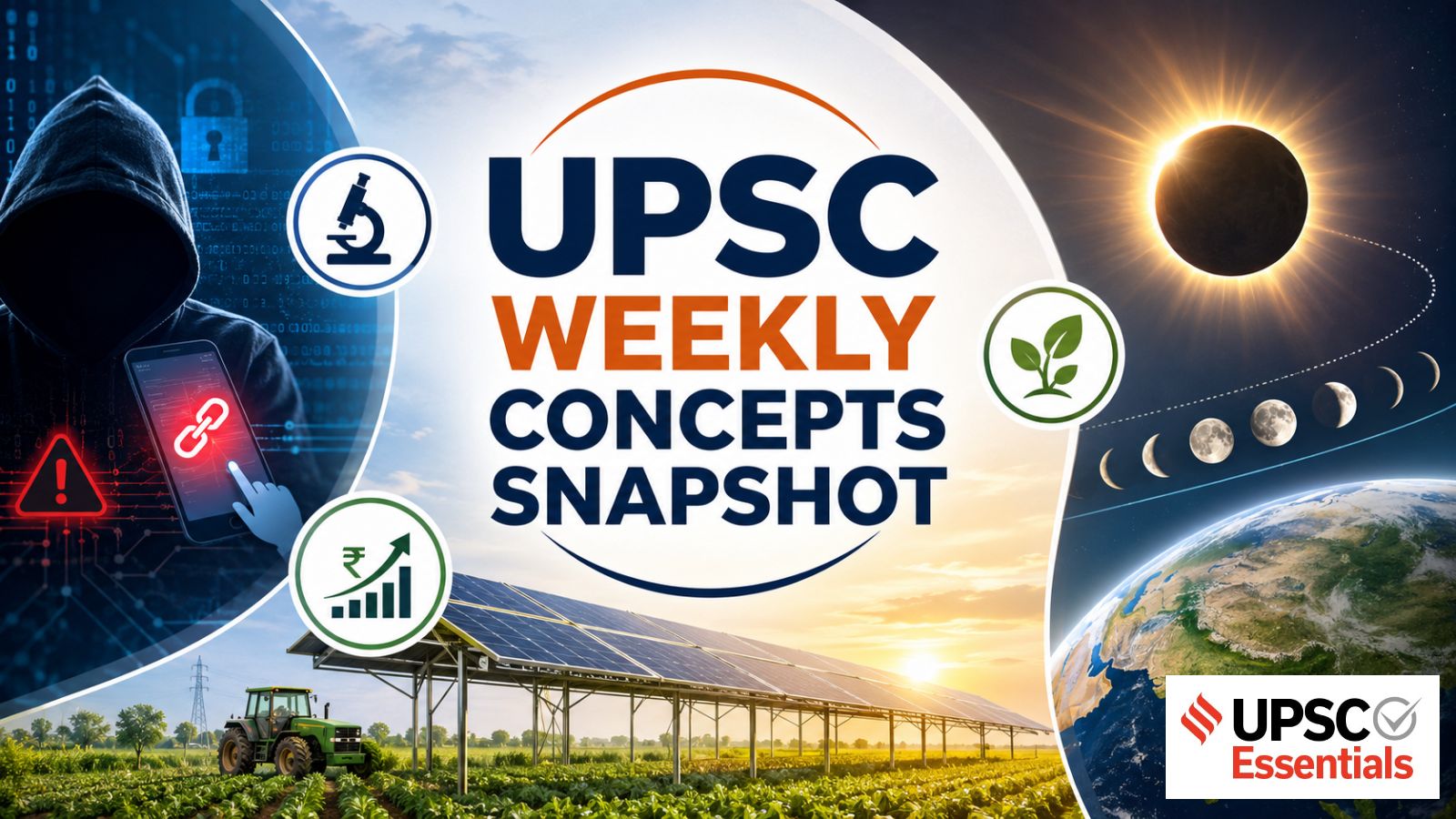
Here are three important topics from Science, Economy, and Environment decoded focusing on concepts and clarity. (Image: AI generated)
UPSC doesn’t stop at ‘what happened’—it asks ‘why’ and ‘how’. Building conceptual clarity is what transforms current affairs into scoring answers in both Prelims and Mains. That is especially true in the most dynamic areas of the syllabus: Science, Economy and Environment.
The UPSC Weekly Concepts Snapshot, every Wednesday, simplifies three important current themes from these subjects through an exam-oriented lens, focusing on concepts and clarity.
If you missed the previous UPSC Weekly Concepts Snapshot | BMS ‘hack’, Credit-Deposit Gap and GEI targets: Beyond the headlines from the Indian Express, read it here.
SCIENCE
“One-click” exploits
Core Concept:
— A one-click exploit requires the victim to perform a single action – typically clicking on a malicious link sent through a messaging app, email or SMS.
— Once the link is opened, the attacker exploits software vulnerabilities to silently install Pegasus spyware on the target’s device, often without any further interaction or visible signs of compromise.
How “One-click” attack works. (Infographic: AI-generated)
— According to Meta, the latest campaign involved spear-phishing links that redirected users to malicious websites outside the app, resembling previous one-click Pegasus operations.
— Security researchers say one-click attacks may appear less technically advanced, but they remain highly effective because they exploit human behaviour through carefully crafted phishing messages that appear legitimate.
Story continues below this ad
What is Pegasus?
It is a highly sophisticated commercial spyware developed by the Israeli cyber-intelligence company NSO Group. Pegasus is being notoriously used by authoritarian governments to target politicians, journalists, and civil society activists, among others. Once installed, Pegasus can gain near-complete control over a smartphone, allowing operators to read encrypted messages, access emails and photos, record calls, activate the microphone and camera, and track the device’s location. The NSO Group says it only sells Pegasus to governments.
📍UPSC Twist Points: “Zero-click” exploits
— Zero-click exploits are considerably more sophisticated than one-click exploits because they help spyware like Pegasus gain control over a device without human interaction or human error. So all awareness about how to avoid a phishing attack or which links not to click are pointless if the target is the system itself.
— Most of these attacks exploit software which receive data even before it can determine whether what is coming in is trustworthy or not, like an email client.
— Zero-click exploits are hard to detect given their nature and hence even harder to prevent. Detection becomes even harder in encrypted environments where there is no visibility on the data packets being sent or received.
ECONOMY
Agriphotovoltaics
Core Concept:
— Agriphotovoltaics (Agri-PV) integrate solar power generation and crop cultivation on the same piece of land. This allows farmers to harvest both sunlight and crops.
— Solar panels are mounted at a height of about 3.5 metres, which permits cultivation beneath them while generating electricity for sale to discoms. The result is dual use of land and dual streams of income.
Story continues below this ad
— Unlike agricultural income, which is vulnerable to weather shocks, pest attacks and market fluctuations, solar income is stable. In effect, solar becomes a “third crop” that provides a dependable source of earnings when conventional crops fail.
(Infograhic: AI-generated)
— The significance of Agri-PV extends beyond farmers’ income. It also addresses a longstanding distortion in India’s power sector. Agriculture consumes nearly 2,60,000 GWh of electricity annually, yet pays tariffs far below the actual cost of supply.
— Agri-PV offers an opportunity to fundamentally alter this equation. By generating electricity at the farm level and feeding it into local distribution networks, it reduces transmission losses and infrastructure costs while transforming farmers from consumers of highly subsidised power into producers of clean energy. However, scaling Agri-PV requires supportive policy.
📍UPSC Twist Points: Rail/road-integrated photovoltaics (RIPV)
— RIPV involves integrating solar photovoltaic (PV) systems directly into existing rail and road infrastructure. PV technology converts sunlight directly into electricity through the photovoltaic effect, where semiconductor materials in a PV cell absorb photons (particles of energy) from sunlight and release electrons, generating flow of electricity.
Story continues below this ad
How photovoltaic technology works.
— What sets it apart from conventional solar PV systems is that it eliminates the need for dedicated land for installation. Instead, solar panels can be installed along railway tracks, highway dividers, and medians or onto other structures. This not only overcomes land constraints but also brings energy generation closer to the point of consumption.
ENVIRONMENT
Total Solar Eclipse
Core Concept:
— A solar eclipse takes place when the Moon moves in the middle of Earth and the Sun. The Moon blocks the light of the Sun, either fully or partially, which casts a huge shadow on some parts of the world.
— There are four different types of solar eclipses, including total solar eclipse, annual solar eclipse, partial solar eclipse, and hybrid solar eclipse.
(i) Total solar eclipse: When the Moon blocks the Sun entirely, the areas in the centre of the Moon’s shadow at the time witness a total solar eclipse. The sky darkens and people who are in the path of a total solar eclipse can get a glimpse of the Sun’s corona — the outer atmosphere — which is usually not visible due to the bright face of the Sun.
(ii) Annular solar eclipse: When the Moon passes in front of the Sun but is at or near the farthest point from Earth, an annular solar eclipse occurs. In this scenario, the Moon covers the Sun in such a way that only the periphery of the Sun remains visible — looking like a ring of fire.
Story continues below this ad
(iii) Partial solar eclipse: A partial solar eclipse takes place when the Moon blocks just a part of the Sun, giving it a crescent shape. During both partial and annular eclipses, the regions outside the area covered by the Moon’s umbra — the middle and the darkest part of the lunar shadow — will see a partial solar eclipse. Partial solar eclipse is the most common type of solar eclipse.
(iv) Hybrid solar eclipse: It is the rarest type of solar eclipse — is witnessed when an eclipse shifts between annular and total as the shadow of the Moon moves across the globe. In this case, some parts of the world see a total solar eclipse, while others observe an annular solar eclipse.
Why is a total solar eclipse so rare?
— While there can be between two and five solar eclipses every year, total eclipses only happen about once every 18 months or so. The total eclipse is only visible if one is standing in the umbra — the other part of the shadow is called the penumbra, which is not as dark as the umbra. The umbral shadow is very small, covering only a small part of Earth.
— Moreover, about 70 per cent of the globe is underwater and half of the land is considered uninhabited. That’s why, it is quite rare when a total solar eclipse happens and a lot of people get to see it.
Story continues below this ad
📍UPSC Twist Points: Lunar eclipse
— There are two types of eclipses: lunar and solar. During a lunar eclipse, Earth’s shadow obscures the Moon. During a solar eclipse, the Moon blocks the Sun from view.
— Lunar eclipses occur at the full moon phase. When Earth is positioned precisely between the Moon and the Sun. Solar eclipses occur only at the new moon phase, when the Moon is positioned between Earth and the Sun.
— Types of Lunar Eclipses
1. Total lunar eclipses: The Moon moves into the inner part of Earth’s shadow, or the umbra. Some of the sunlight passing through Earth’s atmosphere reaches the Moon’s surface, lighting it dimly. Colors with shorter wavelengths ― the blues and violets ― scatter more easily than colors with longer wavelengths, like red and orange.
2. Partial lunar eclipse: An imperfect alignment of Sun, Earth and Moon results in the Moon passing through only part of Earth’s umbra. The shadow grows and then recedes without ever entirely covering the Moon.
3. Penumbral eclipse: The Moon travels through Earth’s penumbra, or the faint outer part of its shadow. The Moon dims so slightly that it can be difficult to notice.
Answer Key
1. (d) 2. (d) 3. (b)
🚨 Click Here to read the UPSC Essentials magazine for June 2026. Share your views and suggestions in the comment box or at [email protected]🚨
Subscribe to our UPSC newsletter. Stay updated with the latest UPSC articles by joining our Telegram channel – Indian Express UPSC Hub, and follow us on Instagram and X.
© IE Online Media Services Pvt Ltd
Roshni Yadav is a Deputy Copy Editor with The Indian Express. She is an alumna of the University of Delhi and Jawaharlal Nehru University, where she pursued her graduation and post-graduation in Political Science. She has over five years of work experience in ed-tech and media. At The Indian Express, she writes for the UPSC section. Her interests lie in national and international affairs, governance, the economy, and social issues. You can contact her via email: [email protected]. ... Read More
Tags:
Current Affairs
government jobs
Sarkari Naukri
UPSC
UPSC Civil Services
UPSC Civil Services Exam
UPSC Essentials
View original source — Indian Express ↗
Related stories

Euronews
TechnologyJul 15, 2026 · 1 min
Von der Leyen arrives in Kyiv to discuss drones and EU accession with Zelenskyy
Euronews
The Guardian
TechnologyJul 15, 2026 · 1 min
‘Not up for grabs’: Albanese establishes AI office and vows to protect Australian creatives from copyright ‘theft’
The Guardian

Dawn
TechnologyJul 15, 2026 · 1 min
IRGC warns of blocking more waterways after Hormuz as US renews blockade of Iranian ports
Dawn

Stuff
TechnologyJul 15, 2026 · 1 min
David Seymour ponders smartphone ban for under-16s
Stuff