Indian Express
ICAI Corporate Mitra registration begins today: Where to apply, eligibility, important dates
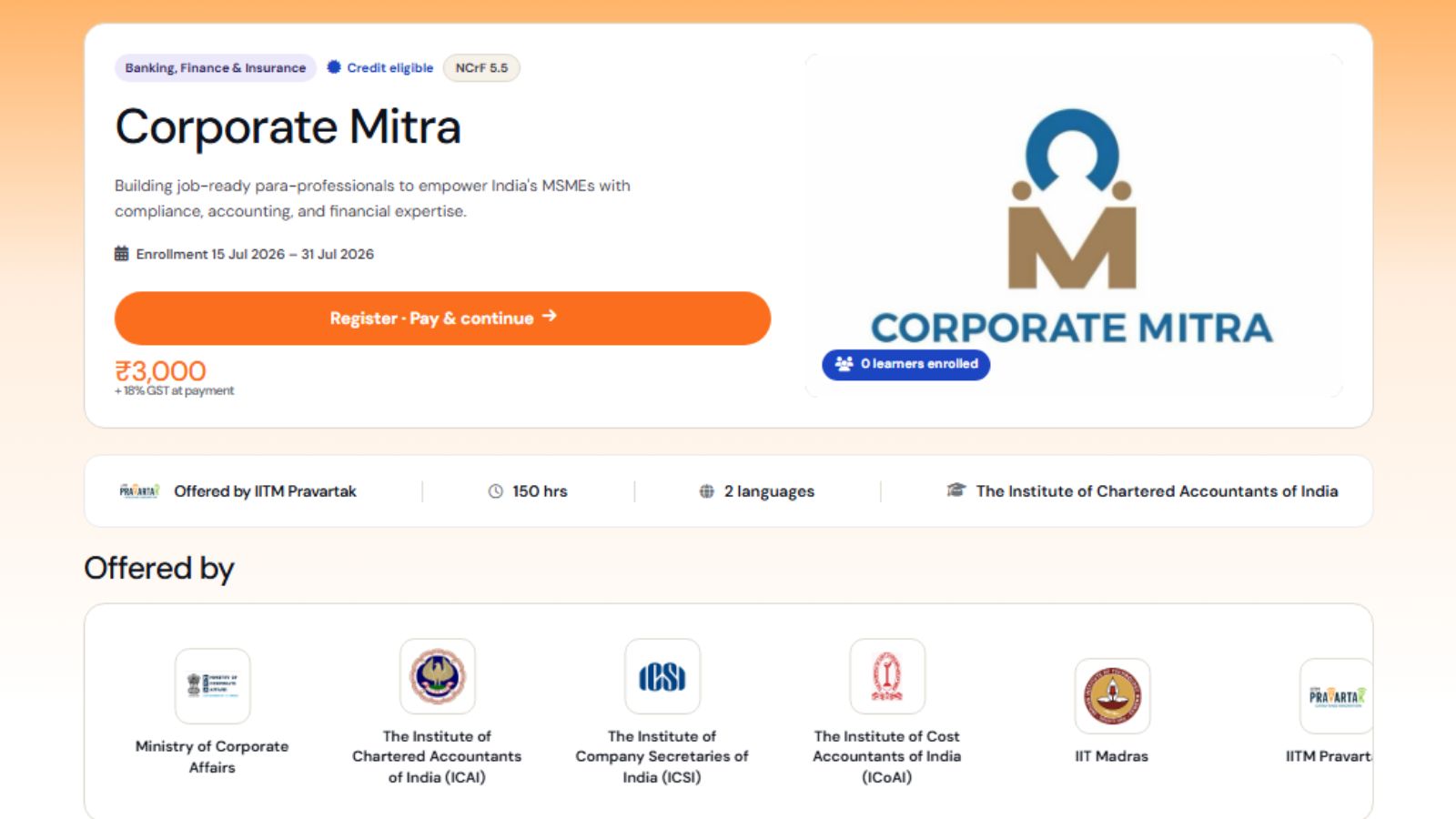
The Institute of Chartered Accountants of India (ICAI) will open the registration window for the Corporate Mitra programme from today, July 15, with applications remaining open until July 31. The programme aims to build a pool of job-ready para-professionals equipped to support India’s micro, small and medium enterprises (MSMEs) in areas such as compliance, accounting and financial management.
Eligible candidates will be able to register once the portal opens at swayamplus.education.gov.in/courses/corporate-mitra.
The course is offered through the Swayam Plus platform at a fee of Rs 3,000 plus 18 per cent GST.
Corporate Mitra Scheme: Who is eligible to apply?
The programme is open to Indian nationals who are graduates from a recognised university or students currently in their final year of graduation. However, final-year students will receive the Corporate Mitra certificate only after successfully completing their graduation. Applicants should be between 20 and 30 years of age.
ICAI Corporate Mitra scheme will provide 150 hours of learning, and on-job training
The course is offered by IITM Pravartak on Swayam Plus and carries 150 hours of learning. It has been assigned NCrF Level 5.5 and is credit eligible. The curriculum is divided into six modules covering accounting, taxation, banking, financial management, legal and secretarial practices, and cost and management accounting.
Successful candidates will also undergo six months of on-the-job training before certification.
Story continues below this ad
Corporate Mitra Course Structure: What candidates will learn
The programme is designed to train individuals with practical skills in accounting, taxation, banking and financial management, legal and secretarial compliance, and cost and management accounting, enabling them to support MSMEs under the supervision of qualified professionals.
Under the Accounting module, participants will learn basic accounting principles, preparation of journals, ledgers and trial balances, error rectification, bank reconciliation statements, preparation of profit and loss accounts, balance sheets and cash flow statements, along with the use of digital tools such as MS Excel and Tally.
The Taxation module covers income tax concepts, residential status, the five heads of income, clubbing provisions, set-off and carry-forward of losses, deductions under both tax regimes, advance tax, TDS and TCS compliance, e-filing of income tax returns, and GST fundamentals including e-invoicing, e-way bills and return filing.
The Banking module focuses on the fundamentals of banking and financial systems for MSMEs, assessing credit requirements and financing options, and understanding digital banking, payment systems and financial technologies.
Story continues below this ad
Under Financial Management, learners will study financial statement analysis using basic ratios, working capital estimation and corrective measures, and financial documentation and compliance under professional supervision.
The Legal and Secretarial module includes business organisation structures, MSME registration, labour codes, environmental regulations, board meetings, annual general meetings, Companies Act compliance, SME listing on BSE SME and NSE Emerge, SEBI compliance requirements, and the MSME Online Dispute Resolution (ODR) portal for delayed payment recovery.
The Cost and Management Accounting module introduces learners to the fundamentals of costing, cost accumulation techniques, total cost determination for products and services, and concepts such as marginal costing, standard costing and budgetary control.
Corporate Mitra Scheme: Assessment and certification
Assessment for the programme will be conducted in centre-based MCQ format, with the assessment fee included in the course fee. The assessment will be jointly administered by ICAI, ICSI and ICMAI after candidates complete the mandatory six-month on-the-job training. Candidates who pass the assessment will receive a verifiable Swayam Plus certificate. Those who do not clear the assessment will have to register and pay afresh, as reattempts are not permitted on a completed assessment.
View original source — Indian Express ↗
Related stories

The Punch
WorldJul 15, 2026 · 1 min
Kebbi gov approves N2.11bn for gratuities of 772 retirees, families
The Punch

Euronews
WorldJul 15, 2026 · 1 min
'Lisbon is not a sauna': Environmentalists demand climate shelters throughout Portugal
Euronews
The Punch
WorldJul 15, 2026 · 1 min
Sultan declares Thursday first day of Safar 1448AH
The Punch

Philippine Daily Inquirer
WorldJul 15, 2026 · 1 min
Free breakfast now served at Cebu's Walang Gutom Kitchen
Philippine Daily Inquirer