Indian Express
Why The Odyssey has endured for nearly 3,000 years
As Christopher Nolan’s The Odyssey arrives in theatres this weekend, bringing Homer’s ancient Greek epic to the IMAX screen with blockbuster scale and a star-studded cast, it is also reviving one of the oldest and most enduring stories in literature.
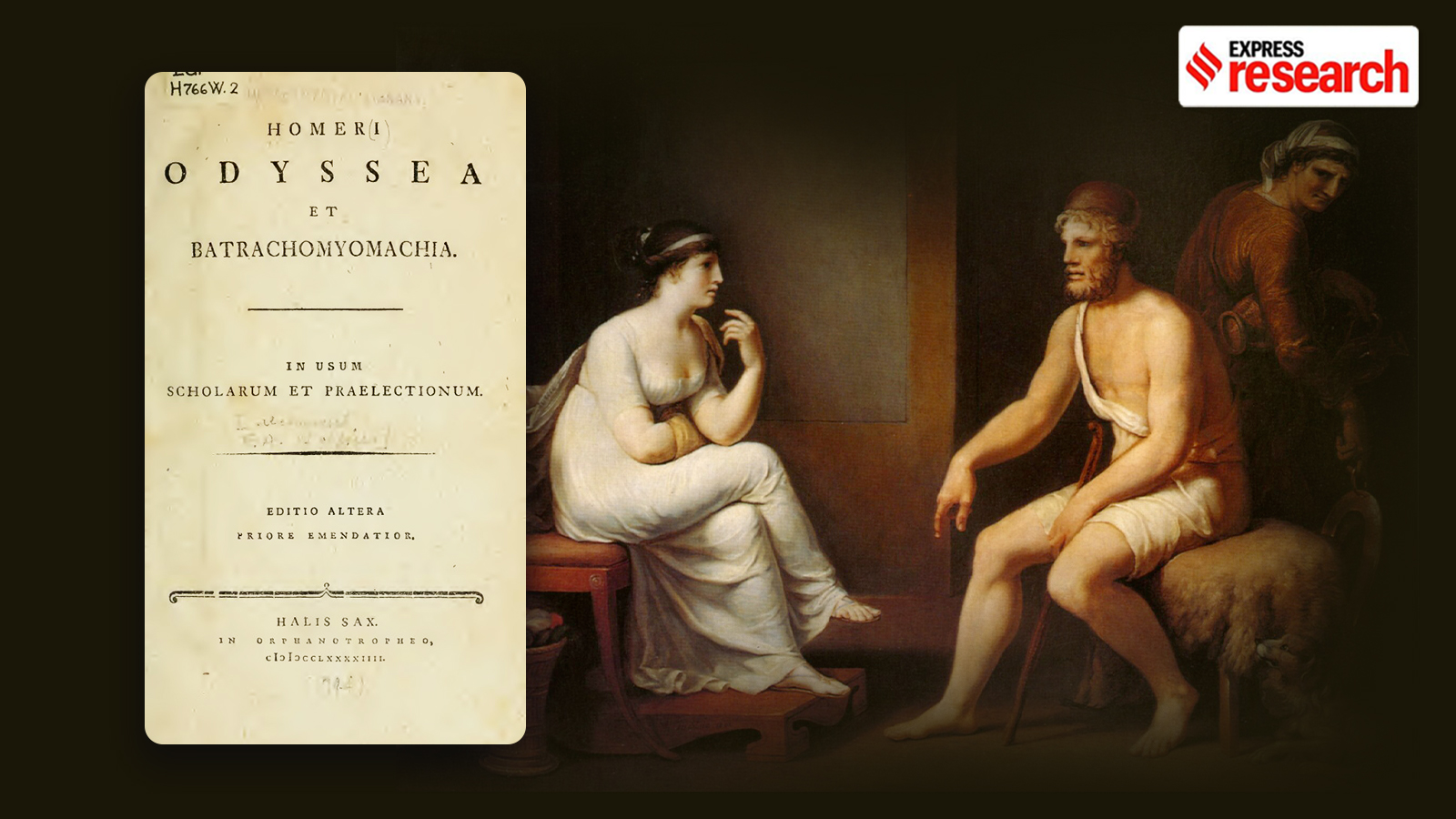
At its heart, The Odyssey is the tale of Odysseus, the king of Ithaca, and his long and perilous journey home after the Trojan War, a voyage that has come to symbolise exile, resilience, and the universal longing for belonging.
Traditionally attributed to the ancient Greek poet Homer and composed in the eighth century BCE, The Odyssey is the second of his two great epics, following The Iliad. It emerged as Greece was recovering from the centuries-long upheaval known as the Greek Dark Age (c 1100–800 BCE). The collapse of the Mycenaean kingdoms had erased writing for centuries, but the adoption of the Phoenician alphabet enabled stories that had long circulated orally to be written down.
Odysseus was one of the principal heroes of the Trojan War. To understand why he spends 10 years wandering the Mediterranean before finally returning home, one must begin with the events that triggered the conflict.
From Troy to Ithaca
Helen, later known as Helen of Troy, was married to King Menelaus of Sparta and was celebrated in Greek mythology as the world’s most beautiful woman. Before her marriage, many Greek princes had sought her hand. Fearing conflict among the rejected suitors, Helen’s father, King Tyndareus, required them to swear an oath to defend whoever became her husband if anyone attempted to take her away.
Ancient traditions differ on whether Paris, prince of Troy, abducted Helen or whether she accompanied him willingly. Either way, Menelaus invoked the oath, and Greek kings and heroes, including Odysseus, united in an expedition against Troy. The decade-long war that followed forms the backdrop to The Iliad and sets in motion the journey at the heart of The Odyssey.
Story continues below this ad
While The Iliad tells the story of war, The Odyssey asks what happens after victory. Before it was written down, the poem belonged to an oral tradition in which travelling bards recited tales of heroes and gods.
In The World of Odysseus (1954), historian Moses I Finley argued that the Homeric epics preserve echoes of an earlier Mycenaean world, even though they were composed centuries later. Building on the study of oral tradition, classicist Gregory Nagy argued in Homeric Questions (1996) that the poems evolved through repeated performances rather than emerging as the fixed work of a single author. Scholars such as Jonathan M Hall, in Hellenicity: Between Ethnicity and Culture (2002), have further argued that these epics became central to the development of a shared Panhellenic identity.
Essentially, however, The Odyssey is a remarkably simple story: a man trying to get home.
The poem opens not with Odysseus leaving Troy, but after years of his wandering. His troubles begin when he blinds Polyphemus, the one-eyed Cyclops and son of Poseidon. Although he escapes, he incurs the sea god’s wrath, condemning him to years of hardship before he can return to Ithaca.
Story continues below this ad
His voyage has become one of literature’s greatest adventures. He encounters the enchantress Circe, resists the Sirens’ fatal songs, sails between Scylla and Charybdis, and spends years detained by the nymph Calypso, who offers him immortality if he abandons his homeland.
Yet another story unfolds simultaneously in Ithaca. Believed dead, Odysseus leaves behind a kingdom overrun by more than a hundred suitors seeking his wife Penelope’s hand and consuming his household’s wealth. His son, Telemachus, grows into adulthood with only the faintest memory of his father. Penelope’s steadfast refusal to remarry and Telemachus’s search for Odysseus give the epic much of its emotional power.
Unlike The Iliad, which centres on the battlefield and the pursuit of heroic glory, The Odyssey turns to the consequences of war. The Greek word nostos, meaning “return” or “homecoming”, lies at its heart.
Odysseus seeks neither conquest nor everlasting fame, but the recovery of the ordinary life that war interrupted. Beneath its gods and monsters lies an experience that remains recognisably human: the fear that home may have changed beyond recognition, and the hope that one can still reclaim one’s place within it.
The many lives of The Odyssey
Story continues below this ad
The epic’s afterlife stretches far beyond ancient Greece. In 1922, Irish writer James Joyce reimagined Odysseus’ wanderings in Ulysses, the Latin name for Odysseus, compressing the epic journey into a single day in Dublin and transforming the search for home into a modern exploration of memory, identity, and urban life.
In 1922, Irish writer James Joyce reimagined Odysseus’ wanderings in Ulysses, the Latin name for Odysseus. (Wikimedia Commons)
The Coen Brothers’ 2000 satirical musical film O Brother, Where Art Thou? transplanted the story to Depression-era America, turning the wandering hero into an escaped convict making his way through the American South in search of treasure.
In 2017, classicist and translator Emily Wilson became the first woman to publish an English translation of The Odyssey, a version celebrated for its clarity and for drawing renewed attention to the poem’s themes of exile, slavery and homecoming. Wilson’s translation gives greater voice to marginalised characters and encourages a fresh reading of The Odyssey as both a heroic adventure and a deeply patriarchal text.
In the following year, novelist Madeline Miller’s Circe retold parts of the myth from the perspective of the enchantress who briefly detained Odysseus, placing one of Greek mythology’s most enigmatic women at the centre of the narrative. The novel reflects a contemporary interest in retelling classical stories from overlooked and marginalised perspectives.
Story continues below this ad
Each retelling has found in The Odyssey something different, yet all have returned to the same enduring questions of belonging, loss, and the desire to return home.
Why The Odyssey still speaks to us
Nearly three thousand years after it was first composed, The Odyssey continues to inspire readers as the questions it asks remain deeply relevant. Every generation has found something different in the poem. For the ancient Greeks, it reflected the uncertainties of travel and seafaring. Later readers saw a tale of endurance and self-discovery. Today, it is often read as a meditation on displacement, exile, and the lasting consequences of conflict.
Its themes resonate in a world marked by migration and war. Millions of people have been forced from their homes by conflict, persecution or economic hardship. Odysseus’s struggle to return speaks not only to refugees and exiles, but also to those who discover that coming home is itself a difficult journey. He returns to a son he scarcely knows, a household in disorder and a kingdom transformed by his absence. The epic recognises that journeys change both the traveller and the destination.
Wilson has described The Odyssey as “the story of a man trying to get home.” The description is deceptively simple. Beneath the adventures lies a meditation on family, memory, resilience and belonging. The poem asks enduring questions: What do we owe to those we leave behind? How do we rebuild our lives after conflict? And what does it mean to belong somewhere again?
Story continues below this ad
Perhaps that is why artists continue to return to Homer’s epic. Every adaptation reflects the concerns of its own age, whether as an adventure, a war story, a family drama or a tale of self-discovery.
Nolan’s film is simply the latest retelling in a tradition that stretches back almost three thousand years. Long before it became a Hollywood spectacle, The Odyssey was a poem about one of humanity’s oldest aspirations: finding one’s way home.
Shefali Narula is intern at Indianexpress.com
View original source — Indian Express ↗
Related stories

The Punch
WorldJul 15, 2026 · 1 min
We’ll report ‘fake’ DG’s arrest to Trump gov’t – Atiku-linked US firm
The Punch
The Punch
WorldJul 15, 2026 · 1 min
Nigerian priest in US dies by suicide after order to return home
The Punch
The Punch
WorldJul 15, 2026 · 1 min
NAF names successful candidates for 2025 recruitment, training begins July 19
The Punch

RNZ
WorldJul 15, 2026 · 1 min
Queensland Origin star Kurt Capewell extends stay at NZ Warriors
RNZ