Indian Express
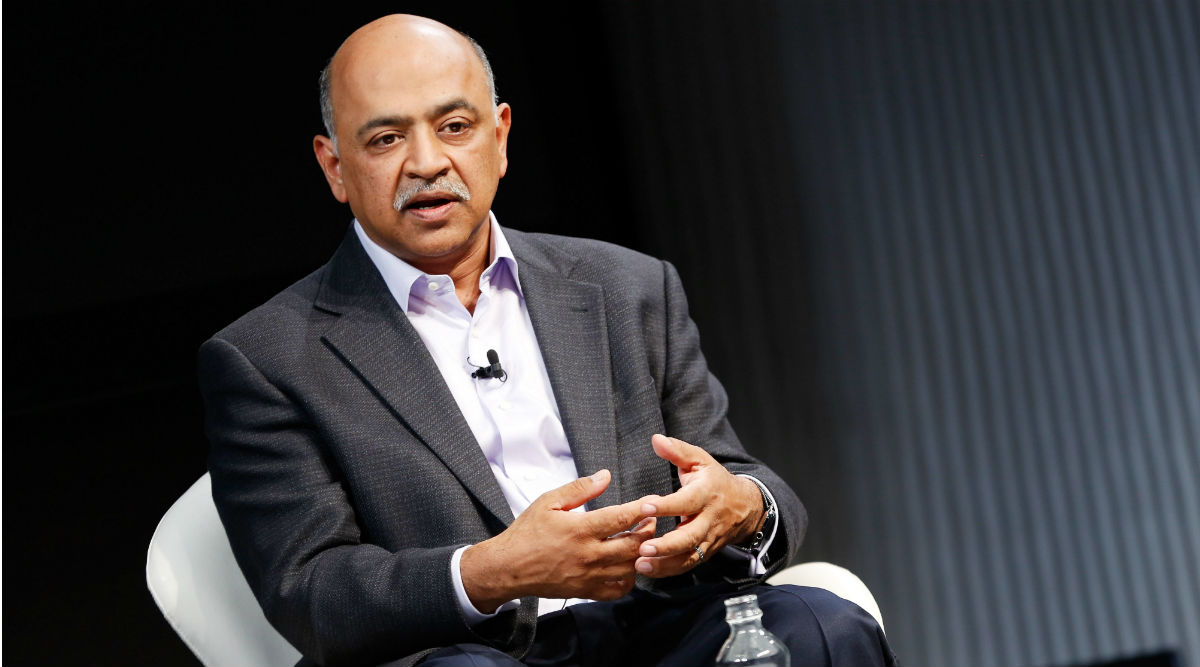
Inside CEO Arvind Krishna’s letter that preceded IBM’s worst one-day stock fall since 1987
4 min readUpdated: Jul 15, 2026 01:10 PM IST
IBM stock plunged after its chief executive officer (CEO) Arvind Krishna admitted that the company had “faltered” in keeping pace with a shift in corporate spending from software to data-centre infrastructure and would take a big earnings hit in the second quarter, in the clearest sign yet of AI’s growing toll on the sector.
In a letter released on Tuesday, Krishna told investors that capital expenditures were flowing toward chips, servers and storage at a far faster pace than anticipated and that IBM failed to adapt to the new circumstances.
The company expects second quarter revenue from its infrastructure unit, which includes its mainframe business, to fall 7 per cent year-over-year.
IBM’s shares tanked 25 per cent on Tuesday, putting the stock on track for an even steeper single-day decline than it suffered during the 1987 “Black Monday” crash. Other software stocks also fell, news agency Reuters reported.
‘We did not adapt and move quickly enough’
“These conditions require our teams to execute perfectly, and this quarter we faltered. We did not adapt and move quickly enough, and numerous large deals failed to close on the timelines we expected,” Krishna wrote.
Krishna said the company had expected some disruption after the launch of its z17 mainframe but underestimated the extent to which customers would redirect capital spending towards AI infrastructure in the final weeks of June.
“We saw clients shift their quarterly capex spend toward servers, storage, and memory purchases to secure supply-constrained infrastructure ahead of expected price increases,” he wrote.
Story continues below this ad
‘IBM did not anticipate the magnitude of capex reprioritisation’
He added that IBM had anticipated some supply-chain-related disruption but “did not anticipate the magnitude of the capex reprioritisation.” The company also cited rapidly evolving cybersecurity concerns across the industry as another factor that delayed customer buying decisions.
Despite the disappointing quarter, Krishna said the company remained confident about its long-term strategy.
“These are not excuses, but they are realities. Our job is to help our clients through uncertainty,” he said, adding that IBM continued to see strength across several parts of its business.
Software revenue rose 5 per cent, while Red Hat posted 11 per cent growth. IBM also said its distributed infrastructure business recorded its strongest performance on record, rising 37 per cent as customers increased spending on AI-ready hardware.
CEO highlights IBM’s latest AI initiatives
Krishna also underlined IBM’s latest AI initiatives, including Lightwell, a new AI-powered cybersecurity platform backed by a $5 billion commitment and supported by more than 20,000 engineers.
Story continues below this ad
He also reiterated IBM’s aggressive push into quantum computing, saying the technology is no longer a distant goal.
“Quantum computing is no longer decades away, it is upon us, and we are investing aggressively,” Krishna wrote.
IBM recently announced plans to invest more than $10 billion in quantum technologies over the next five years and said it remains on track to deliver the world’s first large-scale fault-tolerant quantum computer by 2029.
The company reported preliminary second-quarter revenue of $17.2 billion, up 1 per cent year-on-year. Software revenue increased 5 per cent, consulting revenue was largely flat, while infrastructure revenue declined 7 per cent.
Story continues below this ad
Krishna said IBM would accelerate new initiatives to improve execution ahead of its full earnings announcement later this month, maintaining that the company still had “conviction in the strength of our portfolio and the strategic transformation of our business.”
The Express Global Desk at indianexpress.com which delivers authoritative, verified, and context-driven coverage of key international developments shaping global politics, policy, and migration trends. The desk focuses on stories with direct relevance for Indian and global audiences, combining breaking news with in-depth explainers and analysis.
A major focus area of the desk is US immigration and visa policy, including developments related to student visas, work permits, permanent residency pathways, executive actions, and court rulings. The Global Desk also closely tracks Canada’s immigration, visa, and study policies, covering changes to study permits, post-study work options, permanent residence programmes, and regulatory updates affecting migrants and international students.
All reporting from the Global Desk adheres to The Indian Express’ editorial standards, relying on official data, government notifications, court documents, and on-record sources. The desk prioritises clarity, accuracy, and accountability, ensuring readers can navigate complex global systems with confidence.
Core Team
The Express Global Desk is led by a team of experienced journalists and editors with deep expertise in international affairs and migration policy:
Aniruddha Dhar – Senior Assistant Editor with extensive experience in global affairs, international politics, and editorial leadership.
Nischai Vats – Deputy Copy Editor specialising in US politics, US visa and immigration policy, and policy-driven international coverage.
Mashkoora Khan – Sub-editor focusing on global developments, with a strong emphasis on Canada visa, immigration, and study-related policy coverage. ... Read More
Stay updated with the latest - Click here to follow us on Instagram
Tags:
artificial intelligence
global stocks
IBM
View original source — Indian Express ↗
Related stories

Japan Times
BusinessJul 15, 2026 · 1 min
Solar is sending European power prices on a roller-coaster
Japan Times

MarketWatch
BusinessJul 15, 2026 · 1 min
‘I don’t want to sound callous’: Nobody knows when they’ll die. Don’t base when you claim Social Security on that.
MarketWatch

TASS
BusinessJul 15, 2026 · 1 min
Rostec may increase robot production to 6,000 units annually by 2030
TASS

Antara News
BusinessJul 15, 2026 · 1 min
2026 Global Digital Economy Conference Xiongan Future Digital Intelligence Forum Held
Antara News