CNA
Taiwan’s opposition TPP launches historic first trip to mainland China
East Asia
The Taiwan People’s Party aims to build goodwill and promote dialogue while supporting cross-Strait peace, its delegation leader says.
New: You can now listen to articles.
This audio is generated by an AI tool.
15 Jul 2026 04:37PM
The Taiwan People’s Party (TPP) has sent its first formal delegation to mainland China since the party’s founding, seeking to maintain cross-Strait peace through dialogue amid heightened tensions with Beijing.
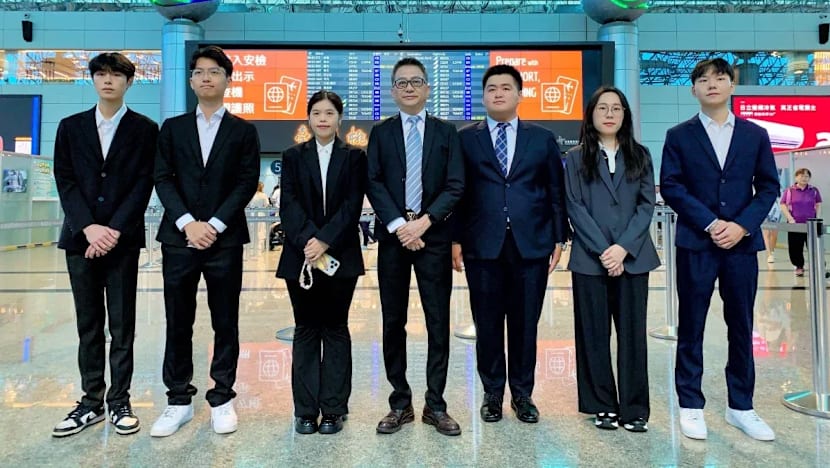
The nine-member delegation from the island’s smaller opposition party left for Shanghai on Tuesday (Jul 14) for a four-day visit focused on youth exchanges, urban governance, artificial intelligence (AI), technological innovation and entrepreneurship.
“The trip aims to build goodwill and mutual trust through pragmatic engagement, reduce misunderstandings across the Taiwan Strait and explore a more stable and sustainable model for exchanges,” the TPP said.
The delegation is led by Lee Wei-hwa, chairman of the TPP Central Review Committee, and also includes three party cadres and five youth wing members. Lee described the visit as a milestone for the party founded by former Taipei mayor Ko Wen-je in 2019.
“This is the first time since the Taiwan People’s Party was founded that it has formally organised a delegation to mainland China for a visit and exchanges,” Lee said before the group’s departure.
“At a time when the cross-Strait political situation is severe and the global situation is tense, the darker the moment, the more we cannot afford to lose communication. The greater the differences, the more we need dialogue.”
Lee said the delegation’s guiding principle was to “build goodwill through exchanges and replace confrontation with dialogue”, while maintaining the party’s long-standing position of supporting “Taiwan’s autonomy and cross-Strait peace”.
He acknowledged the complex historical, political and security disputes between Taiwan and mainland China, but said these challenges made it even more important to find a pragmatic path that could reduce the risk of conflict.
“Peace is not just a slogan. Peace requires preparation and effort,” Lee said. “It also requires everyone to be willing to sit down, communicate and clearly explain and understand each other’s views.”
During the visit, the delegation will tour major economic development projects, historical venues, technology companies and youth entrepreneurship hubs.
Members will also visit Shanghai Jiao Tong University to hold discussions with mainland Chinese students, which Lee described as the most important part of the trip.
“The future of the two sides of the Taiwan Strait belongs not only to today’s politicians, but also to the next generation of young people,” he said.
“Only by allowing young people to get to know, question and understand each other can peace cease to be merely a political slogan.”
The Shanghai visit was “not an end, but a beginning”, Lee said, adding that it did not aim to avoid cross-Strait differences but to create space for understanding and peace despite them.
Beijing sees Taiwan as part of China to be reunited by force if necessary. Most countries, including the United States, do not recognise Taiwan as an independent state, but Washington is opposed to any attempt to take the island by force and is committed to supplying it with weapons.
TPP chairman Huang Kuo-chang said the visit was “very straightforward” and centred on pragmatic dialogue between younger generations rather than political confrontation.
He said the party wanted to maintain open channels of communication with different sides, increase mutual understanding and gradually build trust.
Huang said the TPP’s core cross-Strait strategy remained unchanged, firmly anchored by Ko’s platform of “Taiwan’s autonomy and cross-Strait peace” and the party’s “five mutuals” of mutual recognition, understanding, respect, cooperation and accommodation.
“Whether we are ‘anti-China’ or ‘not anti-China’ is simply not the most important objective,” he said.
“The most important goal is how to preserve Taiwan’s freedom, democracy, rule of law and human rights while at the same time promoting peace across the Taiwan Strait.”
Huang said the TPP opposed reducing cross-Strait issues to ideological labels, adding that dialogue and communication could coexist with the defence of Taiwan’s democratic system and way of life.
This article was first published on SCMP.
Source: South China Morning Post/lk(ws)
Related stories

The Punch
WorldJul 15, 2026 · 1 min
Why Oyo kidnap rescue tactics can’t always work in North — Ex-DSS ADG
The Punch
Indian Express
WorldJul 15, 2026 · 1 min
After performance review: Madhya Pradesh minister loses portfolio, CM takes over
Indian Express
The Punch
WorldJul 15, 2026 · 1 min
Police recover illegal gun, ammunition from A’Ibom residence
The Punch

Rio Times
WorldJul 15, 2026 · 1 min
A Company 115 Days Old Is Buying Control of Jamaica’s Dolphin Cove
Rio Times