Indian Express
Why your neighbourhood paan shop in Maharashtra was probably shut on Tuesday
4 min readJul 15, 2026 03:13 PM IST
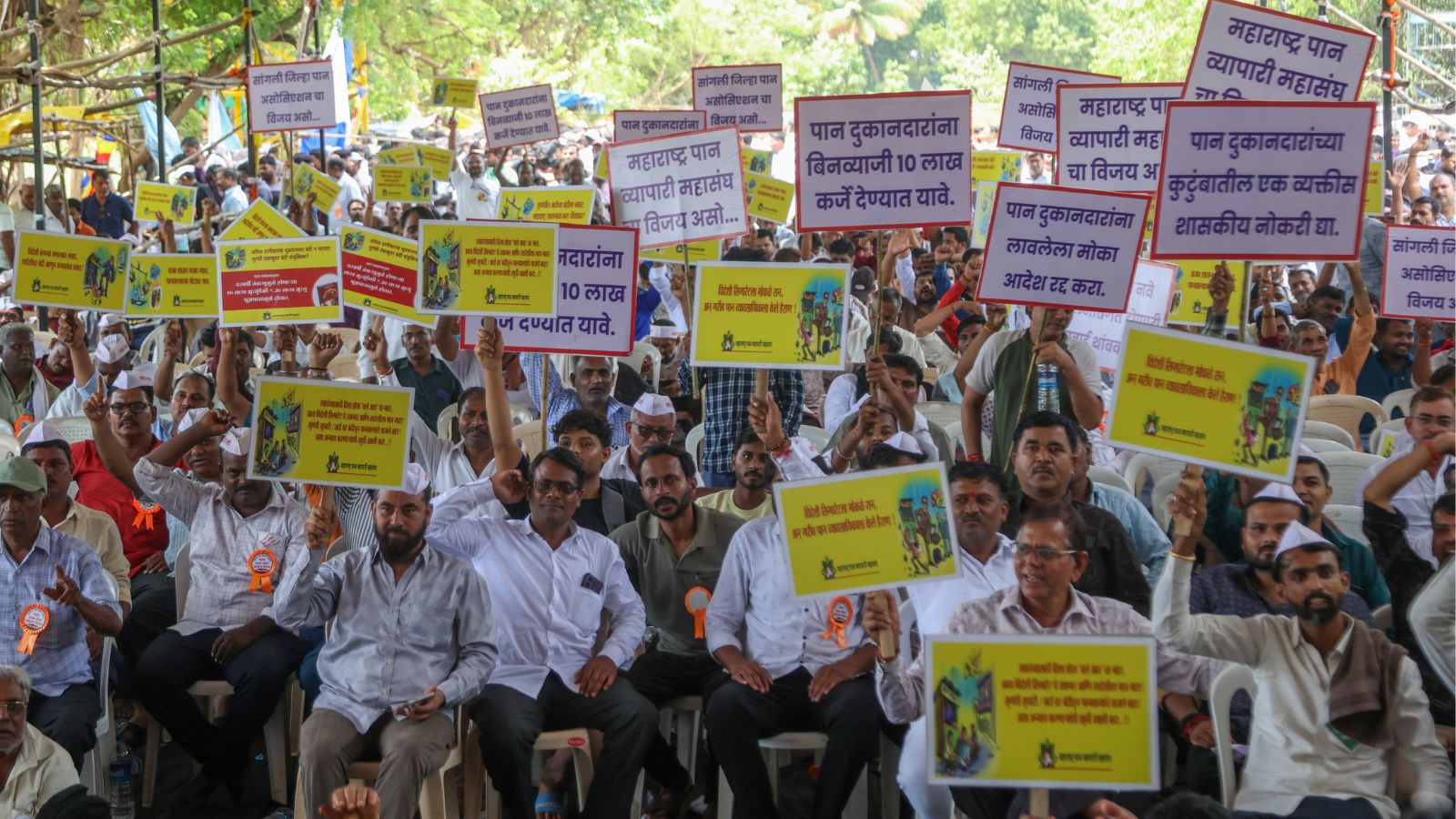
The protest is not against action on banned gutka or pan masala, but against what the Maharashtra Pan Vyapari Mahasang calls the misuse of stringent criminal laws against small retailers. (Express photo by Akash Patil)
Pan shops across Maharashtra remained shut on Tuesday as traders observed a statewide bandh to protest what they alleged was the indiscriminate use of stringent criminal laws against small retailers. More than 1,000 pan shop owners and workers gathered at Mumbai’s Azad Maidan before submitting their demands to the state government. Here’s why they are protesting.
Why are pan shop owners protesting?
The protest is not against action on banned gutka or pan masala, but against what the Maharashtra Pan Vyapari Mahasang calls the misuse of stringent criminal laws against small retailers.
According to the organisation, the Food and Drug Administration (FDA) and police have increasingly booked pan shop owners caught selling banned tobacco products under Section 328, which deals with causing hurt by poison or other harmful substances, as well as the Maharashtra Control of Organised Crime Act (MCOCA).
The traders argue that while they are willing to face prosecution under the Food Safety and Standards Act, which provides for imprisonment ranging from six months to three years, they should not be booked under laws meant for poisoning offences or organised crime syndicates, which carry much harsher penalties.
Maharashtra Pan Vyapari Mahasang president Ajit Suryavanshi said the legality of invoking Section 328 in such cases is still pending before the Supreme Court. He also pointed to observations by the Bombay High Court that the provision cannot be invoked in such cases. “The matter is currently pending before the Supreme Court with no final verdict being issued yet. Separately, the High Court has observed that Section 328 cannot be invoked in such cases,” Suryavanshi said.
What are pan shop owners demanding?
A delegation of Mahasang representatives later met Deputy Chief Minister Eknath Shinde and FDA Minister Narhari Zirwal at Mantralaya to press their demands that the use of Section 328 be kept in abeyance until the Supreme Court delivers its verdict. They have also opposed the use of MCOCA against pan shop owners and reiterated their demand for lifting Maharashtra’s ban on certain tobacco products.
According to the Mahasang, the ministers assured the delegation that the government would examine the concerns and explore an appropriate solution within the framework of the law.
Why has the FDA crackdown intensified?
Story continues below this ad
The protest comes amid an intensified crackdown on banned tobacco products by the Maharashtra FDA.
Last month, Maharashtra FDA Commissioner Tukaram Munde directed officials to invoke MCOCA against organised networks involved in the manufacture, supply and sale of gutka, tobacco and nicotine-containing pan masala.
Although the FDA’s powers are limited to the Food Safety and Standards Act, Munde directed officials to coordinate with the police in cases where criminal laws, including MCOCA, could be invoked. The directive followed statements by FDA Minister Narhari Zirwal in December last year that the state was considering using MCOCA to curb the illegal gutka trade.
The enforcement drive has continued in recent months. Between April 1 and June 18 this year, the FDA seized banned tobacco products worth Rs 11.81 crore and confiscated 79 vehicles valued at Rs 4.05 crore from 730 establishments. On July 13 alone, officials seized prohibited products worth Rs 67.3 lakh, registered four FIRs and arrested seven people.
What is Maharashtra’s tobacco policy?
Story continues below this ad
In 2012, Maharashtra banned the manufacture, storage, distribution and sale of gutka, tobacco-containing pan masala, scented tobacco and kharra under the Food Safety and Standards Act.
The ban has repeatedly been challenged in court. In September 2012, the Bombay High Court upheld the prohibition, and in 2024 it again refused to stay the ban, observing that the state has a duty to safeguard public health.
View original source — Indian Express ↗
Related stories

TechRadar
TechnologyJul 15, 2026 · 1 min
New Windows 11 update is a big one — these are my top 4 features, including the ability to pause updates indefinitely
TechRadar

Euronews
TechnologyJul 15, 2026 · 1 min
UK unveils plans for voluntary overnight social media curfew for older teens
Euronews

TechRadar
TechnologyJul 15, 2026 · 1 min
'Ineffective and useless': the UK government is proposing a midnight social media curfew for 16 and 17-year-olds, but…
TechRadar

TechRadar
TechnologyJul 15, 2026 · 1 min
Hold up, Mint Mobile is currently selling the Google Pixel 10 for just $150 — and you don't even need to trade in
TechRadar