BBC
Air India crash report likely to be ready in October, say investigators
The Indian agency investigating last year's Air India plane crash that killed 260 people has said that a draft final report could be ready in October.
The Aircraft Accident Investigation Bureau (AAIB) told the Supreme Court in an affidavit filed on Tuesday that it was currently "engaged in the analysis phase" of the investigation, which is expected to complete in around six weeks.
The affidavit did not say when the report would be made public or disclose any findings related to the crash.
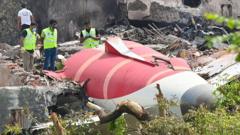
The tragedy took place on 12 June 2025, when an Air India Boeing 787 Dreamliner en route to London crashed seconds after taking off from the Ahmedabad airport in western India.
The plane came down about 6km (3.7 miles) from the airport, crashing into a building used as doctors' accommodation at a medical college, causing an explosion.
Altogether, 260 people - 241 on board and 19 on the ground - were killed in the crash. Only one passenger - Viswashkumar Ramesh, from Leicester - survived.
The AAIB launched an investigation soon after the crash and released a preliminary report a month later.
In an update released on the first anniversary of the crash, it said that "significant progress" had been made in the analysis of evidence but gave few other details.
In Tuesday's affidavit, the AAIB said that it had taken 49 of the 66 mandated steps for investigating any serious aircraft accident.
A year on, six questions still haunt the Air India crash investigation
The furious dispute over what caused Air India flight 171 to crash
A year of grief after Air India crash
This included examining the accident site and plane wreckage; collecting evidence, including the flight recorders; and reviewing relevant records, including the crew members' medical history and training records.
"A review of organisational culture, human factors and safety practices was undertaken. A psychological autopsy and evaluation were conducted, and the final report of the psychologist has been received," the affidavit said.
A psychological autopsy suggests that investigators asked an aviation psychologist to assess one or more crew members' psychological profile as part of the wider human factors investigation.
The affidavit also stated that it had prepared a transcript of the cockpit voice recorder but didn't reveal more details.
The preliminary report published last July had said that just seconds after take-off, fuel-control switches abruptly moved to the "cut-off" position, starving the engines of fuel and triggering total power loss.
Audio recordings from the cockpit captured one pilot asking the other why he had done it, with the other replying that he had not. The report did not identify which pilot made either statement.
The ambiguity in the report led to speculation about the role of the pilots in the crash, with some foreign media reports saying that investigators were shifting attention towards the senior pilot in the cockpit - Capt Sumeet Sabharwal.
The reports prompted a strong backlash from Sabharwal's father, pilots' associations in India and the AAIB, which criticised the coverage.
In the affidavit, filed in response to a lawsuit by Sabharwal's father asking for an independent investigation into the crash, AAIB said that "media speculation and narrative attributing blameworthiness to the pilots have, regrettably, caused some witnesses to become restrictive and non-responsive".
Related stories

The Punch
WorldJul 15, 2026 · 1 min
Free TV to reach 40m households with 100 channels — FG
The Punch
The Punch
WorldJul 15, 2026 · 1 min
FG sets date for final analogue TV switch-off
The Punch

Al Jazeera
WorldJul 15, 2026 · 1 min
What are the Israeli withdrawal ‘pilot zones’ in southern Lebanon?
Al Jazeera

Euronews
WorldJul 15, 2026 · 1 min
‘Once we were like you’: Ancient Roman faces brought back to life in Budapest exhibition
Euronews