Antara News
One-stop export policy to boost commodity bargaining power: minister
Bener Meriah, Aceh (ANTARA) - Indonesia is implementing a one-stop export policy as a strategic initiative to boost the bargaining position of its commodities in the global market and improve the welfare of domestic farmers.
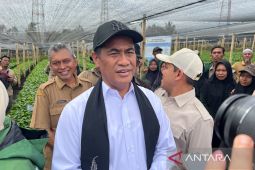
Speaking during a working visit to a coffee nursery in Aceh on Tuesday (July 14), Agriculture Minister Andi Amran Sulaiman stated that the policy directly reflects the directives of President Prabowo Subianto.
"Going forward, our exports will be one-stop. Why one-stop? So that we can be the ones determining prices. Not the consumers, but producers—which is Indonesia,” Amran said.
Through this centralized mechanism, Indonesia is projected to transition into a global price-setter for key export commodities.
The minister explained that this shift would ensure that the added value of national resources directly benefits the local farmers while significantly boosting the country's foreign exchange reserves.
Currently, the pricing of several major Indonesian commodities remains heavily dependent on foreign buyer markets, which limits potential profits for both local farmers and the state.
Amran Sulaiman pointed out that crude palm oil (CPO), for instance, has previously been priced at approximately Rp15,000 (approximately 0.94) per kilogram domestically, while the global market price hovered around Rp27,000 (US$1.69) per kilogram.
He noted that if domestic CPO prices could be lifted to Rp20,000 (US$1.25) per kilogram—closer to international rates—farmers’ incomes would see a substantial increase.
The centralized export policy, managed through state-owned enterprise PT Danantara Sumberdaya Indonesia (DSI), also aims to eliminate the rampant practice of under-invoicing.
Under-invoicing, where exporters intentionally report lower transaction values domestically than the actual sale price abroad, has long depleted potential state revenue.
To illustrate the stark pricing disparities, Minister Amran pointed to the CPO sector, where domestic buying prices languish between Rp14,000 and Rp15,000 (US$0.88 to US$0.94) per kilogram, even as the global resale price climbs upward of Rp27,000 (US$ 1.69) per kilogram on the international market.
"Under-invoicing means this is not taxable in Indonesia. The state has lost an estimated Rp16,000 trillion over 34 years because of this," Amran revealed.
“Now, we are fighting to correct this,” he added, acknowledging that the reform has faced resistance from affected parties.
Under Government Regulation No. 24 of 2026 concerning the Governance of Exports of Indonesia's Strategic Natural Resource Commodities, the one-stop export policy took effect on June 1, 2026, and is targeted to be fully operational by January 1, 2027.
To execute the mandate, state financial institution Danantara established PT Danantara Sumberdaya Indonesia (DSI) as the dedicated state-owned enterprise for exports.
The initial phase of the centralized policy will focus on three key strategic commodities: coal, crude palm oil, and ferroalloys.
Related news: Indonesian govt says shipping sector backs one-stop export policy
Related news: Danantara Sumber Indonesia won't profit from CPO export policy: Gov't
Translator: Muhammad Harianto, Yashinta Difa
Editor: Rahmad Nasution
Copyright © ANTARA 2026
View original source — Antara News ↗
Related stories

The Punch
WorldJul 15, 2026 · 1 min
How soldier forced Oyo kidnappers to free pupils – Ex-DSS chief
The Punch
The Punch
WorldJul 15, 2026 · 1 min
Free TV to reach 40m households with 100 channels — FG
The Punch
The Punch
WorldJul 15, 2026 · 1 min
FG sets date for final analogue TV switch-off
The Punch

South China Morning Post
WorldJul 15, 2026 · 1 min
Hong Kong police raid 2 indie bookstores, arrest several over national security
South China Morning Post