Indian Express
Explained: The row over Jammu and Kashmir’s sweeping ‘audit’ of academic material
The Jammu & Kashmir government has directed a sweeping audit of all academic material in educational institutions and public libraries across the Union Territory.
This was triggered by a controversy over the procurement of two books, allegedly “glorifying” separatist leaders, for government school libraries.
This fresh row over books comes a year after the Lieutenant Governor banned a number of books, including those by Arundhati Roy and A G Noorani, for “propagating secessionism”.
Here’s a look at the controversy, its fallout and the concerns the government action has raised.
At the centre of the controversy are two books — ‘Personalities and Legends of Jammu and Kashmir’ and ‘Great Personalities of Jammu and Kashmir’ — that were procured by many school libraries under the Union government’s Samagra Shiksha scheme for higher secondary classes.
The two books counted senior separatist leaders — such as Syed Ali Shah Geelani, Masrat Alam and the founder of Jammu and Kashmir Liberation Front (JKLF), Maqbool Bhat, who was hanged in 1984 — among the great personalities of the erstwhile state.
Story continues below this ad
While 123 copies of the first book were supplied to school libraries in Jammu, Ramban and Udhampur districts, 128 copies of the second were supplied in Jammu and Baramulla districts.
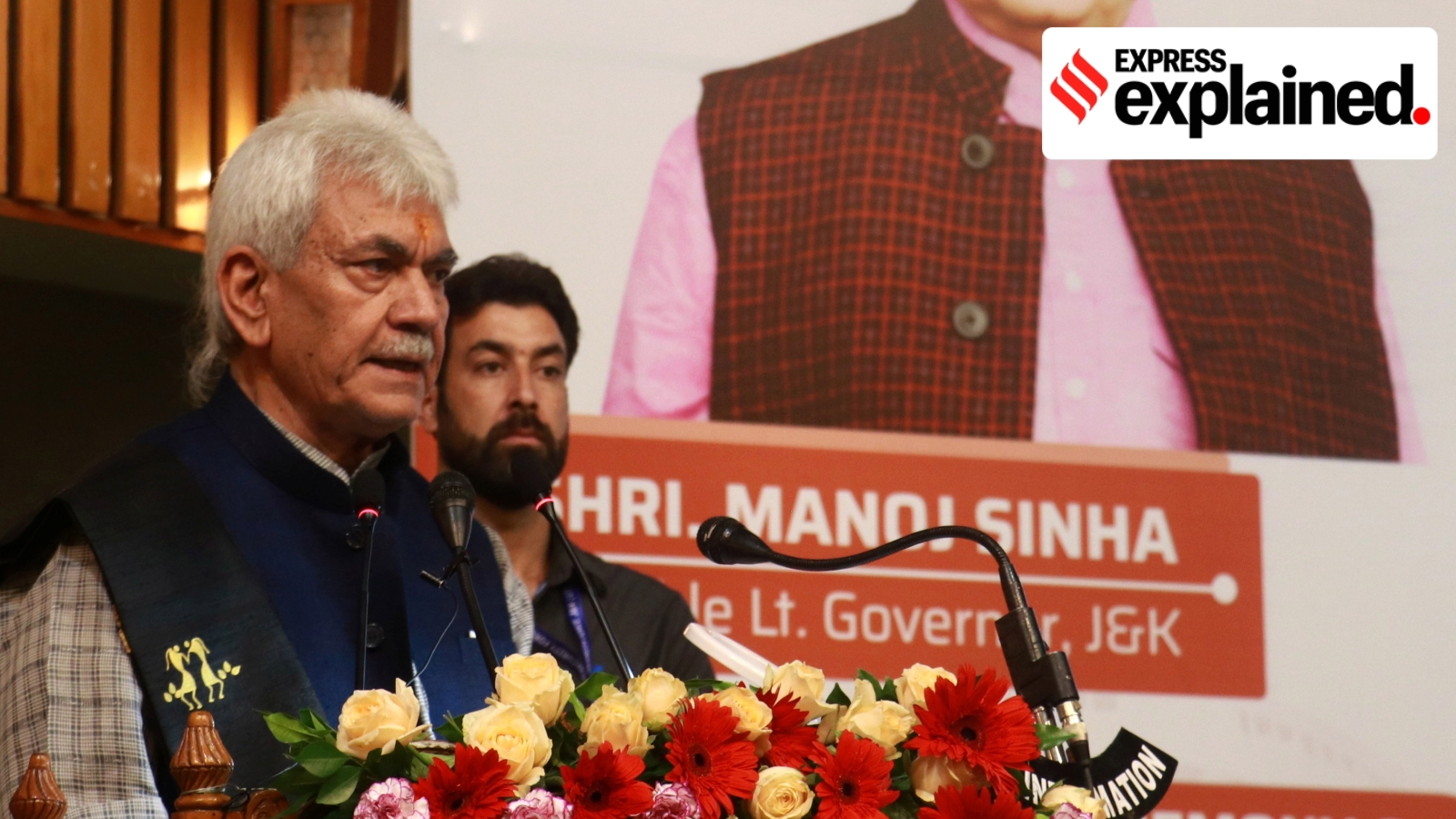
Following protests by the BJP in Jammu over the procurement, Lt Governor Manoj Sinha ordered the immediate suspension of eight employees of the school education department. Sinha also ordered a probe by a senior IAS officer. The two books were withdrawn from school libraries, and their authors and publishing houses were blacklisted.
How are books generally procured?
A government official, declining to be named, told The Indian Express that subject teachers generally recommend books as per their expertise. The list of recommended books is placed before a book procurement committee — every school has such a panel. The books that are approved by the committee are then procured for the school library.
The official said that some books are procured at higher levels of the government and sent to different schools for their libraries. Most of such books are procured through the Samagra Shiksha scheme now, he said.
What happened after the controversy broke out?
Story continues below this ad
Two days after the Lt Governor ordered suspension of eight employees, the Director of School Education issued a circular directing the heads of institutions of all government and private schools, as well as coaching centres, to screen all the books in their libraries, offices, classrooms or staff rooms for “inappropriate or objectionable content”.
It directed them to submit a document to Chief and Zonal Education Officers certifying that no book in the premises of their educational institution contains any “objectionable material”.
The order, issued by the Kashmir School Education Director Naseer Ahmad Mir read: “The purpose of this screening is to ensure that no book contains inappropriate or objectionable content. This includes material that may violate religious sentiments of any section, be it inappropriate content for students, contents against prevailing laws with the potential to harm national interest, affect educational values, and established norms.”
Story continues below this ad
A day later, the government extended the order to colleges, universities and public libraries across Jammu and Kashmir.
The government also broadened the ambit of the “audit”. It would now include not just books but also journals, research publications, academic theses and dissertations, and digital repositories of academic institutions.
What does the government define as objectionable content? What is its stand?
In a statement, the government has defined “objectionable materials” as anything containing “factually inaccurate, misleading, distorted, inflammatory, unlawful or otherwise objectionable content, including material that directly or indirectly promotes, glorifies, legitimises or justifies terrorism, violent extremism, secessionism, radicalisation or any activity prejudicial to the sovereignty, unity, integrity and security of the Nation”.
Story continues below this ad
It said no such book or academic material shall be procured, prescribed, recommended, retained, circulated, published, hosted or otherwise made available in educational institutions.
The government said that the initiative is intended to reinforce academic standards, strengthen institutional accountability, preserve the integrity of the educational ecosystem and establish a uniform framework for reviewing educational resources across schools, colleges and universities in the Union Territory.
Academic concerns
Last year, the Lt Governor’s administration banned the sale and publication of 25 books on Kashmir in Jammu and Kashmir for “propagating false narrative and secessionism in Jammu and Kashmir”. The banned books included A G Noorani’s ‘The Kashmir Dispute’, ‘Contested Lands’ by Sumantra Bose, Arundhati Roy’s ‘Azadi,’ and ‘In Search of Future (The Kashmir Story)’ by David Devdas.
Academics fear that screening books for their content and removing them from libraries could affect the quality of scholarship, research and independent thinking.
Story continues below this ad
“How can one expect quality education and meaningful research if students are exposed to only one set of perspectives?” said a professor of history, who declined to be named. “Research is about engaging with multiple viewpoints and arriving at informed conclusions. This order will lead to a death blow to genuine research and scholarship in Jammu and Kashmir.”
A former professor of political science, who also requested anonymity, said: “Every competing perspective deepens our understanding of a subject. There have long been unwritten restrictions on certain areas of research at Kashmir University.”
Political opposition
Naeem Akhtar, who was education minister in PDP-BJP coalition government, criticised the screening of books for their academic content, saying the government wants people to read what is “determined by their ideologues”. Pointing to last year’s book ban, he said the administration’s actions amounted to “saffronisation” of academics.
Story continues below this ad
“Sheikh Abdullah, the architect of accession, is banned from the school curriculum. Similarly Sheikhul Alam, seen as the icon of Kashmir’s sufi-secular tradition, has been taken out of books. Agha Shahid Ali, one of the biggest names in contemporary English poetry, who is being taught across American universities, is banned,” he said.
National Conference parliament member Aga Syed Ruhullah Mehdi said: “The reports of books relating to Kashmir’s history and identity being removed from University of Kashmir, alongside the ongoing audit of educational institutions are deeply troubling. Libraries exist to preserve knowledge, not curate political narratives. Erasing books doesn’t erase history, it only impoverishes scholarship.”
View original source — Indian Express ↗
Related stories

Euronews
TechnologyJul 15, 2026 · 1 min
UK unveils plans for voluntary overnight social media curfew for older teens
Euronews

TechRadar
TechnologyJul 15, 2026 · 1 min
'Ineffective and useless': the UK government is proposing a midnight social media curfew for 16 and 17-year-olds, but…
TechRadar

TechRadar
TechnologyJul 15, 2026 · 1 min
Hold up, Mint Mobile is currently selling the Google Pixel 10 for just $150 — and you don't even need to trade in
TechRadar

TechRadar
TechnologyJul 15, 2026 · 1 min
"The difference between launching now and launching never"
TechRadar