The Guardian
China’s economy grows at one of its lowest rates on record
China has posted worse-than-expected growth figures for the three months to June as its economy expanded by just 4.3% – one of its lowest quarterly readings on record.
The rate, which came in under the government’s target of 4.5% to 5%, was one of the weakest since reporting on official quarterly GDP figures began in the early 1990s.
The last period when growth was lower was the final quarter of 2022 when the country was still under its three-year period of Covid-19 restrictions.
The data released on Wednesday by the National Bureau of Statistics of China followed official customs figures for June that showed soaring exports, with outbound shipments increasing by 27%.
The contrasting figures highlight the extent to which China’s economy has become dependent on selling its goods abroad while the country struggles to drum up consumer demand and investment at home.
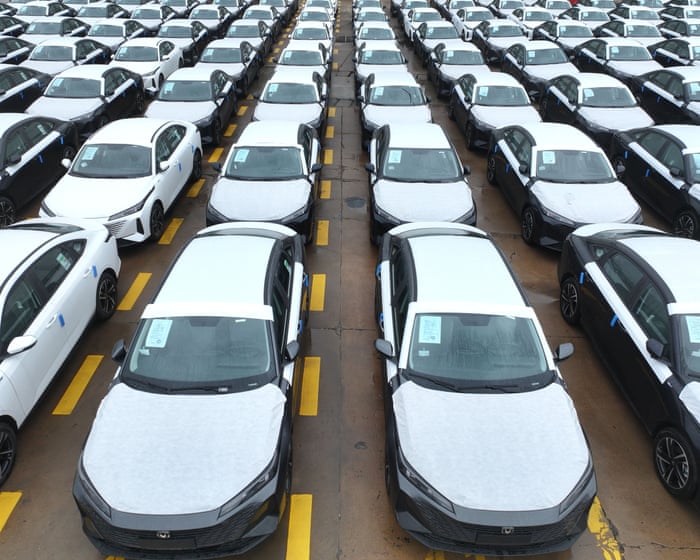
Monthly car exports topped 1m for the first time in June, but Wednesday’s statistical release showed domestic vehicle sales plummeted by more than 16%.
Although retail sales, excluding cars, increased by 3% last month, economists said more sustained growth in consumption was necessary.
Analysts are watching to see whether the Chinese Communist party will make any indication of new stimulus measures during a gathering of its top officials later this month.
Economists say more extensive measures are badly needed to increase consumer spending if the economy is to be rebalanced away from exports, which account for about 20% of gross domestic product.
In a speech on Saturday, Li Daokui, a leading Chinese economist and an adviser to Beijing’s senior leadership, said local governments had transformed from being the engines of growth to the bottlenecks.
Li, a professor of economics at Tsinghua University in Beijing, noted that fixed-asset investment – including spending on bridges, roads and infrastructure that has historically been managed by provincial authorities – declined by more than 4% between January and May.
Real estate and construction have previously been big drivers of the Chinese economy. Similar contractions in fixed-asset investment have happened only twice since the founding of the People’s Republic of China – in 1961 and 1967.
“The intensity and magnitude of this cumulative negative growth are unprecedented,” Li said, according to Chinese media reports. Along with unemployment, the decline in investment “must be given our utmost attention”, he continued. “If [these issues] are not addressed, all of China’s economic goals and tasks will face difficulties.”
The US-China trade war is in a detente phase but Beijing is nervous that a resumption of tariffs when the truce expires in November could hurt Chinese exporters and manufacturers.
The global economy is also under strain from the US-Israel war on Iran, which risks reducing global demand for Chinese goods. Although China has weathered the immediate economic shock of the conflict better than most countries, thanks to its large stockpiles of energy and diversified energy sources, a global recession would cause long-term pain for the export-driven Chinese economy.
Overall growth in the economy for the first half the year was 4.7%, according to official statistics, which was within Beijing’s target range. That may reduce the pressure on policymakers for any large-scale intervention.
View original source — The Guardian ↗
Related stories

TASS
BusinessJul 15, 2026 · 1 min
Russia sets up framework to accelerate adoption of local technologies — expert
TASS

MarketWatch
BusinessJul 15, 2026 · 1 min
Netflix earnings are coming. Here’s what’s needed to prop up the tumbling stock.
MarketWatch

CNBC
BusinessJul 15, 2026 · 1 min
Trump's attorney general nominee Todd Blanche faces Senate Judiciary questions
CNBC
CNBC
BusinessJul 15, 2026 · 1 min
Warren Buffett tells CNBC he initiated Berkshire Hathaway's investment in Alphabet
CNBC