Indian Express
Secret chat recordings can be allowed as evidence, rules Chhattisgarh High Court
6 min readNew DelhiJul 15, 2026 05:30 PM IST
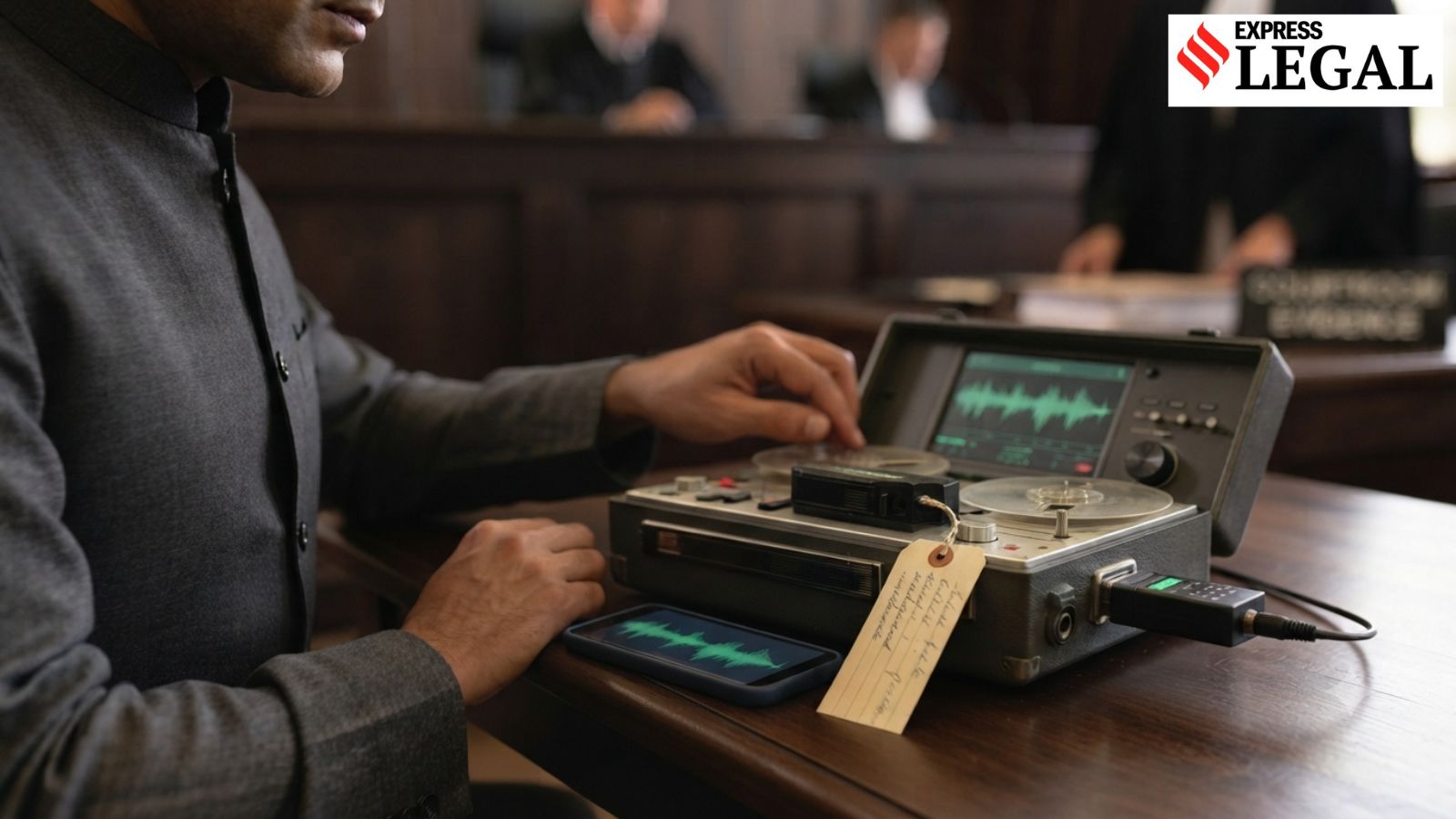
Setting aside the order, Justice Agrawal held that the trial court had committed a jurisdictional error by rejecting the documents solely on the ground of privacy. (Image generated using AI)
The Chhattisgarh High Court has ruled that the constitutional right to privacy does not automatically preclude the use of secret recordings of conversations as evidence in court, holding that such recordings must be tested for relevance, authenticity, and compliance with the law rather than being rejected outright.
The court said that merely because a conversation was recorded without the knowledge or consent of the other party does not, by itself, make it inadmissible in judicial proceedings.
Justice Ravindra Kumar Agrawal was hearing a petition filed by one Manit Singh Wadhawa challenging the trial court’s refusal to take on record an audio recording, its transcript and a forensic analysis report in a civil suit seeking specific performance of a land sale agreement and a declaration that subsequent sale deeds executed in favour of other purchasers were not binding on the plaintiff.
“The right to privacy, though recognised as a fundamental right under Article 21 of the Constitution of India, but it is not an absolute rule of exclusion rendering every privately recorded conversation inadmissible in judicial proceedings. The admissibility of an electronic record is required to be examined on the touchstone of its relevance to the facts in issue, its authenticity and compliance with the statutory requirement governing proof of electronic evidence. Merely because a conversation was recorded without the knowledge or consent of the other party does not, by itself, render such evidence inadmissible,” the court said on July 9.
The ruling came in a land sale dispute in Raigarh, where the plaintiff relied on recording of phone conversations between his brother and a defendant to prove the transaction. Reversing the trial court, which had rejected the recordings over privacy concerns, the high court held that issues of privacy, authenticity and admissibility must be decided during the trial, not while taking documents on record.
Justice Ravindra Agarwal said that although the right to privacy is recognised as a fundamental right, it cannot be treated as an absolute rule. (Image enhanced using AI)
Dispute over land sale
The case arose out of a civil suit filed by the plaintiff seeking enforcement of an agreement dated November 1, 2022, for the sale of a parcel of land in Raigarh. He also sought a declaration that sale deeds executed on November 5, 2024 and January 20 and January 27, 2025 in favour of other purchasers would not bind him.
According to the plaintiff, the son of the original landowner had held several phone conversations with his brother regarding the proposed transaction. During these conversations, the defendants allegedly expressed their need for money for a family wedding and requested that funds be arranged for the proposed sale.
Story continues below this ad
The plaintiff claimed that he subsequently made payments on multiple occasions pursuant to the understanding reached between the parties.
Audio recording before trial court
During the pendency of the suit, the plaintiff got his brother’s mobile phone examined by experts, obtained a transcript of the recorded conversations, secured an audio recording certificate, and produced a forensic analyst’s report.
He sought permission to place these documents on record by filing an application under Order 7 Rule 14 of the Code of Civil Procedure. The trial court, however, rejected the application on March 27.
It held that there was nothing to show that the defendant’s voice had been scientifically compared with the recorded voice and noted that the conversation had been analysed without obtaining the defendant’s permission.
Story continues below this ad
Relying on an earlier decision of the high court, the trial court concluded that permitting the recording would infringe the defendant’s right to privacy under Article 21 of the Constitution.
Trial court’s approach flawed
Setting aside the order, Justice Agrawal held that the trial court had committed a jurisdictional error by rejecting the documents solely on the ground of privacy.
The high court observed that although the right to privacy is recognised as a fundamental right, it cannot be treated as an absolute rule that automatically excludes privately recorded conversations from judicial proceedings.
Instead, the court said the admissibility of electronic records has to be assessed based on their relevance to the dispute, their authenticity and whether they satisfy the statutory requirements governing electronic evidence, not only privacy.
It further observed that issues such as whether the voices were correctly identified, whether the recording had been tampered with and whether the mandatory legal requirements had been fulfilled are all matters to be examined during trial after parties lead evidence.
Those questions, the court said, cannot be prejudged merely because one party alleges an invasion of privacy.
Supreme Court precedents cited
The high court relied on several Supreme Court decisions. It referred to R M Malkani vs State of Maharashtra (1973) and Pooranmal vs Director of Inspection (Investigation) (1974), where the apex court held that relevant evidence cannot ordinarily be excluded merely because of the manner in which it was obtained unless there is a specific statutory prohibition.
The high court also cited the Constitution Bench judgment in K S Puttaswamy (Retd) v Union of India (2017), which recognised privacy as a fundamental right while making it clear that the right is subject to constitutionally permissible restrictions.
Further reliance was placed on Arjun Panditrao Khotkar v Kailash Kushanrao Gorantyal (2020), which clarified that the admissibility and proof of electronic records must be examined under the statutory framework governing electronic evidence.
Story continues below this ad
Order set aside
Allowing the writ petition, the high court set aside the March 27 order of the Fifth District Judge, Raigarh, and directed that the audio recording, transcript and related documents be taken on record.
However, the court clarified that it had expressed no opinion on the admissibility, proof, authenticity or evidentiary value of the electronic evidence.
It directed the trial court to independently decide those questions at the appropriate stage of the proceedings after considering the evidence and objections raised by the parties, strictly in accordance with law.
Vineet Upadhyay is an Assistant Editor with The Indian Express, where he leads specialized coverage of the Indian judicial system.
Expertise
Specialized Legal Authority: Vineet has spent the better part of his career analyzing the intricacies of the law. His expertise lies in "demystifying" judgments from the Supreme Court of India, various High Courts, and District Courts. His reporting covers a vast spectrum of legal issues, including:
Constitutional & Civil Rights: Reporting on landmark rulings regarding privacy, equality, and state accountability.
Criminal Justice & Enforcement: Detailed coverage of high-profile cases involving the Enforcement Directorate (ED), NIA, and POCSO matters.
Consumer Rights & Environmental Law: Authoritative pieces on medical negligence compensation, environmental protection (such as the "living person" status of rivers), and labor rights.
Over a Decade of Professional Experience: Prior to joining The Indian Express, he served as a Principal Correspondent/Legal Reporter for The Times of India and held significant roles at The New Indian Express. His tenure has seen him report from critical legal hubs, including Delhi and Uttarakhand. ... Read More
Tags:
audio recordings
electronic devices
right to privacy
View original source — Indian Express ↗
Related stories

The Punch
WorldJul 15, 2026 · 1 min
JUST IN: NCAA suspends pilots, grounds jet involved in Asaba road-landing incident
The Punch
The Punch
WorldJul 15, 2026 · 1 min
Delta CP warns security outfits against torture, unlawful detention
The Punch
The Punch
WorldJul 15, 2026 · 1 min
How First Lady’s support helped transform my Akara business – Man
The Punch
The Punch
WorldJul 15, 2026 · 1 min
Oyo abduction: Invest in schools’ security, Ansar-Ud-Deen urges FG, state govts
The Punch