CNA
Some businesses will lose out amid deeper Singapore-Malaysia economic integration, but both sides will benefit: Tharman
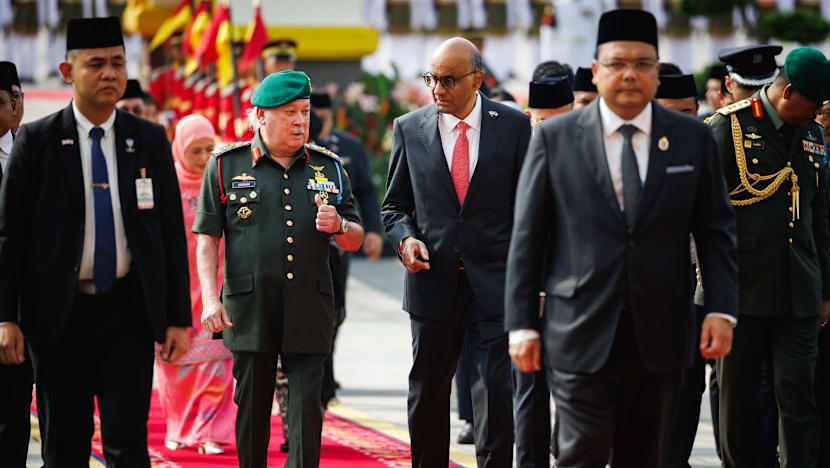
SINGAPORE: President Tharman Shanmugaratnam said some Singapore businesses would lose out as economic ties deepen with Malaysia, but stressed that closer integration would ultimately benefit both countries.
Speaking on Wednesday (Jul 15) at the end of his four-day state visit to Malaysia, Mr Tharman said that initiatives such as the Johor-Singapore Special Economic Zone (JS-SEZ) and the Johor Bahru-Singapore Rapid Transit System (RTS) Link would strengthen the two countries' economic complementarity.
The JS-SEZ, established in 2025, aims to strengthen economic relations between Singapore and Johor by facilitating investment, talent flows and cross-border business activity. The RTS Link, which is expected to begin operations in January 2027, will further enhance connectivity between Woodlands and Johor Bahru.
"It is no secret that, in linking up more with Johor for instance – through the Special Economic Zone and the RTS Link – there will be some businesses in Singapore who lose out - some service industries will lose out," Mr Tharman told reporters in Kuala Lumpur.
"But others will gain, and on the whole, both countries will be winners.
"We have to accept that, with the larger win, there will be some losses. And that is a mature way of thinking about the bilateral relationship, on both sides," he said.
SHARED AMBITIONS
Beyond bilateral ties, Mr Tharman said Singapore and Malaysia are also aligned on broader ambitions for the Association of Southeast Asian Nations (ASEAN).
He said the region could become a "powerhouse" for green energy and processing power, with the former needed to power data centres in Malaysia.
"It is in the national interests of each ASEAN member state that we join forces on green energy, in processing power, and in the digital economy," Mr Tharman said, adding that a stronger ASEAN would help countries navigate an increasingly fragmented global landscape.
He added that Singapore and Malaysia shared "very similar thinking" on ASEAN and that Malaysia was keen to work closely with Singapore on regional initiatives as Singapore assumes the ASEAN chairmanship in 2027.
Mr Tharman also said Singapore and Malaysia were closely aligned on major international issues, including support for the United Nations Convention on the Law of the Sea (UNCLOS), and the principle of safe transit through the Straits of Malacca and Singapore without tolls or fees.
He added that Singapore and Malaysia remained committed to working with Indonesia, as the three littoral states, to manage the straits cooperatively with user states and the shipping industry through voluntary contributions to support navigational safety and environmental protection.
"It has worked well and is an example of how littoral states can manage international waterways in ways that are win-win for all users and, importantly, abide by the law of the sea," Mr Tharman said.
The two countries also shared similar views on maintaining open markets for global trade and investment, he said.
"In a world that's becoming more divided, we are also very keen to diversify our trading links, individually and as a region, and to avoid at all costs being forced by geopolitics into either a US-led bloc or a China-led bloc," said Mr Tharman.
"We have to engage with each of the major powers, and grow our links with other regions of the world. Malaysia's and Singapore's thinking is very much alike in that regard," he added.
ENGAGING WITH MALAYSIAN STATES
On Singapore's engagement with Malaysian states, Mr Tharman said these relationships complemented ties with the federal government.
During his visit, he met the Sultan of Selangor, Sultan Sharafuddin Idris Shah, Crown Prince Tengku Amir Shah and the Sultan's senior advisers. Their discussions covered vocational education, the cleanup of the Singapore River and flood mitigation.
"They are keen to see what they can borrow from our experience, not just the experience of the Europeans and others, but the Singapore experience," Mr Tharman said.
He also met the Selangor chief minister Amirudin Shari, who he said was interested in advancing economic integration. The president noted Singapore companies continue to invest in Selangor, citing SIA Engineering's recently established aircraft maintenance and repair operations in Subang.
During the state visit, Mr Tharman also met with Malaysia's King Sultan Ibrahim Sultan Iskandar and Malaysian Prime Minister Anwar Ibrahim, with discussions covering food security and energy, geopolitical developments and economic partnership.
INVESTING IN FUTURE GENERATIONS
Looking ahead, Mr Tharman said he hoped Singapore and Malaysia could strengthen ties by creating more opportunities for young people to study, work and build friendships across the Causeway.
He suggested that both countries could expand student exchanges, internships and entrepreneurship programmes that allow young people to spend more time together.
"But there is nothing like living together, studying together, and hanging around together over a longer period, or repeated periods, that makes for lasting friendships and a more enduring understanding of each other," he said.
"It’s not easy to arrange; it may require some credit to be given to the students. But there will be larger strategic benefit in time."
Mr Tharman also called for greater collaboration in the arts, saying both countries could build on existing cultural exchanges by giving shared traditions "fresh appeal" for younger generations.
Related stories

The Punch
PoliticsJul 15, 2026 · 1 min
Trump slams ICE decision to suspend traffic stops after two shootings
The Punch

Philippine Daily Inquirer
PoliticsJul 15, 2026 · 1 min
Highlights: Day 6 of Sara Duterte impeachment trial | July 15, 2026
Philippine Daily Inquirer

The Hill
PoliticsJul 15, 2026 · 1 min
Rollins touts USDA ‘progress’ in crackdown on SNAP fraud
The Hill

The Hill
PoliticsJul 15, 2026 · 1 min
Trump administration snubs Aspen Security Forum for second year
The Hill