Times of Israel
There’s a new Democratic consensus on aid to Israel — against it
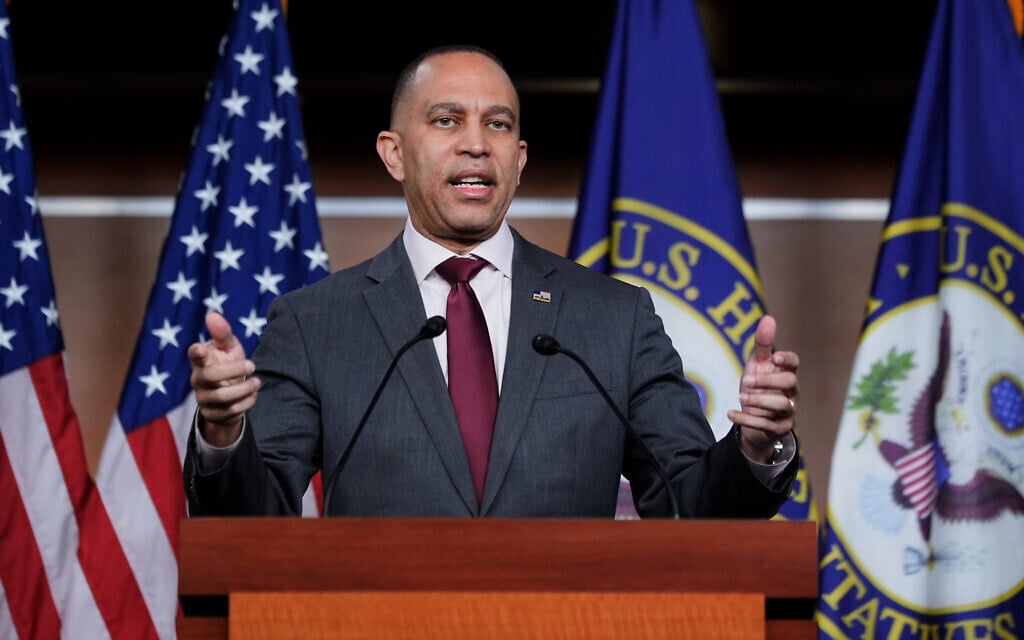
When US Rep. Hakeem Jeffries ascended the stage at the mass pro-Israel rally in Washington, DC, on November 14, 2023 — a political lifetime ago — he wanted the crowd to know how proud he was that the Biden administration was sending billions of dollars of military aid to Israel.
“Congress will continue to support, in a bipartisan way, the State of Israel and Israel’s unequivocal right to exist as a Jewish and democratic state, always and forever,” Jeffries, the Democratic leader in the US House of Representatives, said at the time. “I strongly support President Biden’s supplemental funding request for Israel, for Ukraine and for humanitarian assistance.”
Those billions — which were approved by Congress months later — came on top of the $38 billion in military aid the US had previously agreed to give Israel from 2019 to 2028. That agreement is expiring soon, and as the US prepares to consider a fresh memorandum of understanding with Israel, Jeffries has a new figure in mind for Israel aid: zero.
“A meaningful change in direction is needed,” Jeffries wrote in a recent letter to his Democratic caucus. “Israel has an advanced economy and is capable of paying for its own sophisticated weapons, as the Prime Minister recently acknowledged.”
To clear up any confusion, this was a pro-Israel letter. Its goal was to urge Democrats against voting to immediately bar all aid to Israel in an upcoming 2027 appropriations bill.
Get The Times of Israel's Daily Edition
by email and never miss our top stories
By signing up, you agree to the terms
Doing so, he said, would undermine Israel’s fight against terrorist groups that also threaten the US, and would also threaten funding for humanitarian aid.
But Jeffries does agree on the core idea: At some point, soon, US military aid to Israel should end. That statement, by a senior pro-Israel stalwart no less, shows how much the fault lines have shifted for Israel over the past couple of years among Democrats.
A commitment that has long symbolized the US-Israel relationship is quickly falling out of favor. Both parties, once jointly committed to US military aid, now have voices calling to turn off the spigot. Israel knows it, and is preparing accordingly.
A ‘sacrosanct’ pledge
“Our security assistance to Israel is sacrosanct,” Antony Blinken, US president Joe Biden’s secretary of state, told the liberal Israel lobby J Street in late 2022. Blinken, a Democrat, was speaking for what had been a longstanding bipartisan consensus.
Support for US aid to Israel, in fact, was once virtually unanimous. In 2016, Congress passed a resolution expressing support for continued US aid to Israel. The vote was 405-4. Shortly afterward, the Democratic administration of president Barack Obama inked an unprecedented MOU with Israel, providing $3.8 billion per year for 10 years, $800 million more than the previous MOU.
When Donald Trump took office after Obama, he tried hard to undo much of his predecessor’s legacy. But when the Obama-era MOU came into effect, Trump’s White House celebrated it.
The MOU “reflects the enduring and unshakable commitment of the President, this Administration, and the American people to Israel’s security,” read an announcement from Trump’s US State Department. “The MOU was negotiated under the previous Administration, reflecting the bi-partisan nature of this commitment.”
When Biden assumed the presidency, he continued supporting US aid to Israel, and upped the commitment after the Hamas-led October 7, 2023, attack launched the Gaza war.
But now, instead of agreeing on the importance of sending assistance to Israel, leading Democrats agree that the aid needs to end. Two party members thought of as longshot 2028 presidential contenders, former ambassador Rahm Emanuel and Rep. Ro Khanna, both recently visited Israel. Both want to end aid.
Emanuel, who is on the party’s pro-Israel wing, said in a speech in Tel Aviv that the US “should end at long last the American taxpayer’s subsidy of Israel’s defense budget.”
Khanna, who is firmly on the party’s anti-Israel wing and alleged that he was detained by settlers in the West Bank, supported the congressional measure to immediately block assistance for Israel.
That measure is being spearheaded by a Republican, Thomas Massie, who has long opposed aid to Israel. Massie stands to be ousted from Congress after losing a primary race over his seat representing Kentucky, in part over his opposition to Israel, but he isn’t the only Republican to question US military aid to Jerusalem. In 2024, running for president, Trump mused about converting the assistance into a loan.
“Don’t forget, we help Israel a lot,” Trump said the following year in a meeting with Prime Minister Benjamin Netanyahu, who pushed unsuccessfully to eliminate US tariffs on Israel. “You know, we give Israel $4 billion a year — and congratulations, by the way, that’s pretty good.”
A new debate
The new question dividing Democrats is whether Israel should even be able to purchase US weapons, and whether a ban on arms sales should include parts for missile defense systems. A bill called the Block the Bombs Act, which prohibits certain arms sales to Israel, has 75 cosponsors — more than a third of House Democrats (and Massie).
Polls show that about half of Democrats believe Israel is guilty of genocide. Progressive candidates are running on the idea that billions lavished on Israel should instead be spent addressing the needs of Americans at home.
The Democratic pro-Israel position is becoming, in effect, that aid should end, but arms sales should continue to ensure Israel’s qualitative military edge over its neighbors, along with ongoing collaborations on defense tech and intelligence.
“A new security arrangement should undergird the maintenance of Israel’s qualitative military edge against Iran and other malign actors in the region,” Jeffries wrote in his letter. “Mutually beneficial joint technology, innovation, research and further development of defensive programs like Iron Dome, Arrow and David’s Sling should be prioritized.”
He asked his fellow Democrats not to vote for Massie’s measure. But recognizing that some would, he didn’t demand party discipline, writing that “given the strongly held views throughout the Caucus in this important area of foreign policy, we are not whipping this vote.”
“There are good faith reasons that will result in members voting in a variety of different ways with respect to the amendment,” he noted.
Next year, depending on the outcome of the US midterm elections, Jeffries may be speaker of the House. He may be able to push through continued funding for Israel, but for the first time in decades, it’s not a given.
J Street, like Jeffries, opposed Massie’s effort, but said it would still support Democrats who vote for it “to signal their opposition to unconditional [military aid] and support for stronger oversight of how US security assistance is used.”
Reading the tea leaves
US aid to Israel still has its defenders. The pro-Israel lobby AIPAC issued a robust defense of the assistance in April, writing in a memo that the aid ensures US access to cutting-edge weapons, does not require an American troop presence on the ground as in other countries, and creates 20,000 jobs at home because the aid must be spent in the US.
“Security assistance to Israel advances America’s interests and values, helps enable our democratic ally to defend itself and strengthens the ironclad relationship between the United States and the Jewish state,” AIPAC wrote.
Israelis, though, are realistic about where things appear headed. One person reading the tea leaves and backing away from continued US funding is Netanyahu himself, who said earlier this year that he hopes to gradually wind down reliance on US military aid.
Other Israeli voices have argued that ending US aid will give Israel more freedom of action on the battlefield. And the $3.8 billion Israel gets from the US annually is only a fraction of its own $45.8 billion defense budget, which has ballooned since the October 7 attack.
“We want to be as independent as possible,” Netanyahu told the Economist in January. Referring to a meeting with the US president weeks earlier, he said, “In my visit to President Trump, I said we very deeply appreciate the military aid that America has given us over the years, but here too we’ve come of age, and we’ve developed incredible capacities.”
Emanuel and Jeffries both framed their calls for a transition from aid to weapons sales as a move to normalize the US relationship with Israel, treating it like any other country rather than a client state.
“Israel should be able to buy American arms under the same financial terms, the same restrictions, and the same requirements as every other trusted ally that abides by our laws,” Emanuel said.
Stopping aid, he added, means Israel will become a country “that buys its weapons like an ally, and not a dependent.”
View original source — Times of Israel ↗
Related stories

The Punch
TechnologyJul 15, 2026 · 1 min
NIMC, IT firms push for secure digital government services
The Punch

Euronews
TechnologyJul 15, 2026 · 1 min
Former Hungarian foreign minister Szijjártó resigns from parliament to join Chinese carmaker
Euronews

Indian Express
TechnologyJul 15, 2026 · 1 min
Publishers sue Google over use of copyrighted books for AI training
Indian Express

The Verge
TechnologyJul 15, 2026 · 1 min
Netflix tries to recapture Stranger Things magic with nostalgic re-release
The Verge