BBC
Report finds secrecy impacted handling of nuclear test veterans' records
High levels of Cold War "secrecy" were a factor in the haphazard approach taken towards the medical records of nuclear test veterans, an official report has found.
The lack of a centralised approach means that the system will appear "complex and inconsistent" to the veterans who have been campaigning for the full release of their medical records.
The findings come in a series of official documents released by the Ministry of Defence (MoD) in response to years of campaigning by the veterans.
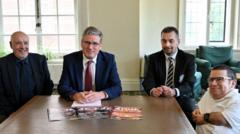
Andy Burnham spoke up in favour of the nuclear test veterans on Tuesday evening in his first speech in parliament since his re-election last month, endorsing their call for a "special tribunal".
As many as 25,000 members of the UK armed services, scientists and civilians took part in the nuclear testing programme between 1952 and 1967 at sites including Australia and several islands in the Pacific Ocean.
Veterans who believe they have suffered ill health as a result of their service can apply for no-fault compensation under the War Pensions Scheme.
They believe that records of blood and urine tests taken around the time they witnessed nuclear tests will provide crucial evidence to prove their claim that their health was damaged.
The report said there has never been "a single store of records" relating to every service person, mainly because the Army, Navy and Royal Air Force were each run by separate government departments until 1964.
It says: "At a basic level, there is not, and never has been, a single store of records related to every serving person, maintained over decades with all preserved in perpetuity.
"This is fundamental to understanding how these records have been managed and therefore what is possible and available for the veterans and their descendants to access."
But the report says that Cold War secrecy was a factor in the way medical records were kept.
It says: "One also cannot overlook the national security considerations around the nuclear testing programme that would likely have influenced what took place, what was recorded, and the levels of secrecy observed by those involved.
"It was a time of extremely high geopolitical tensions at which the world came close to nuclear conflict, and the nuclear weapons programme of the UK and the US were the subject of espionage by our enemies intent on developing technology and weapons of their own.
"There is some evidence of these considerations impacting the approach."
Other finding in the report include:
The disclosure that the medical records of some nuclear test veterans may have been inadvertently destroyed in 2023. They may have been among a batch of 34 RAF medical records destroyed due to "incorrect metadata". The service personnel's dates of birth were not recorded which meant the dates of 1800 and 1900 were put down. That led to the automatic destruction on the grounds that the personnel had been "born" more than 100 years ago
The number of UK armed forces and scientists who took part in the nuclear testing programme may be 15% higher than the estimated 21,357. That would take the numbers to nearly 25,000
The military authorities were aware at the time of the nuclear tests that they might be liable to compensation claims.
The Ministry of Defence has released five reports after the government promised to embark on a comprehensive examination of the information the department holds on medical records.
The reports cover the three armed services, the Atomic Weapons Establishment, and an overall narrative.
The narrative report addresses the core issue at the heart of the veterans' demands: an explanation of what happened to their blood and urine samples.
The report says that a range of policies were in place around blood tests during the nuclear testing programme., but it says no evidence was found to suggest there was an overall policy on urine testing although this was done on an ad hoc basis following suspected exposure to a nuclear explosion.
Blood tests were taken for two reasons: to assess an individual's fitness to work before they were deployed, and to be used as a baseline, in the event of a future accidental exposure to radiation levels above the maximum permissible doses.
The report said that care was taken with the testing but the military authorities were aware that they might be liable for future compensation claims.
The veterans say that access to their medical records – and principally records of their blood and urine tests – are crucial to their campaign to prove their health suffered as a result of exposure to radiation.
The MOD says there needs to be reliable evidence to raise reasonable doubt of a causal link between exposure to radiation and certain cancers.
The report says that the medical records do show in some cases in clear terms the details of blood and urine tests, but in most cases there are no records available.
One of the nuclear veterans told BBC Newsnight on Monday that he expected the report to be a whitewash.
Brian Unthank said: "My take on it is it is going to turn out to be a total whitewash as usual.
"My understanding is there's no comments about the missing medical records, the compensation, a lot of other things. So it has been cut to the bare minimum I think."
The report acknowledges that many veterans believe they have suffered ill health as a result of their service.
But it repeats the MOD claim, based it would say on independent scientific and medical research, that the overall levels of mortality and cancer among nuclear test veterans is similar to matched service personnel and lower than the general population.
Related stories

The Punch
PoliticsJul 15, 2026 · 1 min
PFIPC scandal: Again, Senate rejects probe request
The Punch

The Hill
PoliticsJul 15, 2026 · 1 min
Four states linked to cyclosporiasis outbreak, CDC warns more could be involved
The Hill
The Punch
PoliticsJul 15, 2026 · 1 min
Zambia’s Scott, once Africa’s only white leader, dies at 82
The Punch

The Hill
PoliticsJul 15, 2026 · 1 min
Kathy Hochul bans data centers for a year; accountability incoming
The Hill