Times of Israel
High Court freezes implementation of law banning arrest of Haredi draft-dodgers
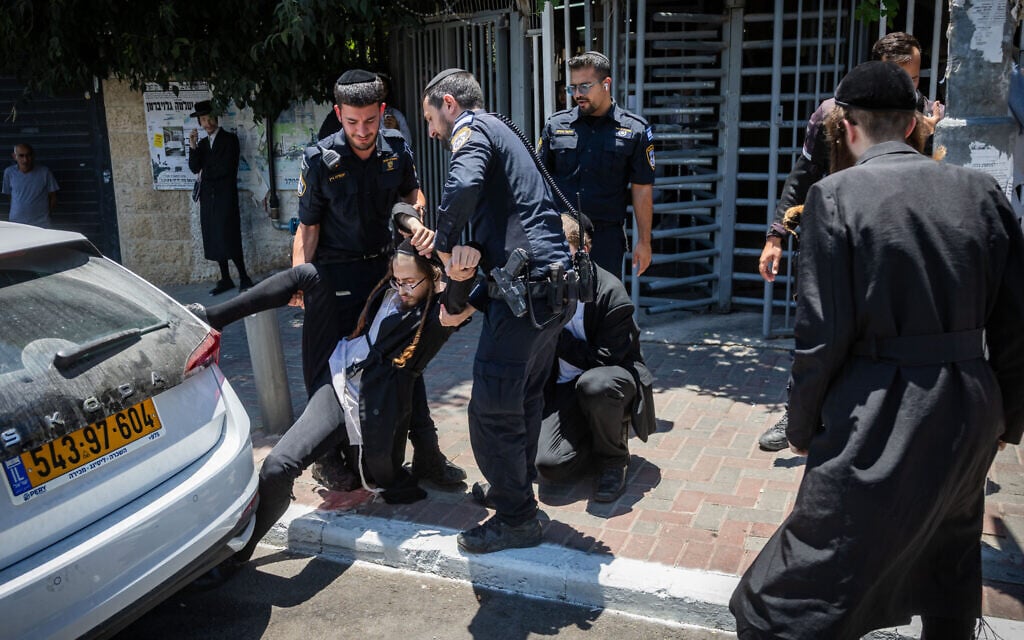
In a dramatic intervention on Wednesday, the High Court of Justice froze the implementation of a law passed by the Knesset only a day before, which banned the arrest of ultra-Orthodox draft dodgers for seven months.
In response to petitions against the law, the court ordered that a hearing be held as soon as possible over the legislation and issued a temporary order preventing the law from coming into effect until further decision.
The court also issued a conditional order requiring the government to explain why the law should not be struck down, in light of previous High Court rulings on the issue and the arguments of petitioners which the court said held “significant weight.”
Justice Ofer Grosskopf, who issued the decision, said he did so due to “this court’s longstanding rulings on the issue of drafting yeshiva students, the implications of freezing arrest, investigation and enforcement procedures with respect to only certain segments of the population, and the weighty arguments raised by the petitioners against its validity.”
A hearing before an expanded panel of judges will now be scheduled, after which the court may issue an interim order freezing implementation of the law until a final ruling.
Get The Times of Israel's Daily Edition
by email and never miss our top stories
By signing up, you agree to the terms
The law bans arrests, investigations and enforcement measures against draft dodgers enrolled in yeshiva study until November 30, but will actually extend to February 2027 due to legal reasons tied to the upcoming elections.
IDF Chief of Staff Lt. Gen. Eyal Zamir called the law “inconceivable” on Monday, saying it was “clearly and unequivocally inconsistent with the IDF’s needs” and amounted to “providing mass exemptions from prosecution.”
Some 72,000 ultra-Orthodox men aged 18 to 24 are currently eligible for military service, but have ignored conscription orders. The IDF has said repeatedly in recent months that it urgently needs 12,000 new recruits amid the ongoing multifront conflict.
Several petitions were filed against the law immediately after its passage Tuesday afternoon, arguing that the legislation was discriminatory since it bans arrests for ultra-Orthodox yeshiva students who have failed to obey conscription orders, while allowing arrests for non-Haredi draft dodgers to continue.
Immediately following the court’s decision to freeze implementation of the law, Communications Minister Shlomo Karhi called for the government and the police to ignore the order.
“An order that cancels or ‘suspends’ a law has no legal validity. There is no legal source of authority for such an action. One must not obey lawbreakers,” said Karhi, seemingly denying entirely the authority of the High Court to conduct judicial review of legislation, one of its key roles.
“Law enforcement authorities in the State of Israel must obey the law,” Karhi added, in an apparent call for police not to conduct arrests of haredi draft dodgers, in line with the legislation.
Karhi, a hard-right member of the Likud party, has repeatedly called for the government not to obey the court, and on one occasion gave instructions to his ministry that directly contravened a court order.
MK Meir Porush of the Haredi United Torah Judaism party made similar comments, saying that the court ruling was “not legal” and adding that “any policeman or soldier who arrests or cooperates with the arrest of Torah students is breaking the law.”
Shas Chairman MK Aryeh Deri denounced the court over its Wednesday decision, saying the court was “drunk with the power of judicial activism. He also claimed that the law was designed to provide time for “agreement within Israeli society” over ultra-Orthodox enlistment, and that the court had “trampled democracy” by failing to allow such a process to unfold.
Deri and other Haredi political leaders have repeatedly insisted that yeshiva students should not be obligated to perform military service and have worked to pass legislation to that effect.
The government has increasingly come close to triggering a constitutional crisis in its rhetoric against obeying court orders. Two weeks ago, the cabinet issued a resolution declaring that it did not view a High Court ruling regarding Israel’s broadcast media regulatory body as valid, and said that decisions by that body under the terms of that ruling would not be considered binding. The cabinet secretary later asserted that the declaration merely represented a “sharp criticism” of the court.
View original source — Times of Israel ↗
Related stories

Straits Times
TechnologyJul 15, 2026 · 1 min
Dozens arrested in Egypt for joining opposition Discord server
Straits Times

TechCrunch
TechnologyJul 15, 2026 · 1 min
Google’s biggest clean power project is 40 miles north of xAI’s unpermitted gas power plant
TechCrunch
TechPana
TechnologyJul 15, 2026 · 1 min
How a Family Dispute Became YouTube Content: The Legal and Ethical Questions Behind the Junu Pariyar Case
TechPana

TechRadar
TechnologyJul 15, 2026 · 1 min
‘A candidate who was hostile from day one never produces that baseline’
TechRadar