Mexico News Daily
Sheinbaum presents anti-femicide bill expanding prosecution and punishment of the crime: Wednesday’s mañanera recapped
Sheinbaum’s mañanera in 60 seconds
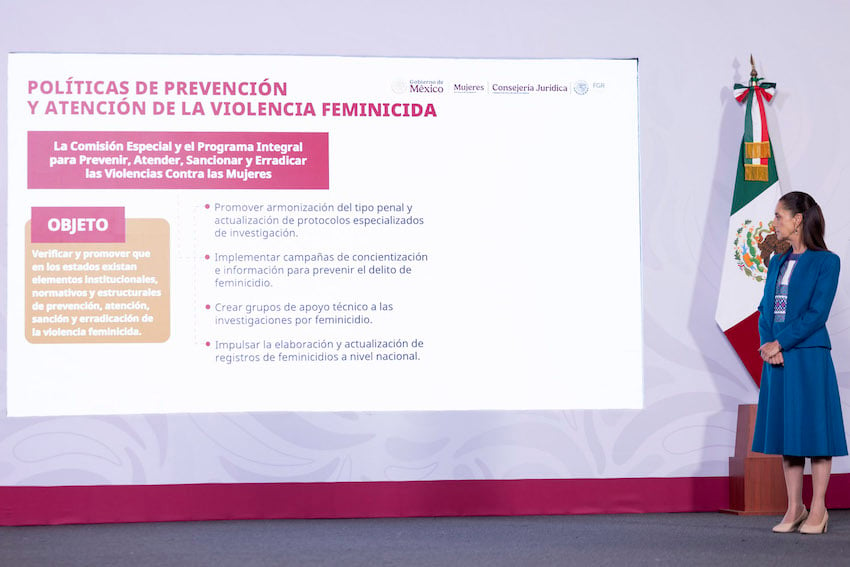
⚖️ Femicide prevention bill presented: Legal adviser Luisa María Alcalde unveiled a proposed general law aimed at standardizing femicide investigation nationwide. The proposed law seeks to establish 10 “reasons of gender” for the crime and set a uniform penalty of 50 to 70 years imprisonment, with 19 aggravating circumstances able to increase punishments further. Attempted femicide would carry sentences as high as 45 years imprisonment.
🚫 No more “suicide” reclassifications, Sheinbaum says: The president said some state prosecutors’ offices still classify violent deaths of women as suicides, and the new law aims to standardize how all Attorney General’s Offices handle femicide cases. She said the goal is “zero impunity,” noting that most femicides are committed by a partner or ex-partner.
💊 Sheinbaum dismisses DEA chief’s cartel remarks: Responding to DEA Administrator Terry Cole’s claim that the Mexican government and cartels are “one and the same,” Sheinbaum called the statement baseless and more political than substantiated. She argued the DEA should focus more on drug production, sales and money laundering inside the United States.
Why today’s mañanera matters
At today’s mañanera, the federal government presented a bill aimed at preventing femicides and ensuring that there is no impunity when the crime is committed. The presentation of the proposed law lent significant weight to the presidential press conference, held, as usual, at the National Palace in the historic center of Mexico City. The bill is expected to be passed by Congress later this year.
Violence against women is a major problem in Mexico, but President Claudia Sheinbaum — the country’s first female president — is determined to do all she can to combat it.
The bill presented at her Wednesday morning press conference is the latest manifestation of that commitment.
The government reported on Tuesday that femicides declined 10.7% annually in the first half of 2026, but there is still plenty of work to be done.
According to official data cited in an El Universal newspaper report, there were 6,440 femicides in Mexico between January 2019 and January 2026. The real number of victims is certainly higher than official data indicates, given that, as Sheinbaum pointed out at today’s mañanera, not all femicides are classified as that crime.
Alcalde presents femicide prevention bill
At the start of her press conference, Sheinbaum announced that the government would present a proposed law on femicide, whose full title is set to be the General Law to Prevent, Investigate, Sanction and Compensate for the Crime of Femicide.
“Remember that we made a modification to the constitution so that femicide could be investigated in the same way in the entire country through a general law,” she said.
“This initiative was approved by all political forces in Congress,” Sheinbaum said.
The proposed general law, if approved, would obligate “all states” to investigate femicide in a uniform manner, she said.
Luisa María Alcalde, the president’s chief legal adviser, told reporters that a general law on femicide is needed as Mexico’s 32 federal entities “regulate” femicide in different ways and there are “deficiencies” in processes to investigate the crime.
Alcalde said that the proposed law — which Sheinbaum signed on Wednesday ahead of its submission to Congress — will standardize the definition of femicide. She explained that femicide will be defined across Mexico as the act of killing a woman (or girl) for “reasons of gender.”
Alcalde said that “10 reasons of gender” will be established including “signs of sexual violence”; a “crime motivated by stereotypes or prejudices”; “history of violence against the victim”; and “contexts of power asymmetry.”
She also said that the proposed law will establish a uniform national penalty for femicide of 50 to 70 years imprisonment. Alcalde also said the law will establish 19 “aggravating circumstances,” which — if applicable — would increase the sentences given to perpetrators of femicide.
Offenders’ prison sentences would increase if their victim was a girl; an adolescent; a journalist; a human rights defender; a migrant; elderly; pregnant; or had a disability.
Among the other “aggravating circumstances” is one in which perpetrators of femicides use acid or flammable substances during their attacks.
Alcalde also said that the proposed law will establish standardized penalties for attempted femicide. People found guilty of that crime could face prison terms in excess of 45 years.
Among the other aspects of the proposed law is a prohibition on the presentation/consideration of extenuating circumstances in cases of femicide.
Sheinbaum: ‘I assumed the responsibility to protect women from violence’
After signing the proposed femicide law, Sheinbaum told reporters that “as the first woman president [of Mexico], I assumed the responsibility to protect women from violence.”
She noted that the “first thing we did” was to enshrine the rights of women in the Mexican Constitution, including the right to live a life free of violence.
Regarding femicides in Mexico, Sheinbaum told reporters that some state Attorney General’s Offices “continue classifying the violent death of a woman as suicide.”
“… What this [proposed] law does is guarantee that all Attorney General’s Offices work in the same way regarding the crime of femicide,” she said.
Sheinbaum asserted that the law will do everything possible to avoid femicides being classified as suicides.
She subsequently highlighted that the majority of femicides in Mexico are committed by a person close to, or formerly close to, the victim, such as a partner or ex-partner.
Sheinbaum said that among the aims of the proposed law is to have “zero impunity” in cases of femicide.
Sheinbaum rejects remarks by DEA chief
A reporter asked the president about the claim on Tuesday by U.S. Drug Enforcement Administration (DEA) Administrator Terry Cole that there is a “deadly connection” between the Mexican government and drug cartels.
Reuters reported that Cole said on Tuesday that the Mexican government and cartel networks were “one [and] the same” and the DEA’s “number one priority.”
⭕️Luego de que Terrance Cole, titular de la DEA, dijera que el @GobiernoMX y el crimen organizado “son uno mismo”, la presidenta @Claudiashein rechazó los señalamientos y le pidió que continúe colaborando con México de manera respetuosa. pic.twitter.com/eQ4iINhNaS
— Animal Político (@Pajaropolitico) July 15, 2026
Sheinbaum said she considered Cole’s statement “unfortunate for several reasons.”
“First because it seems to me to be more of a political statement than a statement that is supported,” she said.
“What he’s saying is baseless,” Sheinbaum said.
“Secondly, I think the DEA has a lot of work in the United States. Normally, the DEA focuses most of its work outside the United States, but there is a lot of work [to be done] in the United States and the DEA should be mainly focused on work inside its country,” she said.
“… There is production of methamphetamine and other drugs in the United States,” Sheinbaum said, adding that drug sales are greater in the U.S. than anywhere else in the world.
“Who sells it? How do they sell it? How do they distribute it? How do they launder the money? That is something that the DEA should be investigating,” she said.
By Mexico News Daily chief staff writer Peter Davies ([email protected])
View original source — Mexico News Daily ↗
Related stories

NPR
PoliticsJul 15, 2026 · 1 min
Trump relished in being compared to dictators like Hitler and Stalin, journalist says
NPR

TASS
PoliticsJul 15, 2026 · 1 min
Coalition of the Willing troops in Ukraine, Western sanctions: Foreign Ministry briefing
TASS

The Hill
PoliticsJul 15, 2026 · 1 min
Democracy rally planned for anniversary of MLK-led March on Washington
The Hill
The Guardian
PoliticsJul 15, 2026 · 1 min
Shabana Mahmood expected to be named Andy Burnham’s chancellor
The Guardian