The Next Web
An OpenAI researcher is leaving to build a $2bn AI drug startup that has no name yet
No name. No product. No confirmed funding. And, possibly, a $2bn price tag. That is the shape of the newest bet in AI drug discovery.
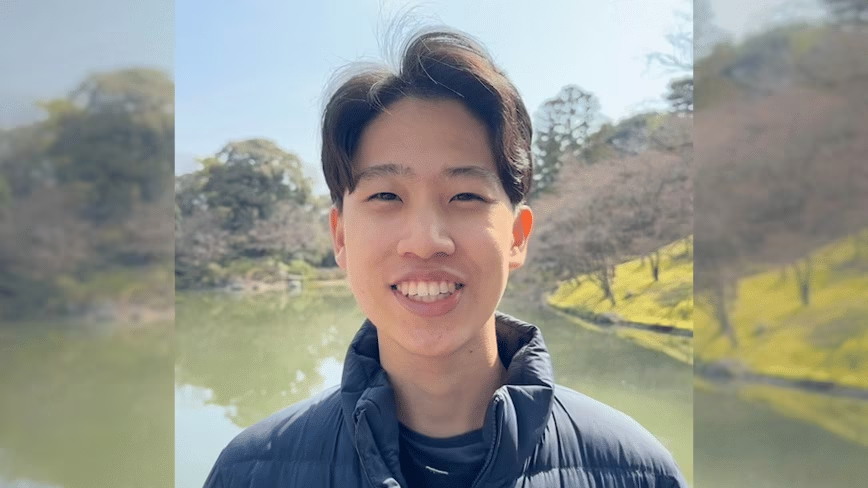
Miles Wang, a researcher at OpenAI, is leaving to start his own company, TechCrunch reported. He is in talks to raise about $200m at a $2bn valuation, with Lightspeed in discussions to lead. Several other OpenAI researchers plan to follow him out the door.
There is a catch. Wang disputed both the funding figures and TechCrunch’s description of the company, though he did not offer corrected numbers. Lightspeed declined to comment. The talks are ongoing, and the terms could change.
Reviving dead drugs
What the startup will build is still fuzzy. Two sources told TechCrunch it may develop AI models that find new uses for approved drugs, and even for candidates that failed in earlier trials.
The logic is money. A drug already cleared for safety can reach patients, and revenue, far faster than one designed from scratch. Repurposing does not remove the need to prove a medicine works for its new use, but it skips years of early testing.
Wang is an unusual founder for a $2bn round. He left Harvard to join OpenAI in March 2024, where he sits on the reinforcement-learning team. By his own account, his work spans alignment and safety, plus AI for science, and biology in particular. He co-authored a wet-lab study in which GPT-5 suggested tweaks to a cloning protocol while humans ran the experiments. OpenAI later reported a 79-fold efficiency gain in that narrow setup, while stressing it produced no drug.
An AI-bio gold rush
The frenzy around Wang says less about him than about the moment. Money is flooding into AI for the life sciences. Chai Discovery raised $400m at a $3.8bn valuation on the very same day, and its co-founder also passed through OpenAI. Isomorphic Labs, the Google DeepMind spinout, raised $2.1bn in May.
The pattern repeats. ByteDance and Anthropic are chasing the same prize, and OpenAI researchers keep leaving to build labs of their own.
The part AI has not cracked
The enthusiasm skips over the hard part. Designing a molecule is the easy end of the pipeline. Getting it through human trials is not.
“Drug discovery is a ‘lighter’ problem in the food chain of bringing a drug to market,” Immunai chief executive Noam Solomon told Calcalist, speaking about Anthropic’s separate effort rather than Wang’s. “The harder problem is making drugs succeed in clinical trials.” Those take about a decade, cost roughly $2.7bn, and fail more than 90% of the time.
For now, Wang has none of that to worry about. He has an idea, a team forming around him, and a market willing to write a nine-figure cheque before the company even has a name.
View original source — The Next Web ↗
Related stories

The Verge
TechnologyJul 15, 2026 · 1 min
Apple’s reportedly raising the price for AppleCare Plus on Macs and iPads
The Verge

The New York Times
TechnologyJul 15, 2026 · 1 min
Door-to-Door Search for Grapevines Sold at Costco Begins in California’s Santa Clara County
The New York Times
VentureBeat
TechnologyJul 15, 2026 · 1 min
Agentic orchestration: Enterprise AI organizations have a deployment problem, not a platform problem
VentureBeat

The Verge
TechnologyJul 15, 2026 · 1 min
Valve says iFixit will keep selling Steam Deck batteries after all
The Verge