The Guardian
Lionel Messi’s inevitable gravity bends another occasion in Argentina’s favour | Barney Ronay
To strive, to seek, to find, and not to yield. Well, not to this lot anyway. On a day of ceaseless rolling noise under Atlanta’s vast refrigerated dome, England reached the end of the road, the end of their own capacities at this World Cup, the end of the gears within this team. Mainly they ran into Lionel Messi, who wasn’t ready to be done just yet. Not like this anyway.
With 55 minutes gone England were actually winning this game, 1-0 up thanks to Anthony Gordon’s goal, the only real moment of clarity they produced all match. At which point they simply disappeared as an animate entity from the stage.
England played poorly here. The substitutions had no effect. Harry Kane basically did some light cardio quite close to a World Cup semi-final. But it was the change that really did for them, one of those moments where the clock starts to tick backwards, the skies darken, the cow really does appear to have jumped over the moon, and the energy inside the stadium is suddenly revolving entirely around that slouching, mooching figure in dark blue, who from a walking start had begun to do strange, painful things, to draw the spaces together, to make the objects around him revolve in his favour. And feeling also the lack of resistance coming the other way. Suddenly everyone out there was in the Messi space.
Fast forward to 91 minutes, the score somehow still 1-1, a scoreline that looked by now like a glitch, like temporary signage, and it was of course Messi who produced the final cut. By that stage England were strung like shipwrecked mariners around their own box, scurvy-ridden, desiccated, a single skinny hand somehow still fixed on the tiller.
Alexis Mac Allister had just struck the post with a low shot. Djed Spence, who chased the day to the end here, managed to nip in front of Messi for a second and nick the ball away. But it was only ever on loan. Facing two full-backs now, Spence and Nico O’Reilly, Messi simply eased into the space where a third should have been, all alone in that portable little patch of green.
The cross from his right foot was perfectly, tactfully floated into the only logical area, like somebody very slowly and patiently explaining a maths problem. For a moment the ball just seemed to hang there, a lovely soft white orb, the day stretching out, as everyone in the stadium became Messi, seeing the moment before it happened.
Time clicked forward again, Lautaro Martínez nodded the ball past a splayed Jordan Pickford and into the England net. And that was it, the outcome that was always coming from the moment Messi began to see the end of this game, to feel the snags, the subplots disappear, to see that it was time to apply his full force to the shapes in front of him.
There were some final spasms from the corpse of England’s tournament, although this was like watching a hackneyed stage-show version of England football, Dan Burn hurling his body around the Argentina box under the high ball, flopping to the turf like a double mattress hurled from an upstairs window.
But the game was done. England had shrunk from this occasion, had failed to press when they might have, had ultimately been aura-mogged, erased by a form of sporting genius that even on its quieter, more muddled days will eventually find its shape.
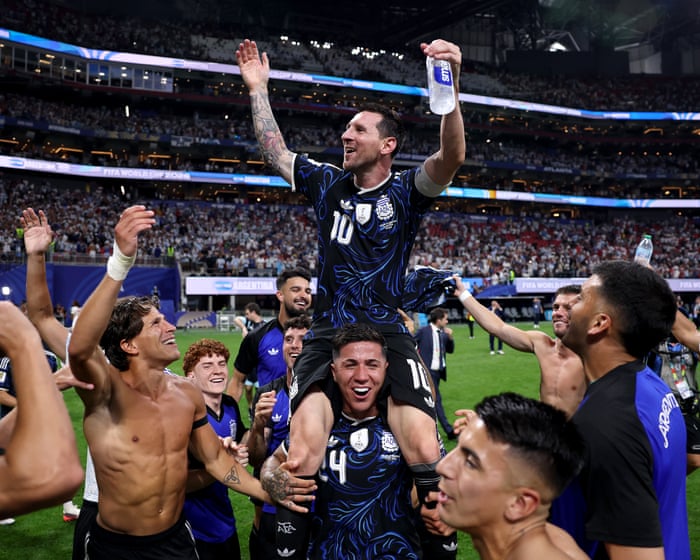
The final whistle brought an endless rolling wave of noise. Although even here Messi kept on walking, finding space, dipping away from the prone bodies of his teammates, both fists pumping the air in the middle of all that heat and light.
England were undeniably poor here, a semi-final that they basically tossed away. They produced almost no threat, no energy, no sense they had the capacity to seize the day. There will be time to assess that entropy, to find the faultlines, to wonder what might have been different, from selection to the deeply familiar sense of blinking in the light.
But this was Messi’s day, and Messi’s moment. He will now play his third World Cup final, the oldest outfield player ever to appear on that stage, as well as the greatest. It has been different this time too. There had already been something new in Messi’s appearances through that edgy run to the final. He looked at times on the brink of something, like a man waking up with a start.
Messi has always had one key advantage over every other player. He gets to play with Messi every game. And Messi makes every other player in his team better. He brings a separate gravity field, bathing teammates in that borrowed light, And he always has the best time, because every game is a Messi game. Think about it: this is a man who has literally never played a game of football where Messi is not in it. Every day is a Messi day. No wonder he loves football. As a spectator there are times when you feel like tapping him on the shoulder and saying: “You do know it’s not always like this, don’t you?”
How would England approach this, because Messi will always be schematised, planned for, played around. Thomas Tuchel went for power and speed generally, with Morgan Rogers in on the right. For the Messi detail at left-back, Spence, the form horse, spirit animal, and cultish hero of this England team.
Atlanta Stadium is a proper, city‑centre venue, appearing out of the grid of high rises and glass hangers like a huge jagged silver meteorite crash-landed in the urban incline.
The colours and shapes were mesmeric at kick-off, those blocks of deep blue, white, red gold so perfectly matched. The anthems before kick-off were just energy, indistinct electricity.
With a minute and 20 seconds gone Jude Bellingham was chopped down by Leandro Paredes, and it felt like a necessary formality, like Black Rod announcing parliament is now open.
Messi’s first act was to wriggle through a crush of bodies, moving as always in his own plane of space and time. He fell. No foul. Outrage. Almost immediately Paredes hacked down Anderson and was booked. The first crush of shirts the coming together, the formal dance.
From there, the game didn’t really start. England had their moment in that first half to apply pressure, to push with greater energy. Messi kept on walking, playing at the edge of things, a man for whom the game is so often waiting.
But they failed to rush into the space when it was there, took the lead, then almost immediately collapsed as Messi began to twitch on the threads, to glide past white shirts, to release those malevolent, dipping passes.
By the end this felt like two things at once. An England team that blinked, that failed to respond to its manager’s urgings; but which was also swallowed by the inevitability of Messi, and a grand, all-time talent that is somehow out there walking across this stage, shrinking it to his size, and which isn’t ready to be denied just yet.
View original source — The Guardian ↗
Related stories
ESPNcricinfo
SportsJul 16, 2026 · 1 min
Moises Henriques announces Sixers and BBL retirement
ESPNcricinfo

ESPN
SportsJul 16, 2026 · 1 min
ESPYS 2026 highlights: Myles Garrett, Chloe Kim am...
ESPN

Buenos Aires Times
SportsJul 16, 2026 · 1 min
Argentina's World Cup semi-final hero Lautaro Martínez 'dreamt' of scoring winner
Buenos Aires Times
Al Jazeera
SportsJul 16, 2026 · 1 min
‘Epic squared’: Scaloni lauds Argentina’s back-to-back World Cup comebacks
Al Jazeera