Indian Express
The Odyssey is not Ramayana: Christopher Nolan epic humanizes the king, doesn’t deify him
Christopher Nolan's The Odyssey humanizes its king instead of deifying him like the Ramayana.
When I attended the India premiere of Christopher Nolan’s action adventure fantasy epic The Odyssey last week, the IMAX theatre turned into a roaring stadium in the climactic sequence. For those familiar with Homer’s ancient Greek tale, from which the film is adapted, it entails what in India is recognized as a swayamvar — the queen/princess testing her suitors and picking the winner as her to-be husband. Sounds familiar?
The Odyssey and Ramayana parallel
The swayamvar runs in the Indian DNA, thanks to the Indian epic Ramayana. Sita, the princess of Mithila and the daughter of King Janaka, picks her husband through a competition of stringing a bow. Since the said bow, Pinaka, is the celestial weapon of Lord Shiva, no king manages to even budge the arrow, let alone lift or attempt to string it. The only one who manages to is Rama, prince of Ayodhya and son of King Dashratha, who not only lifts it, but also ends up breaking it in the process of stringing it.
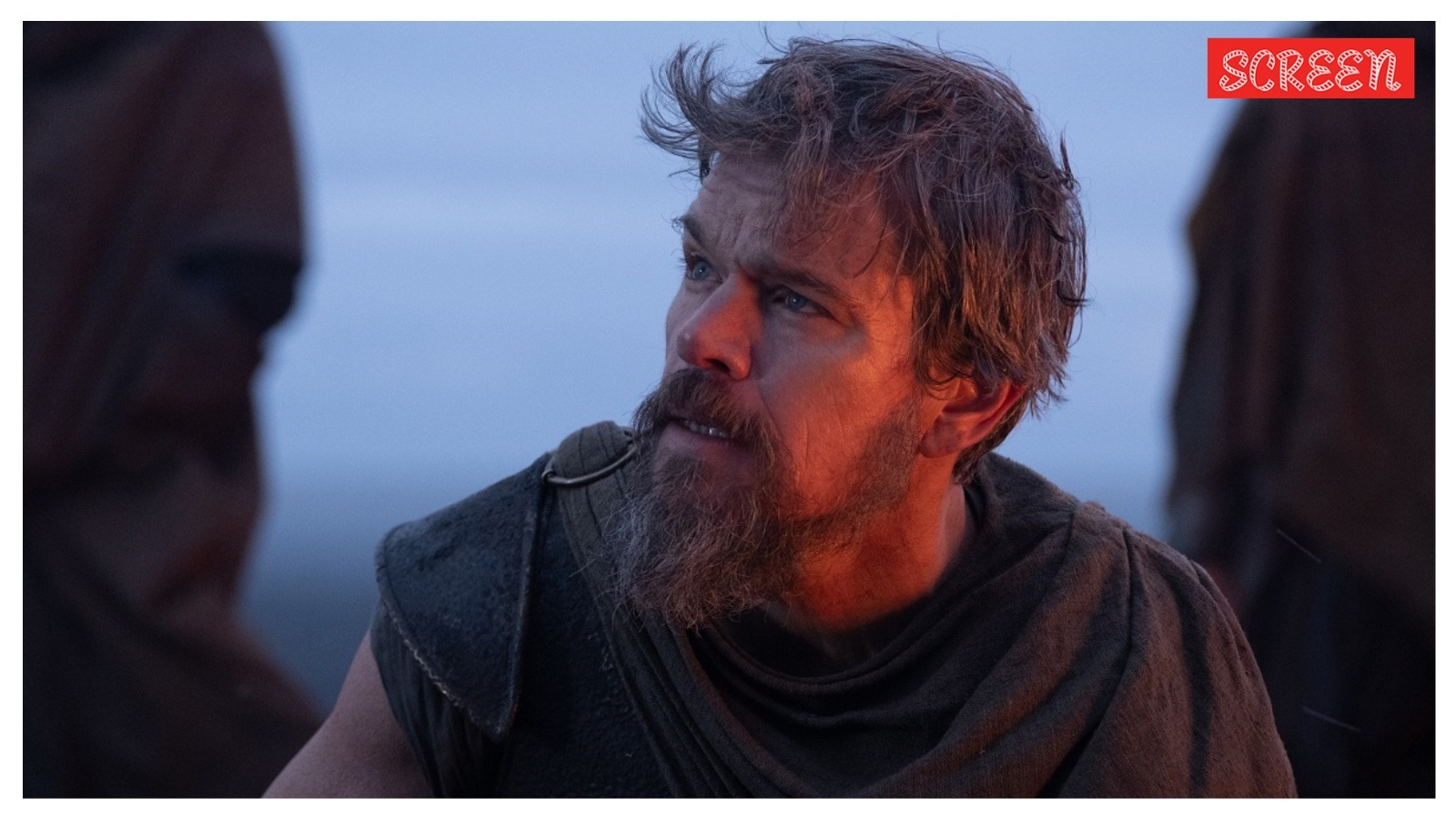
This instance gets recreated in the climax of The Odyssey, when Queen Penelope (Anne Hathaway) challenges her desperate and power-hungry suitors to string her husband, King Odysseus’ (Matt Damon) recurve bow, known as the palintonos bow in Greek terminology, as her own swayamvar. Yet again, none of them manage to come close, with the exception of a beggar, who manages to not only string it effortlessly, but also showers arrows to eliminate all the suitors. That beggar is none other than Odysseus in disguise.
Anne Hathaway as Penelope performs a ‘swayamvar’ with the suitors.
What came first? Odyssey or Ramayana?
It’s no wonder then that sequence received the ovation it did during the India premiere. Some go as far as to claim that the track is inspired by the Ramayana. While the Indian epic is set in the Treta Yuga, an age that came many millennia before The Odyssey, it’s widely believed that Homer documented the ancient Greek tale first, in 750-650 BCE, that is the 7th or 8th century BCE. On the other hand, the Ramayana, in its present form, is believed to have been documented first in 500-750 BCE or the 3rd-4th century BCE.
However, both the tales were passed down orally for centuries before they were first converted to text during the above timelines. It’s even believed that Homer was not a person, but a group of poets which turned into this homogeneous singular identity with the passage of one. While Valmiki is believed to have written the Ramayana, there are multiple versions of both the tales that have co-existed, with one often emerging as the dominant perspective as per the sociopolitical demands of the corresponding times.
The Odyssey is no Ramayana
Both the epic tales — divided by civilizations and cultures — are also united by a common primary theme. Firstly, both are epic stories of homecoming. Odysseus craves to return to his kingdom of Ithaca in Greece after winning the Trojan War, while Rama, having undertaken a 14-year vanavasa (forest exile), must rescue his wife Sita from Ravana’s captivity in Lanka before returning to his kingdom of Ayodhya. But Nolan’s interpretation of The Odyssey also makes it another spiritual form of homecoming, not far removed from Imtiaz Ali’s recent plea to compassion, Main Vaapas Aaunga.
The Trojan horse sequence in The Odyssey.
Odysseus is a changed man when he makes his 25-year-long return to home. So is Rama. The ‘maryada purshottam‘, who agrees to forfeit his heirship of the Ayodhya throne to his younger brother Bharat because of a years-old promise his father made to his stepmother Kaikeyi, decides to destroy the kingdom of Lanka in his quest to rescue his wife.
Story continues below this ad
But with his interpretation, Nolan advocates exactly the opposite. In fact, this film is the third and most definite instalment of what I’d hail as his anti-war trilogy — after Dunkirk (2017) and Oppenheimer (2023). In The Odyssey, as he undertakes the gruelling and endless voyage back home, Odysseus must also come to terms with the reckoning of his own deeds, where he’s destroyed an entire civilization, Troy, and killed many innocent lives, as part of his larger mission to expand his kingdom and retain his power. Of course, there’s no law of the land back then, and he approaches Troy like any expansionist conqueror would, but his physical homecoming also coincides with the spiritual awakening of the widespread and merciless destruction he unleashed upon another civilization.
The battle of Troy in The Odyssey.
*spoiler alert*
Like Rama and his army’s journey to Lanka, Odysseus’ voyage back home is also hampered by countless mythical hurdles — a Cyclops in the cave, an aggressive and superior army several times their size, thunderous storms evoked by Poseidon, and a harmless-looking woman who moulds them into pigs. That sequence also has a parallel with the Ramayana — Odysseus chases and hunts down a deer. In this case, the deer is not a mythical illusion created by Ravana who has his eyes on Sita. But it’s the rude realization that animals on that island are actually humans, fallen prey to their ravenous appetites, indefatigable male egos, and the inevitable fate of their physicality to be reduced to what they’re truly at their heart — carnivorous, cannibalistic animals.
*Spoiler alert ends*
But beyond these larger-than-life obstacles, there are also some spiritual hurdles. For instance, being stranded on an island for days without slaughtering the divine cattle for easy meat. Or being chased down by the ghosts of their past — their fellow army men who were martyred on the battlefield, but never honoured with ceremonial burials. Or being gaslit by Calypso (Charlize Theron) into believing they have no past and no greater purpose left to be fulfilled. Or being confronted by who Odysseus assumes to be Athena (Zendaya), the ancient goddess of wisdom and strategic warfare, who keeps reminding him cryptically that he hasn’t played by the book.
Story continues below this ad
“He sacrificed his life so we can escape. We honour him by escaping,” declares Odysseus in the Cyclops’ cave after one of his men gets crumbled by the 30-feet tall giant. Even after him and his men manage to escape the cave, he shoots that one arrow in Cyclops’ eye for good measure. Cyclops’ father Poseidon may have the awarded equal punishment of death to Odysseus as the rest of his men for blinding his son. But perhaps for that last cheap shot, he keeps him alive for worse — to come to terms with penance and atone his deeds.
But these fatal flaws by the almighty king, which serve as the chinks in his otherwise impenetrable armour, render him human. Unlike Ramayana, where the king and his associates have been put on a pedestal and deified for centuries, Nolan’s gaze on Odysseus always personifies him as a lesser mortal, a mere human at the mercy of Gods, and most crucially, a king most prone to not those who eye his throne but his own ceaseless thirst for power and immortality. That’s why when he realizes who he assumes to be Athena really is, it’s a wake-up call for not only him, but also for us who’ve been worshipping flawed idols as our gods — they all bow down to the human conscience, the God within. Everything else is revealed to be what it inherently is — a Trojan horse.
View original source — Indian Express ↗
Related stories

AllAfrica
EntertainmentJul 16, 2026 · 1 min
South Africa: South Africa's Food System Is Failing Children - What Must Change
AllAfrica

AllAfrica
EntertainmentJul 16, 2026 · 1 min
Africa: China Is Funding African Farmers but Not Food Processing and Storage - Why It's a Problem
AllAfrica

AllAfrica
EntertainmentJul 16, 2026 · 1 min
Kenya: How Farmers Are Learning About Restoring Soils and Scaling Agroecology in Kenya
AllAfrica

Indian Express
EntertainmentJul 16, 2026 · 1 min
Shilpa Shinde claims fake MMS was circulated after her Bhabiji exit: ‘My blood ran cold’
Indian Express