Indian Express
‘Direct assault on judiciary’: Life term upheld for Jharkhand judge Uttam Anand’s murder
5 min readNew DelhiUpdated: Jul 16, 2026 10:27 AM IST
The Jharkhand High Court convicted two men in Judge Uttam Anand's murder case.
Observing that the crime was “an assault on the judiciary”, the Jharkhand High Court has upheld the conviction of two men in the murder case of Dhanbad Additional District and Sessions Judge Uttam Anand, holding that evidence clearly established the crime.
A bench of Justices Rongon Mukhopadhyay and Justice Pradeep Kumar Srivastava observed that the absence of motive cannot outweigh direct evidence. The bench added that “motive will be compelled to take a back seat”.
The order noted that, “The enormity of the act of the appellants and the audacious nature of its execution has been an affront to the judiciary, encapsulating serious concerns over the safety and security of the Judicial Officers.”
“The incident gathered momentum on account of the videos of the impact circulated in social media which created a furore as it was viewed as a direct assault on the judicial system of the country,” the July 14 order said.
Justices Rongon Mukhopadhyay and Pradeep Kumar Srivastava heard Judge Uttam Anand’s murder case on July 14.
The appeal challenged a 2022 trial court judgment convicting two men for the murder of Dhanbad Additional District and Sessions Judge Uttam Anand, who were convicted under Sections 302/34 and 201/34 of IPC, invoking multiple individual commit murder together and subsequently destroy evidence.
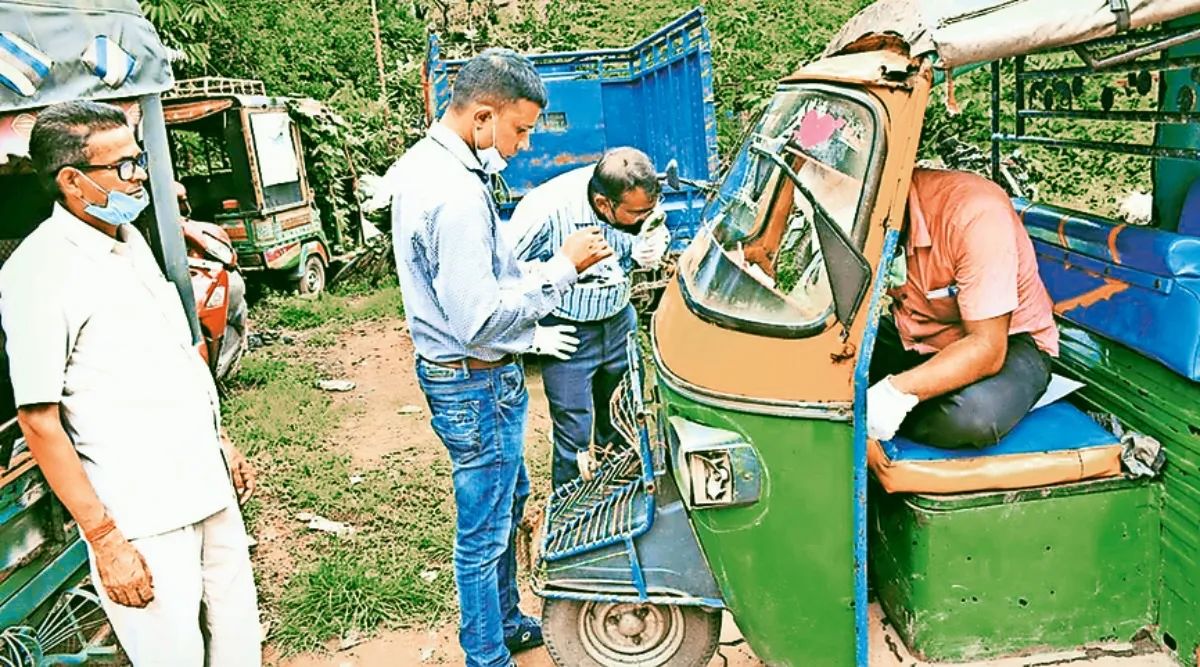
On July 28, 2021, Anand had left for his morning walk and did not return. His family later learnt he was taken to the hospital after being hit by an auto-rickshaw. A video of the incident went viral, allegedly showing the auto-rickshaw driver deliberately hitting the judge, leading to his death.
The Dhanbad police had registered a case against an unknown auto-rickshaw driver, after which the investigation was handed to a special investigation team and withing day, due to the seriousness of the matter, was transferred to the CBI. After the CBI’s investigation, a charge sheet was filed against Lakhan Kumar Verma and Rahul Kumar Verma for murder and destruction of the evidence. They pleaded guilty and faced trial before the CBI court.
Story continues below this ad
Court Finding and Observation
Advocate Sabyasanchi, appearing for the appellants, submitted that there was no intention to commit bodily injury, pointing out that only a single blow was inflicted. However, the court noted that the evidence attracted the “Thirdly” clause of Section 300 IPC.
The court said a collision by an auto, the impact hardly lasting for one second, led to a massive haemorrhage of the brain, and there lay beside the road, the victim unidentified, unconscious and profusely bleeding from the mouth, nose and ears. The city of Dhanbad was waking up and Randhir Verma Chowk, one of the busiest thoroughfares of the city due to its location, wore a desolate look with some health freaks, carts and auto rickshaws interrupting the morning serenity
The court cited one of the witnesses as a responsible citizen, who managed to stop an e-rickshaw on the opposite side of the road from where Uttam Anand was lying and, with the help of some persons, loaded him on the same and proceeded to Sadar Hospital, Dhanbad.
The court observed that the case, on account of the importance it generated and to explore the deep-rooted conspiracy it evoked, was handed over to the CBI, where detailed investigation mostly on the technical aspects of the case led to submission of charge sheet against the appellants who ultimately were convicted for the offences under Sections 302/34 and 201/34 IPC.
Story continues below this ad
The court concluded that the auto rickshaw seen in the CCTV footage of the incident dated July 28, 2021, and the auto rickshaw seized during investigation appear to be the same in all probabilities. The forensic reports also established that the broken fibres recovered from the place of occurrence were part of the one-side indicator of the seized auto.
The court said that the enormity of the act of the appellants and the audacious nature of its execution have been an affront to the judiciary, encapsulating serious concerns over the safety and security of the Judicial Officers.
The court, based on the voluminous records of the case, found that the complicity and culpability of the appellants was palpable. The judgment and order of conviction and sentence embody the features of the case and the role played by the appellants. It held that it did not find any rationale to arrive at a different conclusion, and based on the reasoning enunciated, dismissed this appeal.
Somya Panwar works with the Legal Desk at The Indian Express, where she covers the various High Courts across the country and the Supreme Court of India. Her writing is driven by a deep interest in how law influences society, particularly in areas of gender, feminism, and women’s rights.
She is especially drawn to stories that examine questions of equality, autonomy, and social justice through the lens of the courts. Her work aims to make complex legal developments accessible, contextual, and relevant to everyday readers, with a focus on explaining what court decisions mean beyond legal jargon and how they shape public life.
Alongside reporting, she manages the social media presence for Indian Express Legal, where she designs and curates posts using her understanding of digital trends, audience behaviour, and visual communication. Combining legal insight with strategic content design, she works on building engagement and expanding the desk’s digital reach.
Somya holds a B.A. LL.B and a Master’s degree in Journalism. Before moving fully into media, she gained experience in litigation and briefly worked in corporate, giving her reporting a strong foundation. ... Read More
Tags:
Jharkhand High Court
View original source — Indian Express ↗
Related stories

The Punch
WorldJul 16, 2026 · 1 min
US, Iran trade fresh strikes as Hormuz conflict escalates
The Punch
The Punch
WorldJul 16, 2026 · 1 min
EFCC releases activists Randy Peter, Mama Pee
The Punch
ABC News
WorldJul 16, 2026 · 1 min
Transgender woman's 'humiliating' experience with major corporations
ABC News

South China Morning Post
WorldJul 16, 2026 · 1 min
Hongkonger dies in New Zealand car crash, third fatality this year
South China Morning Post