Indian Express
Sonam Wangchuk down 9 kg on Day 19 of fast, says ‘don’t ask me to give up’
5 min readNew DelhiUpdated: Jul 16, 2026 11:22 AM IST
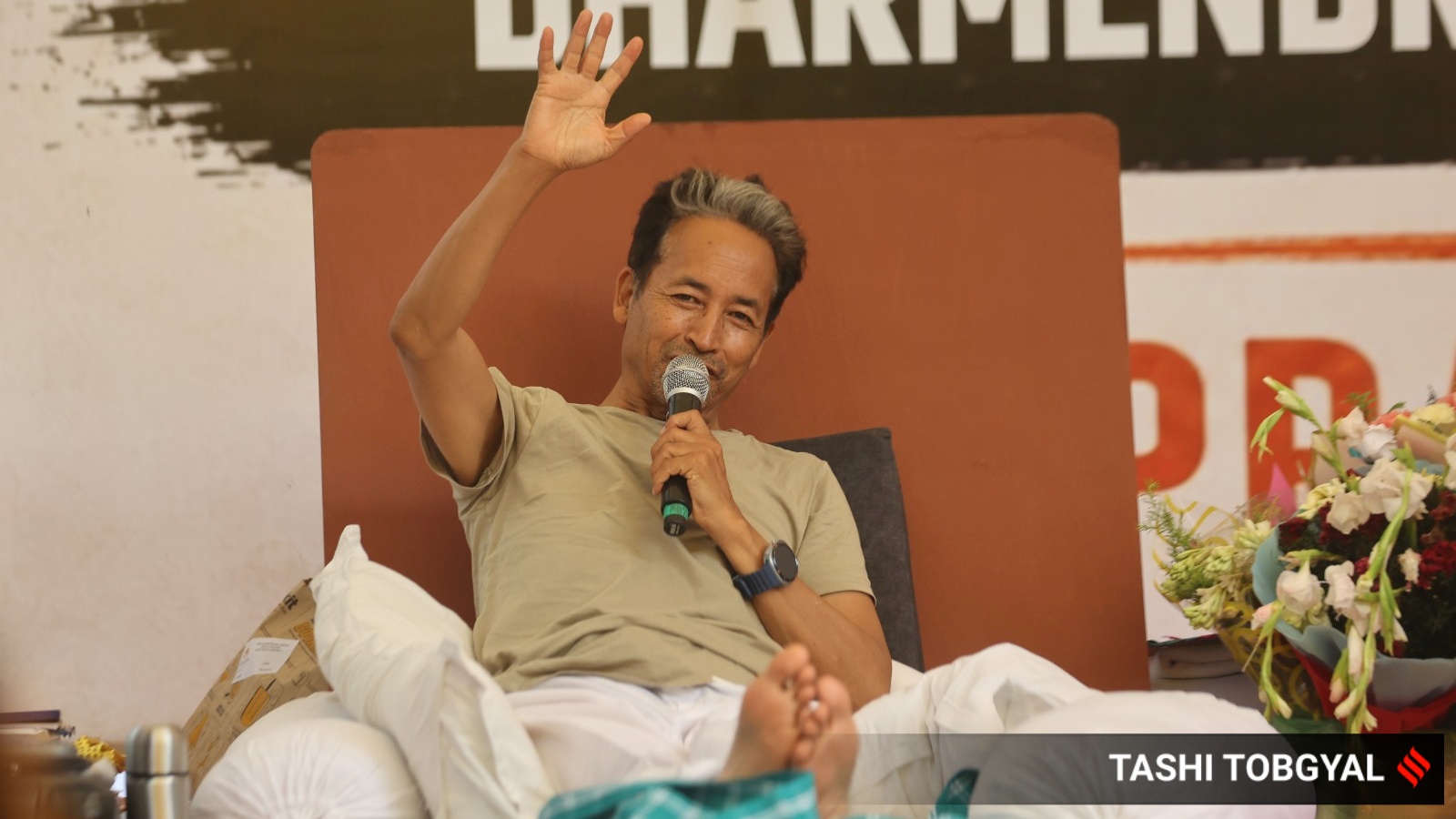
Activist Sonam Wangchuk during his indefinite hunger strike in support of the Cockroach Janta Party's protest at Jantar Mantar in New Delhi on Wednesday. (Express Photo by Tashi Tobgyal)
Activist Sonam Wangchuk has lost more than 9 kg on the 19th day of his indefinite hunger strike at Delhi’s Jantar Mantar, his doctor said on Thursday. Wangchuk remains stable, but doctors say the coming days could prove critical, even as he ruled out ending the fast and urged supporters to join a planned march to Parliament on July 20 instead.
Dr Satish Lamba, the senior general physician monitoring Wangchuk’s health, said his blood sugar stood at 80 mg/dL, pulse rate at 72 beats per minute, and blood pressure at 105/61 mmHg lying down and 101/65 mmHg while sitting. Lamba said Wangchuk’s hydration was fair and that he remained mentally alert.
Wangchuk is fronting the protest by the Cockroach Janata Party (CJP) demanding the resignation of Union Education Minister Dharmendra Pradhan for a string of exam paper leaks and student suicides. After initially calling the protest “anti-national”, the government has stonewalled it in the face of mounting criticism.
A public interest litigation was filed in the Delhi High Court on Wednesday by a lawyer, seeking that Wangchuk be force-fed and shifted immediately to a government hospital. The request, which claims Wangchuk could “lose his life in two days,” was due to be heard by Chief Justice D K Upadhyaya and Justice Tejas Karia on Wednesday but has been posted for Thursday because of a lawyers’ strike.
‘Don’t ask me to break fast’
Wangchuk has ruled out ending his strike despite appeals from political leaders and supporters, saying breaking the fast without any response from the government would send the wrong message. “If I eat, what message will go? The message to the government will be that there is no need for accountability,” he said, questioning what would change if he ended the fast.
VIDEO | Delhi: Dr. Satish Lamba, Senior General Physician, gives update on health of Sonam Wangchuk, who has been on a hunger strike at Jantar Mantar since 19 days.
He says, “Today, on the 19th day, I am presenting Sonam Wangchuk’s health bulletin. First, I will discuss the… pic.twitter.com/HXSrcv48VZ
— Press Trust of India (@PTI_News) July 16, 2026
In a video message shared late on Wednesday night, on the 18th day of his fast, Wangchuk said he had received thousands of messages urging him to break his strike and that several senior politicians had met him with “love and concern.”
He said some had even approached the courts seeking directions to make him eat. Seeking to address concerns over his health, he said medical tests, including an ECG, had returned largely normal results for an 18-day fast and that his condition was not life-threatening in the immediate term. “There is weakness and my muscles are getting weak, but my heart and core are still fine,” he said.
‘Join our march on Monday’
Instead of appeals to end the fast, Wangchuk urged people to join the Cockroach Janta Party’s (CJP) proposed “Chalo Sansad” march on July 20, calling on schools, colleges and universities to treat the day as one of experiential education under the National Education Policy. He appealed to supporters to register for the march through the campaign’s website or a missed-call initiative.
Story continues below this ad
A team of four to five doctors from Ram Manohar Lohia Hospital, accompanied by Dr Lamba, visits Wangchuk at least twice a day to monitor his blood pressure, blood sugar, weight and other vital parameters. Lamba, a family physician and medical superintendent at a private hospital in Green Park, told The Indian Express that Wangchuk’s uric acid levels are rising as his body begins breaking down muscle tissue for energy, and that ketones have been detected in his urine — a sign the body has moved from burning stored carbohydrates to fat. He said Wangchuk’s kidneys were functioning normally so far, but a prolonged fast could eventually cause kidney damage.
On the question of force-feeding, Lamba said consent would be required first, and that if medical intervention became unavoidable, intravenous support — delivering a dextrose and saline solution with electrolytes — would be the safer option over tube feeding, which carries risks such as food entering the windpipe or a sudden insulin spike.
The CJP has been protesting at Jantar Mantar for 20 days, demanding the resignation of minister Dharmendra Pradhan over question paper leaks and irregularities in key national examinations like the NEET which students take to become doctors, and has called for the Parliament march on July 20, the opening day of the Monsoon session. CJP founder Abhijeet Dipke said on X that when Wangchuk was urged to call off his strike, he replied: “Instead of asking me to end my hunger strike, ask the government why it refuses to listen.”
(With inputs from PTI)
View original source — Indian Express ↗
Related stories

The Punch
WorldJul 16, 2026 · 1 min
US, Iran trade fresh strikes as Hormuz conflict escalates
The Punch
The Punch
WorldJul 16, 2026 · 1 min
EFCC releases activists Randy Peter, Mama Pee
The Punch
ABC News
WorldJul 16, 2026 · 1 min
Transgender woman's 'humiliating' experience with major corporations
ABC News

Euronews
WorldJul 16, 2026 · 1 min
Europe's energy use for cooling doubled in six years: Which countries use the most?
Euronews