CNA
The new wave of Japanese menswear designers taking over Paris Fashion Week
Obsessions
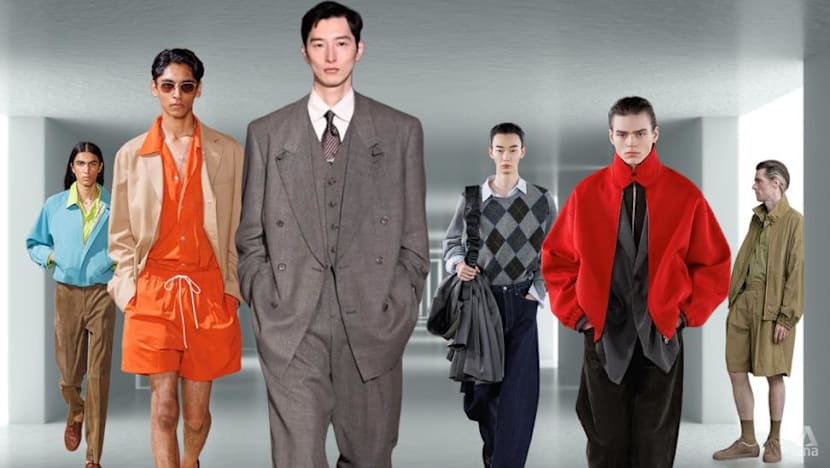
Labels such as Auralee, Ssstein and Soshiotsuki are winning over buyers and fashion insiders with refined tailoring, exceptional craftsmanship and a fresh vision of everyday dressing.
New: You can now listen to articles.
This audio is generated by an AI tool.
16 Jul 2026 02:06PM
At men’s fashion week in Paris, amid a packed schedule of megawatt names such as Dior, Louis Vuitton and Hermes, a new vanguard of menswear designers from Japan is gathering steam.
Among them is Ryota Iwai, founder of Tokyo-based label Auralee, whose shows have become one of the most anticipated of the menswear season. Since its founding in 2015, the brand swiftly built a loyal fan base in Japan thanks to its well-made collections unanchored to seasonal trends. But it was in 2018, when the brand won the Fashion Prize of Tokyo that it was propelled on to the international stage, debuting at Paris Fashion Week the year after.
A suite of other contemporary Japanese menswear labels, including Ssstein and Soshiotsuki, have followed a similar trajectory — first establishing themselves in their local market and then finding success abroad, where they have been scooping up prestigious prizes and creating a buzz at international fashion weeks.
Their design approach differs from that of their predecessors who found fame abroad in the 1980s and 1990s, including Rei Kawakubo of Comme des Garcons, Issey Miyake, Yohji Yamamoto and Nigo. Kawakubo and her peers often looked to their cultural heritage, taking inspiration from traditional garments such as the kimono. Meanwhile, the streetwear pioneer Nigo, whose bold, immensely scarce products appealed to in-the-know fans in the 1990s, has shown great enthusiasm for Americana and vintage reproductions. But an over-reliance on the past has become a crutch for some brands that may see the vintage aesthetic as a shortcut to good taste.
Today’s generation of designers seems more interested in the present, creating outfits for the everyday. As a result, their collections better reflect how modern people dress, while still maintaining the quality and timelessness for which Japanese fashion is known. That’s attractive to longstanding devotees of Japanese menswear, such as Joost Doeswijk, the chief executive of Amsterdam-based brand Wandler, who is a customer of labels such as Kapital, Norbit by Hiroshi Nozawa, and Nanamica.
“Today I see brands from Japan that do not compromise on fabrics and on quality, but that are moving more towards the European style,” he says. And for many European shoppers functionality, a degree of casualness and comfort in their daily outfits is key, he adds.
The willingness of Japanese designers to align with the traditional western selling calendar has also been crucial, says Daniel Todd, the buying director at Mr Porter. The online luxury retailer has recently picked up Ssstein, the Tokyo-based label loved for its impeccably tailored trousers, and Graphpaper, the Japanese brand known for its oversized silhouettes. “Many of these brands now show in Paris, which makes them more accessible” for menswear buyers and enthusiasts, “who are looking for more of what you might call ‘discovery’ brands versus the big box designer brands of old.”
Indeed, Ssstein was founded in 2016 by Kiichiro Asakawa but only presented its debut show at Paris Fashion Week in January 2026, showing relaxed tailoring, wide-leg trousers and oversized coats in a collection that was critically well received. One standout feature was its use of colours: pops of firetruck red and forest green marked a more experimental shift away from the earthy neutral tones traditionally associated with the mid-century American styles that have long influenced Japanese fashion. In February, the brand was shortlisted as a semi-finalist for the 2026 LVMH Prize.
International shoppers have been flocking to Carol, an edgy multi-brand store in Tokyo that stocks Ssstein, says Asakawa. “We see many foreigners come to the store for Ssstein products. A few years ago, it was mainly Asian customers. Right now, we’re seeing more shoppers from the US, Paris and other parts of Europe too.”
To establish global cachet, some Japanese designers have also begun working with respected talents and collaborators from Europe. When the Japanese menswear designer Soshi Otsuki was selected as the guest designer at the Italian fashion trade show Pitti Uomo this January, he chose to team up with the London-based stylist Alister Mackie. The two worked together again at Otsuki’s latest show at Paris Fashion Week in June.
Otsuki has been on a winning streak recently, taking home the LVMH Prize in 2025 for his modern tailoring inspired by Tokyo’s salarymen, and securing a partnership with the Spanish fashion giant Zara in December. “I wanted to bring more depth to the menswear styling of the brand,” Otsuki explains of his partnership with Mackie. “Until now, we had approached styling entirely in-house, without working with external stylists. However, I began to feel that this approach might keep our perspective within a more domestic context. I wanted to work with someone who has a deep understanding of the codes and history of European menswear.”
Elsewhere, Echapper, the Japanese brand founded by Yasuharu Kuzaki and known for using natural materials and botanical dyes, partnered with the British self-described “no-nonsense” clothing brand Studio Nicholson on a capsule collection of loungewear and casual pieces.
Kuzaki recalls meeting Studio Nicholson’s founder Nick Wakeman after she purchased some silk pyjamas from Echapper and became a fan of the brand. “I was introduced to Nick and we found a lot in common in our taste in furniture, in food, in fashion,” Kuzaki says. So when Studio Nicholson was readying to open its first store in Kyoto this year, the timing felt right to collaborate, he explains.
The experience has made Kuzaki receptive to global partnerships. In June, Echapper’s designs were presented at Ogata Paris, a cultural space that celebrates the Japanese art of living. And there were more than just clothes on show; among the brand’s best-selling products are its linen pile towels and — surprisingly — laundry detergent. “We have lots of enquiries from restaurants and private chefs for our kitchen line, which includes tablecloths, placemats, kitchen linens and aprons,” adds Kuzaki. Fundamentally, Kuzaki simply wants “to make something that I like to use in daily life . . . that doesn’t cause harm to the earth” — and hopes customers will feel the same.
This holistic approach, along with a fixation on craft, remains core to Japanese labels — and it may be why a new generation of designers has become attractive to shoppers globally, says Tatsuo Hino, director of Beams & Co, the creative agency of the Japanese lifestyle retailer Beams, which has played an instrumental role in bringing Japanese clothing labels overseas. “I think people are more into how things are made. Especially when you look at the big brands over the past few years, the prices have gone crazy,” he says. “When you buy from Japanese menswear brands, it’s not cheap . . . but you are getting what you pay for.”
Kati Chitrakorn © 2026 The Financial Times.
This article originally appeared in The Financial Times.
Source: Financial Times/bt
Related stories

Philippine Daily Inquirer
EntertainmentJul 16, 2026 · 1 min
The infinite void of Sir Sam Neill, the sinister genius of 'Event Horizon'
Philippine Daily Inquirer

Deadline
EntertainmentJul 16, 2026 · 1 min
Ofcom Investigating TikTok Over Kids “Being At Risk Of Exposure To Harmful Content”
Deadline

Deadline
EntertainmentJul 16, 2026 · 1 min
YMU Signs ‘Rap Game UK’ Host Krept
Deadline

Indian Express
EntertainmentJul 16, 2026 · 1 min
Atul Kulkarni backs Sonam Wangchuk with one-day hunger strike
Indian Express