Indian Express
‘No one can switch off my e-rickshaw now’: Delhi drivers beat Bluetooth hack
4 min readNew DelhiUpdated: Jul 16, 2026 02:00 PM IST
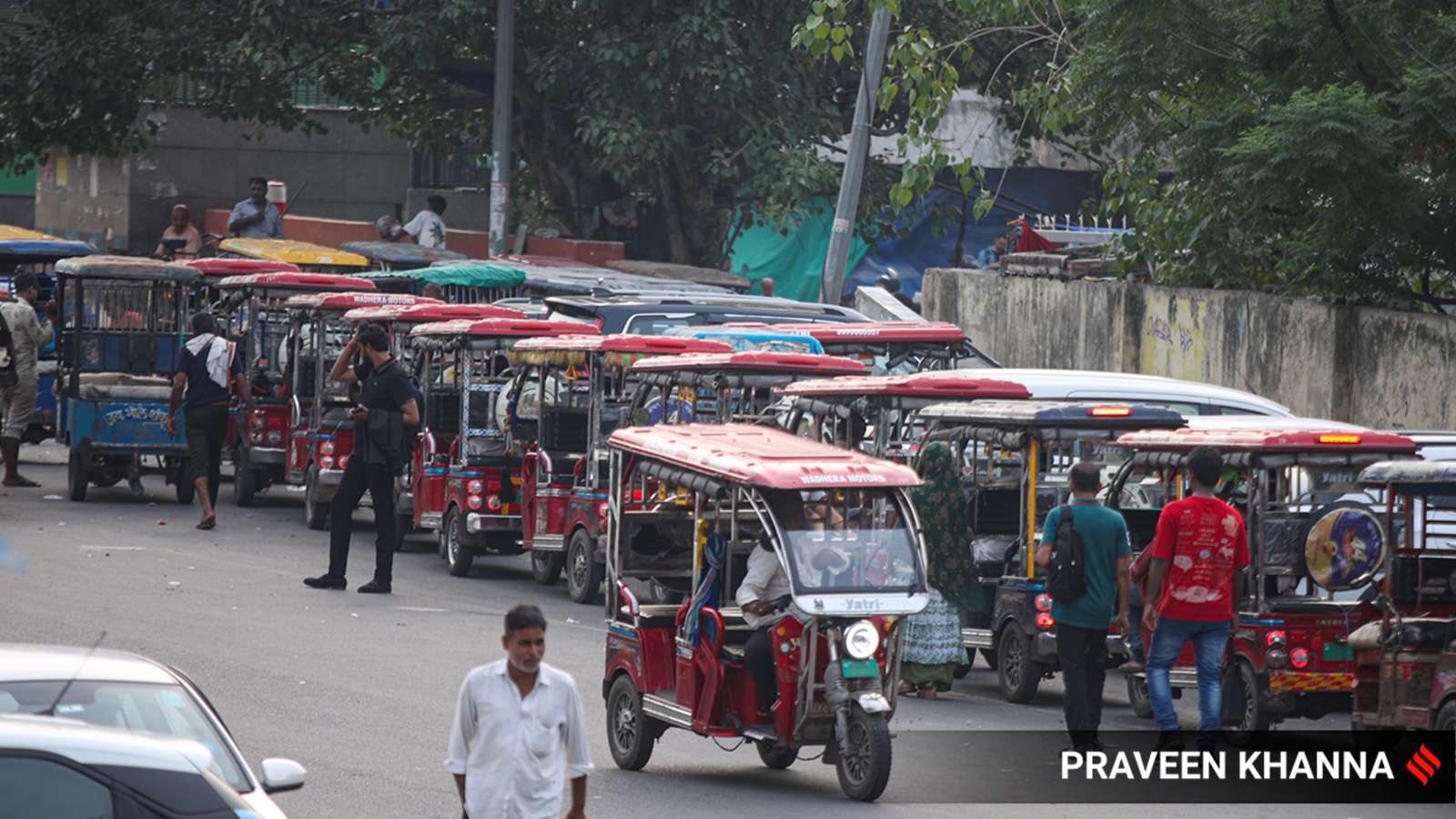
E-rickshaw outside the INA market Metro Station in New Delhi. (Express Photo by Praveen Khanna)
For the past two weeks, every time 45-year-old e-rickshaw driver Peshkar slowed down in traffic, he worried someone had remotely switched off his vehicle.
That fear has now eased.
“I took my vehicle to the manufacturing company in Naraina where they said they had installed a code on my battery, so no one will be able to shut it off. I am happy that they did this for free,” said Peshkar, who ferries passengers in his e-rickshaw between Moti Nagar and Inderlok in West Delhi.
The reassurance comes after weeks of anxiety among Delhi’s e-rickshaw drivers, whose vehicles had stopped dead in the middle of the road after strangers using Bluetooth-enabled mobile apps connected to their vehicles’ battery management systems (BMS) and remotely switched them off.
Following reports of the misuse, the Centre directed Apple and Google to take down seven mobile applications linked to the batteries, while manufacturers rolled out their own apps.
Apart from a few stray incidents, most e-rickshaw drivers who spoke to The Indian Express said they have not experienced any fresh incidents since the apps were blocked, with business returning to normal.
Fifty-year-old Ranjeet still recalls the panic when his e-rickshaw suddenly stopped in the middle of the road two weeks ago. “I was ferrying four passengers when my e-rickshaw suddenly stopped at Mundka Mor. I couldn’t understand it because my battery was more than half charged,” he said.
He said he tried to restart, but to no avail. Some fellow e-rickshaw drivers pushed his vehicle to the side of the road. “I couldn’t push alone as I am a heart patient,” he said.
Story continues below this ad
Besides refunding Rs 40 to his passengers, he estimates he had lost a few hundred rupees more while searching for a mechanic. The vehicle stopped around 5 pm and did not restart until 10 pm, wiping out his peak earning hours.
The next day, his vehicle stopped again at the Mundka Metro station around 11 pm. “This time, some kind strangers helped me in pushing it to the nearest mechanic. He said he has locked my battery. Since then, my vehicle has not stopped,” Ranjeet said.
Rajiv Tuli, General Secretary of Electric Vehicle Manufacturing Society (EVMS), said manufacturing companies set up helplines that stranded drivers could call and get assistance on how to restart their vehicle. “They have also made their own apps now which drivers can use,” he said.
What caused the issue
The apps that had been directed to be blocked include BAT-BMS, Lossigy, Epoch Li-ion, and Smart BMS, among others. At least a couple of them are of Chinese-origin.
Story continues below this ad
The BAT-BMS app was originally developed by China’s Shenzhen Grenergy Technology as a legitimate battery management tool for Bluetooth-enabled lithium-ion batteries. The app allows users to monitor a battery’s state of charge, voltage, current, temperature, charging cycles, and overall health.
Such apps are typically designed to be used at service centres for battery-related diagnostics.
The problem emerged because several low-cost lithium-ion batteries used in e-rickshaws were fitted with Chinese-made battery management systems that lacked adequate password protection or continued to use default credentials, allowing anyone nearby to connect via Bluetooth and remotely switch off the battery.
Not all e-rickshaws were susceptible to these attacks. Many e-rickshaws continue to run on lead-acid batteries, while several lithium-powered vehicles use proprietary battery management systems that cannot be accessed through applications like BAT-BMS.
Story continues below this ad
Jeetu Mehra, a 30-year-old who drives an e-rickshaw at Central Delhi’s Karol Bagh, is among the very few who said their vehicle stalled recently. “On Saturday, the moment passengers sat in my rickshaw at Juta Mandi, it stopped. But I was not scared this time,” he said.
He had installed a BMS app. “It just took me a second to take out my phone and restart the vehicle,” he said.
Devansh Mittal is a Correspondent at The Indian Express, based in the New Delhi City bureau. He reports on urban policy, civic governance, and infrastructure in the National Capital Region, with a growing focus on housing, land policy, transport, and the disruption economy and its social implications.
Professional Background
Education: He studied Political Science at Ashoka University.
Core Beats: His reporting focuses on policy and governance in the National Capital Region, one of the largest urban agglomerations in the world. He covers housing and land policy, municipal governance, urban transport, and the interface between infrastructure, regulation, and everyday life in the city.
Recent Notable Work
His recent reporting includes in-depth examinations of urban policy and its on-ground consequences:
An investigation into subvention-linked home loans that documented how homebuyers were drawn into under-construction projects through a “builder–bank” nexus, often leaving them financially exposed when delivery stalled.
A detailed report on why Delhi’s land-pooling policy has remained stalled since 2007, tracing how fragmented land ownership, policy design flaws, and mistrust among stakeholders have kept one of the capital’s flagship urban reforms in limbo.
A reported piece examining the collapse of an electric mobility startup and what it meant for women drivers dependent on the platform for livelihoods.
Reporting Approach
Devansh’s work combines on-ground reporting with analysis of government data, court records, and academic research. He regularly reports from neighbourhoods, government offices, and courtrooms to explain how decisions on housing, transport, and the disruption economy shape everyday life in the city.
Contact
X (Twitter): @devanshmittal_
Email: [email protected] ... Read More
Stay updated with the latest - Click here to follow us on Instagram
View original source — Indian Express ↗
Related stories

The Punch
WorldJul 16, 2026 · 1 min
Kano, Jigawa Customs generated N63.07bn in six months -Controller
The Punch
The Punch
WorldJul 16, 2026 · 1 min
Kano Hisbah bans mobile movie download business
The Punch

Antara News
WorldJul 16, 2026 · 1 min
RI explores the establishment of Palestinian Museum at TMII Jakarta
Antara News

South China Morning Post
WorldJul 16, 2026 · 1 min
Mainland schools for Hong Kong pupils beat city average in university entrance exams
South China Morning Post