Indian Express
Gauhati High Court blocks senior citizen’s bid to oust son, daughter-in-law from house
6 min readNew DelhiUpdated: Jul 16, 2026 12:30 PM IST
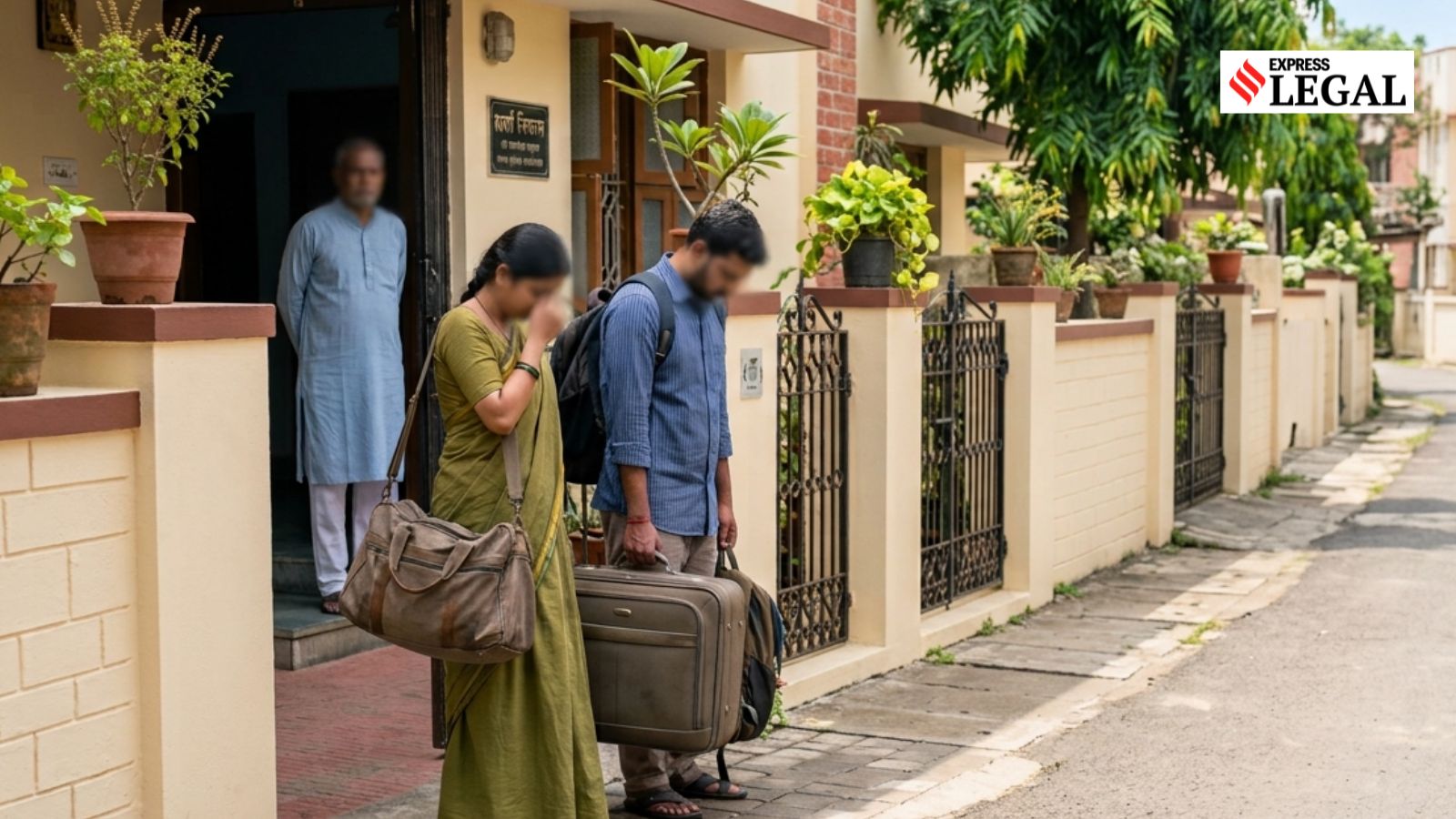
The Gauhati High Court was dealing with plea of son and daughter-in-law challenging their eviction order. (AI-generated Image)
The Gauhati High Court has set aside an eviction order directing a son and daughter-in-law to vacate a senior citizen’s house, over allegations that their presence deprived him of the peaceful enjoyment of his own home, holding that eviction proceedings must follow principles of natural justice.
Justice Mridul Kumar Kalita was dealing with a plea of a couple challenging a maintenance tribunal’s eviction order. The court remanded the case after finding the tribunal failed to allow evidence or follow the prescribed statutory procedure,
“If the maintenance tribunal comes to the conclusion that the senior citizen was unable to peacefully enjoy his own residence due to the continuous presence of the opposite parties, and the same is regarded as detrimental to the security and dignity of a senior citizen, the maintenance tribunal can even pass an order of eviction against the opposite parties,” the order stated on July 14.
Justice Kalita noted that, however, the maintenance tribunal, being a quasi-judicial body, has to conform to the procedure prescribed by the Act and Rules framed to conclude a dispute before it between the senior citizen and his or her children and relatives (opposite parties).
Son said tribunal denied fair hearing
The petitioners, the son and daughter-in-law, are challenging the maintenance tribunal order under the Maintenance and Welfare of Parents and Senior Citizens Act, 2007, which directed the couple to vacate their father’s house.
Justice Mridul Kumar Kalita said that tribunal, being a quasi-judicial body, has to conform to the procedure prescribed by the Act and Rules.
The case started when the senior citizen approached the maintenance tribunal alleging that his son and daughter-in-law had subjected him to continuous harassment, intimidation, and hostile behaviour.
He claimed that their conduct forced him to leave his own house and live in rented accommodation and hotels, affecting his safety, dignity, peace, and mental well-being. Initially, the tribunal rejected his maintenance claim, holding that he had sufficient means to maintain himself. The father challenged that order before the high court, which set it aside in July 2025 and permitted him to file a fresh application under Section 5 (application for maintenance ) of the 2007 Act.
Story continues below this ad
He then filed a fresh application seeking eviction of his son and daughter-in-law from his residential property, contending that their presence deprived him of peaceful enjoyment of his own home. The tribunal allowed the plea on January 29 and directed the couple to vacate the house within 30 days. The son and daughter-in-law challenged that eviction order before the high court.
Appearing for the petitioners, senior advocate A K Bhuyan submitted that though in the order, it has been stated that the counsel for the present petitioners was heard by the tribunal, no such hearing took place before the passing of the impugned order by the maintenance tribunal.
The senior counsel for the petitioners has also submitted that in the instant case, the tribunal has also not complied with the Rules framed under the Act, namely, the Assam State Maintenance and Welfare of Parents and Senior Citizens Rules, 2012.
Missing order sheets violate natural justice: Order
It is pertinent to mention that, by order dated April 8, this court directed the registry to call for the records from the tribunal.
However, it appears that instead of sending original records, photocopies of the records of the case were sent. Be that as it may, the photocopies of records are also sufficient to arrive at a conclusion in this case.
On perusal of the copies of the records, it appears that the records are not properly maintained. There is no index for the said record. There is no order sheet for the proceeding.
After going through the provisions of the Maintenance and Welfare of Parents and Senior Citizens Act, 2007, and the Assam State Maintenance and Welfare of Parents and Senior Citizens Rules, 2012, it appears that, while adjudicating any dispute between any senior citizen and his/her son/daughter/relative, the tribunal, i.e., maintenance tribunal, acts as a quasi-judicial body and as such it has to follow the principles of natural justice.
Further, by being a quasi-judicial body, while adjudicating any dispute, it has to maintain an order sheet in the relevant case/ proceedings as the order sheet serves as a permanent sequential diary of the case.
Maintenance of order sheets in a judicial or quasi-judicial proceeding ensures adherence to accountability and maintenance of judicial discipline.
Maintenance of day-to-day order sheets in such proceedings also ensures transparency and public trust and helps the appellate or revisional court to fully comprehend what happened on a particular day when the matter was taken up for hearing by the tribunal.
However, in the instant case, the records available before this court show that apart from the final order of January 29, no other order passed by the tribunal is on record.
Final order
The court set aside the maintenance tribunal’s eviction order against a senior citizen’s son and daughter-in-law, holding that the tribunal violated principles of natural justice by denying them an opportunity to present evidence. It remanded the matter for a fresh hearing and decision in accordance with the 2007 Act and Assam Rules.
Jagriti Rai works with The Indian Express, where she writes from the vital intersection of law, gender, and society. Working on a dedicated legal desk, she focuses on translating complex legal frameworks into relatable narratives, exploring how the judiciary and legislative shifts empower and shape the consciousness of citizens in their daily lives.
Expertise
Socio-Legal Specialization: Jagriti brings a critical, human-centric perspective to modern social debates. Her work focuses on how legal developments impact gender rights, marginalized communities, and individual liberties.
Diverse Editorial Background: With over 4 years of experience in digital and mainstream media, she has developed a versatile reporting style. Her previous tenures at high-traffic platforms like The Lallantop and Dainik Bhaskar provided her with deep insights into the information needs of a diverse Indian audience.
Academic Foundations:
Post-Graduate in Journalism from the Indian Institute of Mass Communication (IIMC), India’s premier media training institute.
Master of Arts in Ancient History from Banaras Hindu University (BHU), providing her with the historical and cultural context necessary to analyze long-standing social structures and legal evolutions. ... Read More
Tags:
Gauhati High Court
Senior citizen
View original source — Indian Express ↗
Related stories

The Punch
WorldJul 16, 2026 · 1 min
Kano, Jigawa Customs generated N63.07bn in six months -Controller
The Punch
The Punch
WorldJul 16, 2026 · 1 min
Kano Hisbah bans mobile movie download business
The Punch

Antara News
WorldJul 16, 2026 · 1 min
RI explores the establishment of Palestinian Museum at TMII Jakarta
Antara News
South China Morning Post
WorldJul 16, 2026 · 1 min
Mainland schools for Hong Kong pupils beat city average in university entrance exams
South China Morning Post