Indian Express
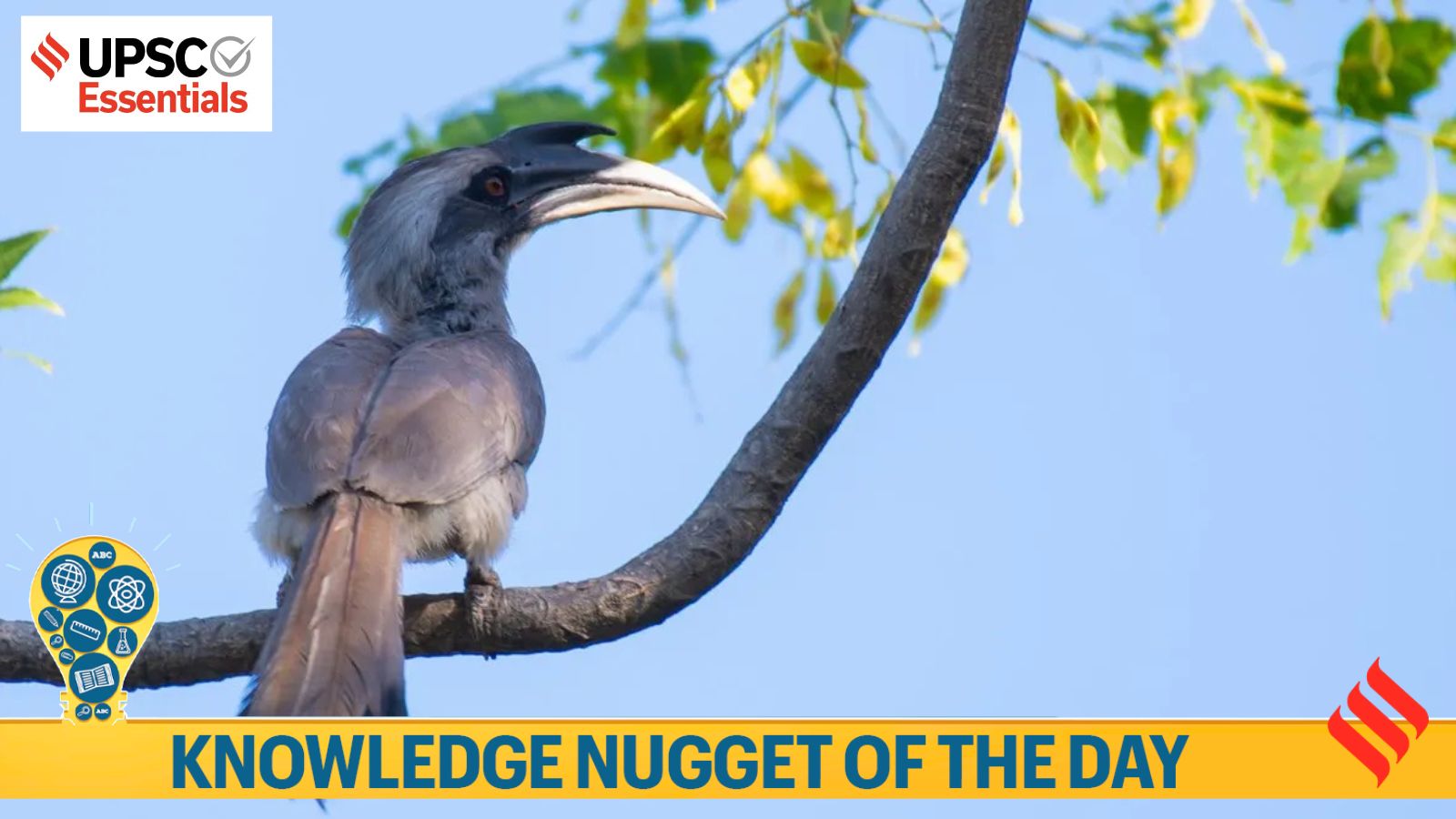
Knowledge Nugget | Indian Grey Hornbill returns to Gir: Meet the bird that seals its mate inside a tree for two months
Take a look at the essential events, concepts, terms, quotes, or phenomena every day and brush up your knowledge. Here’s your UPSC Current Affairs knowledge nugget for today on the Indian Grey Hornbill.
A wildlife conservation success story has been quietly unfolding in Gujarat’s Gir forests. The Indian Grey Hornbill, which went extinct in the region during the 1950s and 60s and was reintroduced under a government initiative, has now successfully established territories and produced offspring. In this backdrop, let’s know more about the Indian Grey Hornbill, its reintroduction programme and great hornbill.
1. The paper—Reintroduction of Indian Grey Hornbills in Gir, India: Insights into Ranging, Habitat Use, Nesting and Behavioural Patterns—was published in the international peer-reviewed journal, Birds, as per an official release from the state government. It has presented the first comprehensive assessment of the reintroduction programme led by Gujarat forest department.
2. “The project involved the release of 40 Indian Grey Hornbills in two phases. Twenty-eight birds were released between 2021 and 2022, followed by another 12 birds in 2023. Eleven males were fitted with satellite transmitters, allowing scientists to track their movements, habitat use, and breeding behaviour over several years,” the release stated, quoting Mohan Ram, Conservator of Forests, Junagadh Circle, and one of the authors of the paper.
Historical records suggest that hunting, rather than habitat degradation, was the primary reason for the Indian Grey Hornbill’s disappearance. (Source: Wildlife division, Sasan-Gir)
3. The birds were translocated from healthy hornbill populations in Gujarat’s Aravalli forests after extensive habitat assessments confirmed that Gir provides suitable ecological conditions, the release added.
4. “The Indian Grey Hornbill plays a crucial ecological role as a long-distance seed disperser, helping regenerate forests by transporting seeds of fruit-bearing trees across large areas,” Principal Secretary (Forest and Environment) Vinod Rao said.
5. Giving a historical perspective behind the disappearance of hornbills from the region, Principal Chief Conservator of Forests (Wildlife) and Chief Wildlife Warden Jaipal Singh said, “Historical records suggest that hunting, rather than habitat degradation, was the primary reason for its disappearance.”
Story continues below this ad
Satellite tracking revealed that newly released hornbills initially travelled widely while exploring unfamiliar surroundings before settling into relatively small home ranges.
6. It was also observed that hornbills selected mature trees with large trunk girths for nesting, particularly Sterculia urens and Terminalia bellirica, highlighting the importance of conserving old-growth trees within the landscape.
What makes Indian grey hornbills so enchanting?
1. Indian grey hornbill (scientific name: Ocyceros birostris) name refers to the unique horn-like beak of this species of birds. Additionally, the male has a noticeable pointed blackish casque at the upper mandible, whereas the female has a less prominent casque. The beak is brownish-black and ivory-white.
2. Indian grey hornbills mainly eat fruits and berries. Due to that, they help in dispersing seeds and expanding forests. Particularly, they are noted in dispersing fig tree seeds. Moreover, they feed on insects, lizards, snails, rodents and bird chicks.
3. As the name suggests, the Indian Grey Hornbill is grey with a yellow-coloured bill with black base, black and white tipped tail and a casque on its beak. It is 50 centimetres in length, weighs about 370 to 400 grams and lives for a decade. It lays 2 to 4 eggs.
Story continues below this ad
4. They usually sit on the topmost branches of the trees, so it is difficult to spot while being under the tree. They are categorised as Least Concern on the IUCN Red List. Indian grey hornbill has also achieved an honour to be the state bird of Chandigarh.
5. Out of 54 species of hornbills globally, nine are found in India Interestingly, India is home to nine hornbill species, with the northeastern region exhibiting the highest diversity of these species in the country.
In Gujarati, the male Indian grey hornbill is fondly called vahughelo, meaning, a doting husband. Why?
6. Indian grey hornbills are usually found in a pair or small group. Indian grey hornbill is known for its conjugal love relationship. The level of trust and bond they share is simply amazing. In Gujarati, the male Indian grey hornbill is fondly called vahughelo, meaning, a doting husband. because once the pair finds a nesting site in a tree hollow, the female sheds her flight feathers and stays inside the nest to hatch the eggs.
Story continues below this ad
7. Then, the male brings mud pellets to the female and she seals the entrance of the nest using them with her excreta. She keeps only one vertical slit open at the entrance to bring her beak out to get the food and shoot faeces far outside from that crack only. Thus, she entirely trusts her partner with her food requirements for about two months while using her shed feathers for layering the nest.
8. Everyday male travels long distances to collect food and feeds the regurgitated food to the female. They mate with one partner at a time. By the time the chicks are grown, the mother regrows her flight feathers. She breaks opens the entrance with her beak and then they feed the young ones together
BEYOND THE NUGGET: Great Hornbill
1. The great hornbill is found in primary evergreen and moist deciduous forests, primarily inhabiting the canopy of tall trees.
Female Great Hornbill in Siolim (Photo credit: Stephen Menezes)
2. It is classified as Vulnerable by the IUCN and is protected under Schedule I of the Wildlife Protection Act of 1972.
What is Hornbill festival?
Story continues below this ad
Often referred to as the “Festival of Festivals,” the Hornbill Festival is one of the most iconic cultural events in Nagaland. Named after the revered Hornbill bird, the festival showcases the culture, heritage, food and customs of Naga tribes and people from these tribes come together to celebrate their traditions with colourful dance performances.
Naga tribesmen sit with their weapons at the annual Hornbill festival in Nagaland. (Source: Express Photo by Deepak Shijagurumayum)
The festival is vibrant and full of energy throughout the day, with warriors dressed in full ceremonial attire performing traditional dances and war cries. Each performance tells a story—of victories, harvests, love, and tribal legends. The warriors, adorned with distinctive headgear decorated with hornbill feathers, boar tusks, and colorful woven sashes, create an unforgettable spectacle.
3. In India, Greater Hornbills are found in the Western Ghats and the Himalayas. It is the state bird of Arunachal Pradesh and Kerala.
Post Read Question
With reference to the Indian Grey Hornbill, consider the following statements:
1. It is classified as Least Concern on the IUCN Red List.
Story continues below this ad
2. It plays an important ecological role by dispersing the seeds of fruit-bearing trees.
3. It is the State Bird of Arunachal Pradesh.
Which of the statements given above are correct?
(a) 1 and 2 only
(b) 2 and 3 only
(c) 1 and 3 only
(d) 1, 2 and 3
Answer key
(a)
(Sources: Decades later, Indian Grey Hornbills thrive in Gujarat’s Gir forests, Birds without Borders: Indian grey hornbill, the conjugal love birds that love Gujarat cities, Knowledge nugget of the day: Hornbill Festival)
🚨 Click Here to read the UPSC Essentials magazine for June 2026. Share your views and suggestions in the comment box or at [email protected]🚨
Subscribe to our UPSC newsletter. Stay updated with the latest UPSC articles by joining our Telegram channel – Indian Express UPSC Hub, and follow us on Instagram and X
View original source — Indian Express ↗
Related stories

South China Morning Post
TechnologyJul 16, 2026 · 1 min
BYD aims to build 3,000 ‘flash-charging’ stations across Europe within months
South China Morning Post

The Verge
TechnologyJul 16, 2026 · 1 min
OnePlus officially gives up on the US and Europe
The Verge

Wired
TechnologyJul 16, 2026 · 1 min
OnePlus, the ‘Flagship-Killer’ Smartphone Brand, Is All but Dead
Wired

AllAfrica
TechnologyJul 16, 2026 · 1 min
Kenya: Ol Kalou By-Election - UDA Candidate Samuel Muchina Nyaga Alleges Voter Bribery
AllAfrica