Indian Express
UPSC Mains Answer Practice — GS 2: India’s Act East Policy and vulnerability of global maritime trade routes (Week 163)
UPSC Essentials brings to you its initiative for the practice of Mains answer writing. It covers essential topics of static and dynamic parts of the UPSC Civil Services syllabus covered under various GS papers. This answer-writing practice is designed to help you as a value addition to your UPSC CSE Mains. Attempt today’s answer writing on questions related to topics of GS-2 to check your progress.
🚨 Click Here to read the UPSC Essentials magazine for June 2026. Share your views and suggestions in the comment box or at [email protected]🚨
Discuss the role of ASEAN centrality in India’s Act East Policy. How can India strengthen its partnership with ASEAN while maintaining strategic autonomy in an increasingly polarised Indo-Pacific?
QUESTION 2
Escalating tensions between the United States and Iran have underscored the vulnerability of global maritime trade routes. Discuss the implications of such geopolitical conflicts for India’s strategic and diplomatic interests.
QUESTION 1: Discuss the role of ASEAN centrality in India’s Act East Policy. How can India strengthen its partnership with ASEAN while maintaining strategic autonomy in an increasingly polarised Indo-Pacific?
Relevance: The question is relevant under GS Paper 2 (India and its neighbourhood; Bilateral, regional and global groupings; Effect of policies and politics of developed and developing countries on India’s interests; International relations).
Note: This is not a model UPSC answer. It only provides you with a thought process which you may incorporate into the answers.
Introduction:
Story continues below this ad
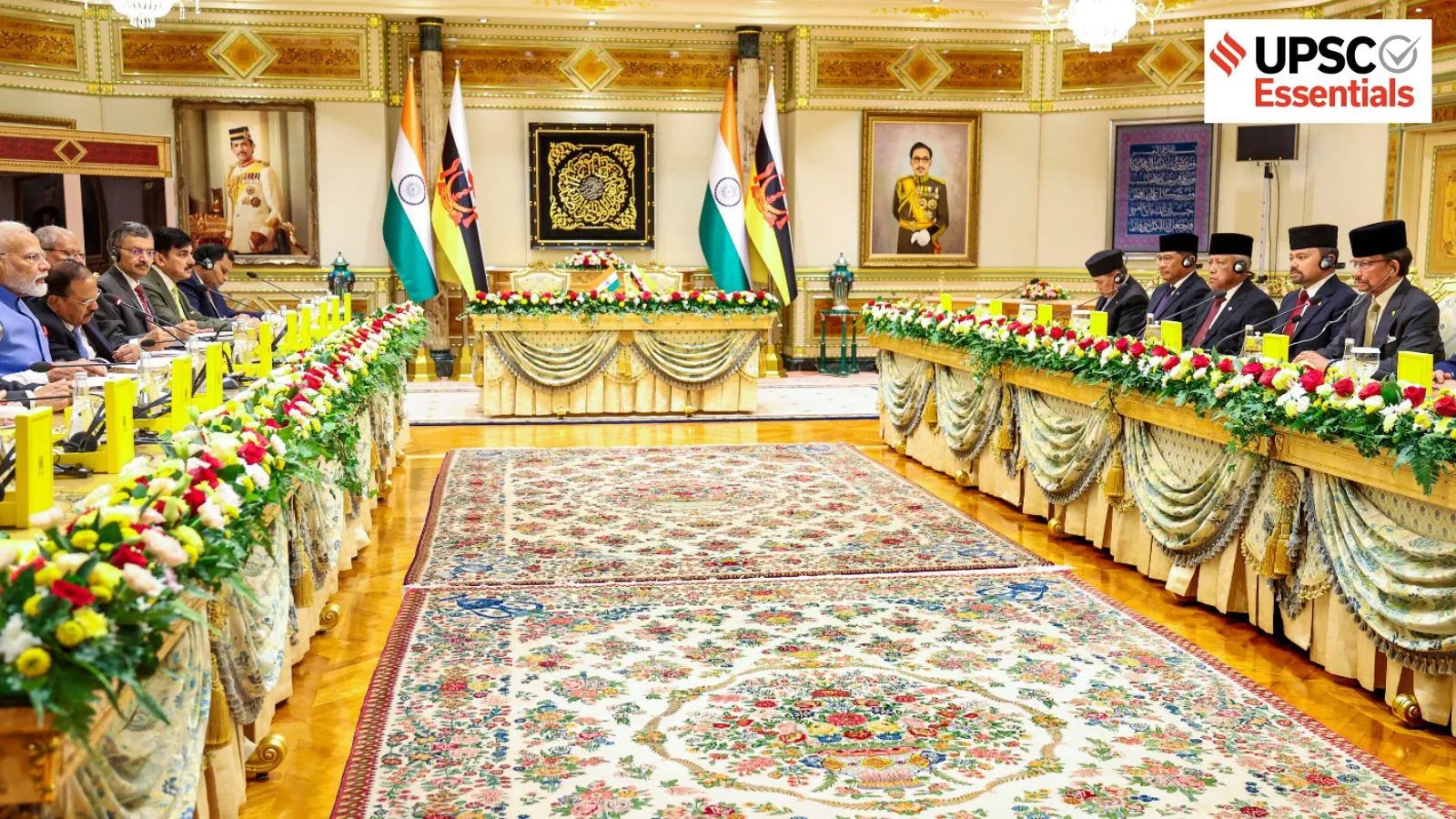
— India’s Act East Policy (AEP), introduced in 2014 as an upgrade to the Look East Policy, has grown into a comprehensive framework that includes economic integration, connectivity, strategic cooperation, maritime security, and people-to-people ties.
— At its center is ASEAN centrality, which India sees as the foundation of a free, open, inclusive, and rules-based Indo-Pacific amidst rising geopolitical conflict.
Body:
You may incorporate some of the following points in your answer:
Role of ASEAN Centrality in India’s Act East Policy
Story continues below this ad
— India sees ASEAN as the driving force behind regional architecture through ASEAN-led mechanisms like the East Asia Summit (EAS), ASEAN Regional Forum (ARF), and ADMM-Plus. ASEAN centrality allows India to pursue an inclusive Indo-Pacific strategy rather than bloc-based geopolitics.
— India-ASEAN relations have grown beyond economic involvement to include cooperation in defence, maritime security, the digital economy, healthcare, education, and emerging technology. This transition is reflected in the upgrading of relations to Comprehensive Strategic Partnership (2022).
— ASEAN connects India’s northeast with Southeast Asia. Projects like the India-Myanmar-Thailand Trilateral Highway and the Kaladan Multi-Modal Transit Transport Project are crucial to regional connectivity.
— ASEAN is strategically located along important sea lines of communication (SLOCs). Collaboration with ASEAN improves maritime domain awareness, disaster response, and conformity to international law.
Story continues below this ad
— ASEAN provides potential for India to build resilient industrial networks, diversify its commerce, and form investment relationships.
Prime Minister Narendra Modi’s recent visit to Indonesia, Australia and New Zealand is significant for India’s Act East Policy. Here is the image of Prime Minister Narendra Modi with Australian Prime Minister Anthony Albanese during the former’s recent visit to Australia. (AP)
Conclusion:
— ASEAN centrality is at the heart of India’s Act East Policy and Indo-Pacific strategy. In an era of geopolitical fragmentation, India may improve its partnership with ASEAN by increasing connectivity, economic integration, and maritime cooperation while remaining committed to its long-standing ideal of strategic autonomy.
(Source: With uncertainty looming, challenges and opportunities for India’s Act East policy, India, ASEAN, and the battle for influence in Southeast Asia, http://www.pmindia.gov.in)
Points to Ponder
Why does ASEAN remain significant despite increasing major-power competition?
Story continues below this ad
What role can initiatives such as IPOI, BIMSTEC, SAGAR, and the India–ASEAN Comprehensive Strategic Partnership play in this regard?
Related Previous Year Questions
Do you think that BIMSTEC is a parallel organisation like the SAARC? What are the similarities and dissimilarities between the two? How are Indian foreign policy objectives realized by forming this new organisation? (2022)
“Increasing cross-border terrorist attacks in India and growing interference in the internal affairs of several member states by Pakistan are not conducive for the future of SAARC (South Asian Association for Regional Cooperation).” Explain with suitable examples. (2016)
QUESTION 2: Escalating tensions between the United States and Iran have underscored the vulnerability of global maritime trade routes. Discuss the implications of such geopolitical conflicts for India’s strategic and diplomatic interests.
Story continues below this ad
Relevance: The question falls under GS Paper 2 (India and its neighbourhood; Bilateral, regional and global groupings; Effect of policies and politics of developed and developing countries on India’s interests; International relations). It tests understanding of India’s West Asia policy, maritime security, energy diplomacy, and strategic balancing in a volatile geopolitical environment.
Note: This is not a model UPSC answer. It only provides you with a thought process which you may incorporate into the answers.
Introduction:
— The Strait of Hormuz, which connects Iran and Oman, is one of the world’s most important maritime chokepoints, permitting approximately a fifth of global oil and LNG commerce.
— Renewed US-Iran tensions have raised fears about delays to shipping, energy supply, and global business, emphasising the strategic importance of secure Sea Lines of Communication (SLOCs) for countries like India.
Body:
Story continues below this ad
You may incorporate some of the following points in your answer:
Implications for India’s Strategic and Diplomatic Interests
— India imports a huge amount of crude oil from Gulf countries such as Iraq, Saudi Arabia, the UAE, and Kuwait, with a large chunk passing through the Strait of Hormuz. Any disruption might limit supplies, exposing India to energy vulnerability.
— A sustained rise in prices will increase India’s import bill, exacerbate the current account deficit, and put inflationary pressure on the economy.
— Increased conflict drives up shipping costs through higher freight charges, insurance premiums, and vessel rerouting. Delays in cargo movement have an impact on India’s commercial competitiveness and supply chains.
— Indian trade vessels operating in the Gulf are more vulnerable to attacks, military escalation, and navigational restrictions. Ensuring the safety of Indian sailors has become a strategic priority.
Daily tanker positions along the Strait of Hormuz from Feb 1 to Feb 15. The New York Times
— Millions of Indians live in West Asia, and long-term regional instability may have an impact on their well-being. Any escalation may entail contingency plans and evacuation procedures.
— India maintains significant strategic partnerships with the United States, as well as long-standing ties with Iran and the Gulf monarchies. The issue necessitates a measured diplomatic response that maintains strategic autonomy while not alienating any significant partner.
Conclusion:
— India has repeatedly stressed the need of safe, secure, and unhindered freedom of navigation and ongoing global trade across the Strait of Hormuz.
— The Strait of Hormuz crisis shows how regional conflicts can have far-reaching implications for India’s energy security, trade, and foreign policy. To protect its national interests in an increasingly unstable geopolitical context, India’s response must include strategic autonomy, marine preparedness, diverse energy sources, and active diplomacy.
(Source: Strait of Hormuz transits plummet again: India’s concerns, US blockade: India says monitoring developments, calls for ‘unimpeded freedom of navigation’ through Hormuz, Strait of Hormuz oil flows dry up: How this affects India, and the options ahead, Dire straits: Hormuz flare-up underscores precariousness of US-Iran MoU; oil market on edge)
Points to Ponder
What diplomatic and maritime measures can India adopt to enhance the resilience of its sea lines of communication (SLOCs)?
Related Previous Year Questions
“Energy security constitutes the dominant kingpin of India’s foreign policy, and is linked with India’s overarching influence in Middle Eastern countries.” How would you integrate energy security with India’s foreign policy trajectories in the coming years? (2025)
Previous Mains Answer Practice
UPSC Essentials: Mains answer practice — GS 3 (Week 162)
UPSC Essentials: Mains answer practice — GS 3 (Week 163)
UPSC Essentials: Mains answer practice — GS 2 (Week 162)
UPSC Essentials: Mains answer practice — GS 2 (Week 161)
UPSC Essentials: Mains answer practice — GS 1 (Week 161)
UPSC Essentials: Mains answer practice — GS 1 (Week 162)
Subscribe to our UPSC newsletter and stay updated with the news cues from the past week.
Stay updated with the latest UPSC articles by joining our Telegram channel – IndianExpress UPSC Hub, and follow us on Instagram and X.
View original source — Indian Express ↗
Related stories
Indian Express
TechnologyJul 16, 2026 · 1 min
Viruses do not respect borders. An expert explains how the world should prepare for their outbreaks
Indian Express

The New York Times
TechnologyJul 16, 2026 · 1 min
What to Know About Mykhailo Fedorov, Ukraine’s Ousted Defense Minister
The New York Times

Wired
TechnologyJul 16, 2026 · 1 min
Please Stop Making Me Opt Out of AI
Wired

Engadget
TechnologyJul 16, 2026 · 1 min
The Oversight Board says leading AI models might be restricting free expression
Engadget