The Next Web
WHO warns Europe’s AI health governance gap is becoming irreversible
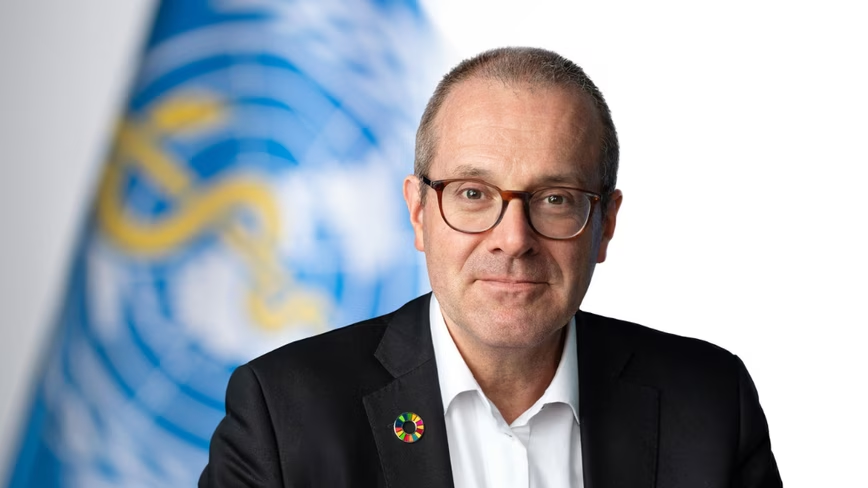
Hans Kluge opened his speech in Lisbon with a number, which is not how the World Health Organization usually does this.
“Let me start with a number: 8%,” the WHO Regional Director for Europe told delegates on 15 July. “That’s the share of countries in the WHO European Region that have a health-specific AI strategy. Just 8%.”
Against that, nearly two-thirds of the region’s countries are already deploying AI in diagnostics, and half have introduced AI-powered patient chatbots. One in 12 has a strategy to govern any of it.
“That gap, between deployment and governance, is the defining challenge of AI in health right now,” Kluge said. It is a framing that will sound familiar to anyone following Europe’s wider AI adoption problem, though here the currency is not productivity.
The 💜 of EU tech
The latest rumblings from the EU tech scene, a story from our wise ol' founder Boris, and some questionable AI art. It's free, every week, in your inbox. Sign up now!
The figures come from what WHO/Europe describes as the most comprehensive assessment of AI readiness ever conducted across its 53 member states, following its first snapshot of AI in EU health care in April. The picture underneath the headline number is worse than the headline number.
Only one in five countries provides AI education for health professionals before they qualify. Only one in four offers training once they are in the workforce.
Fewer than half have assessed whether their legal frameworks are fit for purpose, and almost 40% have no ethical guidance on AI in health at all.
Kluge was specific about what that costs. “A biased algorithm can produce a wrong diagnosis, for a real patient, with real consequences,” he said. “A health worker trained to trust an AI system they can’t interrogate is not empowered, leading to mistakes outside their control.”
The second half of that sentence is the part worth sitting with. It is not an argument about bad algorithms.
It is an argument about clinicians being handed a tool they have no standing to question, which is a governance failure rather than a technical one, and it echoes a complaint that has been building among health workers for a while.
None of which is an argument against the technology, and Kluge did not make one. Some 98% of member states identify improving patient care as the primary driver for adopting AI, and he pointed to Coimbra, where AI-powered image analysis is helping clinicians identify thoracic diseases and bone fractures faster, cutting waiting times in primary care and emergency settings.
“Real patients receive better care today because of AI,” he said. The problem is not that it does not work. The problem is that it works in places that have not decided who is liable when it does not.
His three asks were governance keeping pace with deployment, meaning every country deploying AI in health needs a strategy, liability standards, and workforce training; international coordination, which is why WHO brought 37 countries from all six of its regions to Lisbon; and a specific role for the Portuguese-speaking world.
That last one is concrete. Portugal, Angola, Brazil, Mozambique, and their partners will work towards a Lusophone Cooperation Roadmap on AI and Health, which WHO aims to launch at the Regional Health Summit in Brazil in 2028.
It is a Lusophone instrument, not a global one, a distinction some coverage of the speech has already lost.
The conference, co-hosted with the Portuguese government and opened by health minister Ana Paula Martins, runs to 16 July. Its three pillars are the rules governing how AI is regulated and held accountable, the tools needed to deploy it safely, and the people expected to use it.
Europe is not short of machinery for this. The EU has stood up testing facilities covering medical imaging and robotic rehabilitation, among other things. What Kluge is describing is the gap between that apparatus and 53 health ministries, most of which have not written anything down.
Kluge closed on the point that the sector tends to skip. “The future of AI in health won’t be decided by algorithms,” he said.
“It will be decided by the frameworks we build now, the partnerships we forge and the political will we bring to making sure this technology serves everyone, not just the countries and communities wealthy enough to shape it on their own terms.”
View original source — The Next Web ↗
Related stories

AllAfrica
TechnologyJul 16, 2026 · 1 min
Ghana: Three Granted Bail Over Disruption of NPP Constituency Election in Obuasi
AllAfrica

TechRadar
TechnologyJul 16, 2026 · 1 min
Ann Droid is the new Diane Morgan comedy series on BBC iPlayer this week that you can't miss
TechRadar

RFI
TechnologyJul 16, 2026 · 1 min
Elon Musk's backing of Le Pen presidential bid raises foreign influence concerns in France
RFI

NPR
TechnologyJul 16, 2026 · 1 min
Zelenskyy fires Ukraine's tech-savvy defense minister in government reshuffle
NPR