The Guardian
Demise of Timmy the whale inspires satirical play exploring German identity
When people in Germany organised a daring rescue mission for a humpback whale stranded on the Baltic coast in April, it briefly looked like a country stricken with political division and economic anxiety was rallying around a common cause.
A new satirical play inspired by the episode, however, suggests the spectators, social media influencers, politicians and millionaires who flocked to the seaside in support never just wanted to rescue the cetacean that came to be nicknamed Timmy, but for Timmy to rescue them.
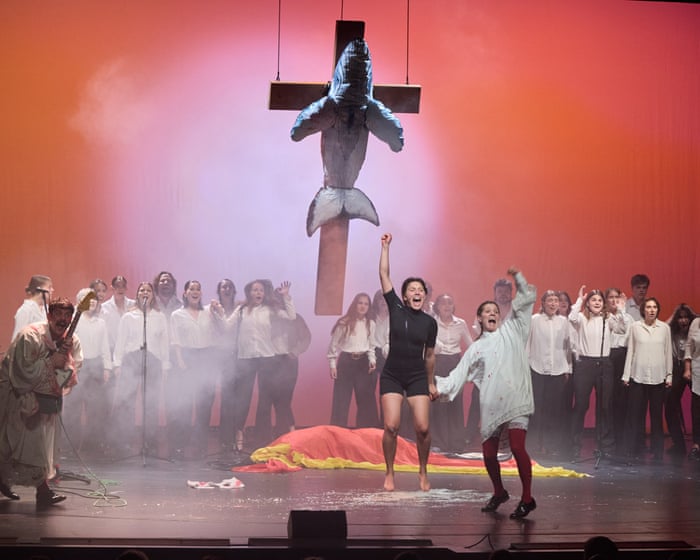
Timmy: Hope Dies Last, which premiered at Hamburg’s Ernst Deutsch theatre last Saturday, reimagines the media spectacle as a passion play in which the leviathan is worshipped, crucified and eventually cut up into sacramental blubber bites.
“In his immeasurable kindness he became a vehicle to us” is a line from the actor Noah Tomiak in the play, dressed in liturgical robes and stood behind an altar laden with a blow-up replica of the sea creature. “And we placed everything inside: our fears, our guilt, our desires, our loneliness. And while we said: ‘We have to save him,’ it was maybe already the other way around: maybe he came to save us.”
The elevation of Timmy into a Jesus figure has drawn criticism from Catholic theologians, but found praise on the pages of the news weekly Der Spiegel. The play, it wrote, revealed “how willing a secularised public seeks refuge in quasi-religious structure as a vehicle for hope”.
The humpback whale was first spotted in German waters in March, stranded at the Timmendorfer resort – inspiring the nickname that, it would later turn out, misgendered an animal that was in fact female. An earlier nickname, Hope, better conveyed the emotional pull of the whale’s tragic fate on the national consciousness.
Throughout the play, its director, Alexander Klessinger, plays audio snippets from interviews with people who descended on Timmendorfer to seek a connection with the ailing mammal. Raw and unfiltered, these confessionals show the extent that people believed the whale was speaking directly to them. “I felt like he was waiting for me, I can’t explain it but he wanted me,” says one woman.
Over the course of the one-hour show, the adoration of the whale takes on a cultish fervour, as actors declare their love via songs and placards. In one recording, a woman explains why she travelled to the Baltic Sea to help the whale with an Aboriginal chant that would “plug energetic holes”.
“Timmy brought out the best in people,” wrote Süddeutsche Zeitung after the premiere of the play. “But also the worst.”
As well as triggering a reported boom in whale and sealife-themed book sales, the Timmy saga inspired several songs, some sentimental, others satirical. At the end of the Hamburg premiere, the rock band Tulpe performed their hit Sprengt den Wal! (“Blow up the whale!”), with its chorus of “Let it rain whale salami and cutlets”.
An AI-generated song that went viral on social media at the height of Timmy mania – performed by the actors as a rock number in the play – mixes in populist resentment against cruel-hearted “experts”. “While he is still breathing,” it says, “they are already talking of what happens afterwards / of tests and numbers / as if he was only an empty body without a heart.”
Eventually, a complex and risky attempt to transport the whale back to the open sea on a water-filled barge was privately funded by two millionaires and cleared by authorities, against the advice of experts who said the animal was hurt and unlikely to survive.
The play restages a press conference at which biologists who proposed leaving the whale to die in peace were criticised by some hangers-on as wanting to “murder” the animal. For the whale to die in a bay rather than out on the open sea, said one woman, was “undignified”.
In the end, far from healing the political fractures running through Germany, the effort to save Timmy seemed in part to be driven by populist resentment against “elites” that is driving the rise of the nationalist Alternative für Deutschland (AfD). As an actor in a wetsuit rails against officials for letting Timmy die and callls for ordinary people to “wake up”, a large German flag is raised behind her back.
Nearly two weeks after Timmy’s release, on 14 May, the whale was found dead near the small island of Anholt in the Kattegat, a broad strait between Denmark and Sweden. The fallout over the cost of the rescue mission – estimated to be about €2m – continues to this day.
View original source — The Guardian ↗
Related stories

Indian Express
EntertainmentJul 16, 2026 · 1 min
Fitness trainer shares 3 cardio methods to lose fat: ‘Choose according to your purpose’
Indian Express

Deadline
EntertainmentJul 16, 2026 · 1 min
Amazon MGM Hires Head Of Theatrical Marketing, UK & Ire, As Studio Continues To Build International Film Team
Deadline
The Guardian
EntertainmentJul 16, 2026 · 1 min
First Thing: US attacks tanker in continuing Iran conflict as Tehran releases US citizen
The Guardian
E! Online
EntertainmentJul 16, 2026 · 1 min
Let This Be Your Easy Guide to What the Easy A Cast Is Up to Now
E! Online